
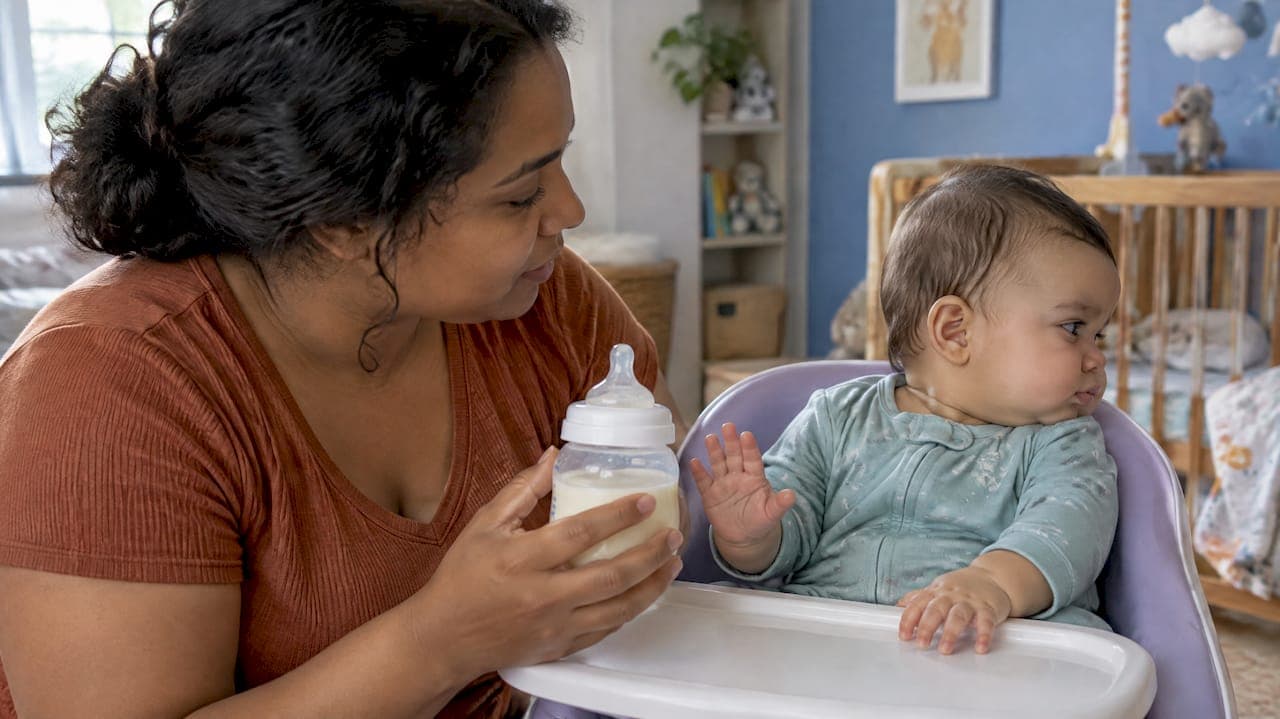
Oral aversion in a baby means your little one avoids or resists things near the mouth, including the bottle, breast, spoon, and sometimes even a pacifier. It is not stubbornness and it is not something you caused. It is a learned response: a baby connects the mouth with something uncomfortable or frightening, and understandably protects themselves. The good news is that with the right team and a calm, patient plan, many babies rebuild trust with feeding.
If you are standing in your kitchen at 2 a.m. with a crying baby and a full bottle, this guide is for you. We will walk through what oral aversion looks like, why it happens, what to rule out first, what therapy involves, and what you can do at home starting today.
TL;DR
- Oral aversion is a fear-based, learned response to mouth-related experiences, such as reflux pain, feeding tubes or forced feeds. It is not defiance.
- Common signs include arching, turning away, clamping the mouth shut, crying in a feeding position, or only feeding when drowsy.
- Medical causes like reflux, constipation or swallowing problems should be checked first, and a team approach works best.
- Pressure, sneaking food, and chasing ounces tend to make aversion worse. Calm, predictable, cue-based feeding helps.
- Early support matters. A feeding therapist can build a step-by-step plan around your baby, your family and your home.
Table of Contents
- What oral aversion looks like day to day
- Why babies develop oral aversion
- Start with the medical picture
- Why pressure backfires
- What feeding therapy for oral aversion involves
- Measuring progress differently
- Oral aversion after feeding tubes
- When the problem is textures: toddlers and older babies
- What you can do at home this week
- How Thriving Joy helps
- Our perspective: you are not the problem
- When to ask for help
- FAQ
- Sources
What oral aversion looks like day to day
Every baby fusses at a feed now and then. Oral aversion is a pattern: distress that keeps showing up around feeding, not just on a tough evening. Cleveland Clinic lists behaviors such as protesting or turning away when something nears the mouth, pushing the tongue out, pressing the lips tightly together, and refusing to latch onto a breast or bottle nipple.
Parents also describe:
- Arching the back or stiffening when placed in a feeding position
- Crying as soon as the bottle comes into view
- Feeding only when sleepy or half asleep
- Taking a little, then refusing for hours
- Happily feeding themselves finger foods but refusing to be fed by someone else
That last one surprises many families. It often points to a baby who is fine with food but wants control over what goes into the mouth.
Oral aversion, feeding aversion and bottle aversion
You will see these terms used almost interchangeably. In practice, "feeding aversion" is the broad label for distressed refusal of feeding, while "oral aversion" focuses on the baby's dislike of things touching or entering the mouth. "Bottle aversion" describes a baby who refuses the bottle specifically, which is common when a baby has breastfed well and then rejects bottles, or the reverse. The Sheffield Children's NHS Foundation Trust has a helpful explanation of bottle feeding aversion that separates normal moments of fullness from true, ongoing refusal.
The label matters less than the question underneath it: what is feeding telling your baby right now? A therapist's job is to find out.
Why babies develop oral aversion
A baby's mouth is full of sensory nerve endings and is one of the first ways they explore the world. When that area repeatedly meets something unpleasant, the brain learns to brace for it. Common triggers include:
- Painful reflux. If every feed ends with burning or discomfort, a baby learns that feeding hurts.
- Medical equipment. Feeding tubes, suctioning, oxygen, and breathing treatments around the face and mouth can all become associated with distress.
- Prolonged NICU stays. Cleveland Clinic notes that aversion is more common in premature babies and those with long hospital stays, with signs usually appearing in the first year.
- Pressure at feeds. Being encouraged, coaxed or pushed to finish a bottle can turn mealtime into something to fear.
- Oral motor or sensory differences. A baby who finds a feed physically hard, or who is highly sensitive to textures and touch, may pull away.
- Discomfort from gas, constipation, or allergies. These can quietly make eating unpleasant.
Often it is more than one thing. A baby with reflux who then gets a feeding tube and then faces anxious, well-meaning pressure at home has had several reasons to say no. None of that is a parenting failure. It is a baby protecting themselves.
Start with the medical picture
Before anyone calls this behavioral, the medical causes need a look. Guidance from ASHA stresses that food refusal should be read as communication, not as bad behavior. A baby who refuses to eat may be telling you that eating is painful or unsafe right now.
Talk with your pediatrician about:
- Reflux or other digestive discomfort
- Constipation
- Swallowing difficulty (dysphagia), which may need a swallow study
- Conditions such as eosinophilic esophagitis
- Growth and weight trends
The mouth works as a whole system, so it can also help to have a dentist look at oral habits and development. If your child sucks a thumb heavily or has mouth habits that seem to interfere with chewing, this explanation of thumb sucking and teeth shows what to watch as the bite develops. Dental findings are one piece of the puzzle, though, and they do not replace a feeding evaluation.
Call your pediatrician promptly if your baby is losing weight, has fewer wet diapers than usual, coughs or chokes during feeds, or turns blue or struggles to breathe while eating. Those signs need medical attention, not a wait-and-see approach.
Why pressure backfires
Here is the hardest part for loving parents: the instinct to get more milk in is the very thing that can deepen the aversion.
Feeding specialists describe a shift from a volume-first mindset to a relationship-first mindset. When anxiety about growth numbers fills the room, a baby often senses it, and fear and tension go up on both sides. The Pediatric Feeding Institute's guide to severe oral aversion describes the challenge practitioners face: increasing intake by mouth while reducing the child's defensiveness. The two goals pull against each other if intake comes first.
Tricks tend to backfire too. Feeding a baby while they are asleep, or using videos and toys to slip food past their refusal, may add a few ounces today. But it can reinforce distrust of feeding and take away chances for your baby to engage with food on their own terms.
We know this advice is easier to read than to follow when your pediatrician is watching the weight chart. That is exactly why a team matters. Your baby's medical needs and their emotional safety around food both have to be protected at once.

What feeding therapy for oral aversion involves
Treatment usually takes a team. ASHA's clinical guidance describes speech-language pathologists, occupational therapists, pediatricians and other professionals working together, with oral motor skills and sensory comfort addressed before food volume.
Step 1: A thorough evaluation
A good evaluation looks at your baby's medical history, feeding positions, bottles or utensils, oral motor skills, sensory responses and the mealtime routine. If you have a few days to prepare, it helps to keep a feeding diary and capture a short video of a typical feed. Our guide to the child feeding evaluation process explains what to bring.
Step 2: Start outside the mouth
Many parents are surprised that therapy does not begin with food. Therapists often start on the outer edges of the face, then move gradually toward the lips and finally inside the mouth. Each step is small and the baby stays in control. This slow, task-analyzed approach helps a child feel safe, which is what makes later acceptance of food possible.
Step 3: Build positive associations
Once touch around the mouth is tolerated, therapy moves toward play with spoons, cups and nipples, then tastes. A baby may spend weeks simply being comfortable with a spoon near the mouth. That counts as real progress.
Step 4: Respond to hunger and fullness cues
Cue-based, responsive feeding puts the quality of the experience ahead of the quantity. Healthline's overview describes supports such as an elevated side-lying position for bottle feeds, when your baby's medical condition allows. Your therapist will tell you what is safe for your baby specifically.
Step 5: Coach the whole family
Parents are not bystanders in this process. Mealtime happens at your table, and you are the one who can make it calm and predictable. Good therapy gives you language, routines and confidence to carry the work into daily life.
Measuring progress differently
One of the most freeing ideas for families is that progress in the early stages rarely shows up as ounces. Success is often measured in small, non-nutritive milestones, like tolerating a spoon near the lips, allowing a washcloth on the cheek, or staying calm in the feeding chair for one extra minute.
Research on moving infants from tube to mouth feeding supports this. In a randomized trial of premature infants, parents guided feeding by the baby's hunger and fullness cues rather than by fixed schedules and volumes. Keep a simple log of tiny wins. On the hard days, it will remind you that your baby is moving forward even when the growth chart does not yet show it.
Oral aversion after feeding tubes
For babies who have relied on a nasogastric or gastrostomy tube, aversion is a frequent companion, and so is the worry about how to ever get off the tube. Prolonged tube feeding can lead to tube dependency when there is no medical reason to continue it, and weaning is often a gradual process that can take months or longer.
What tends to help:
- A multidisciplinary plan that includes your child's physician, a dietitian and a feeding therapist
- Rebuilding your child's own hunger signals rather than relying only on scheduled volumes
- Keeping oral experiences pleasant, even when your child is not yet eating much by mouth
What tends to hurt is forcing intake to reach preplanned numbers, which can lead to lasting feeding trauma. Never reduce or change tube feeds on your own. Weaning decisions belong with your medical team.
If this is your situation, our blog walks through NG tube weaning with multidisciplinary plans and three calls to make this week for G-tube weaning.
When the problem is textures: toddlers and older babies
Oral aversion in infancy can look different by toddlerhood. A toddler who gags at lumpy foods, refuses anything wet or sticky, or lives on a few smooth items may be showing sensory-based aversion rather than ordinary pickiness.
Some selectivity is normal. Babies and toddlers often reject new foods at first, and it commonly takes repeated exposures, around 15 offers, before a new food is accepted. If your child has a narrow list of foods, gags or vomits with new textures, or mealtimes feel like a daily battle, a feeding evaluation can sort out whether it is a phase or something more.
A gentle ladder approach often works well. The Steps to Eating hierarchy starts with simply being in the same room as a food, then tolerating it nearby, touching it, smelling it and finally tasting it. Research on this low-pressure approach reflects how it lowers anxiety and lets children explore at their own pace. Food chaining then bridges from accepted foods to similar ones. You can read our step-by-step guide to food chaining and our post on how feeding therapy helps toddlers.

What you can do at home this week
These are general, low-risk ideas. Ask your own therapist before changing positioning or textures if your baby has a swallowing concern.
- Lower the temperature of mealtime. Keep feeds calm, predictable and short. Soft light, a quiet room and a relaxed face go a long way.
- Watch for stop signals. Turning away, pushing, clamping or crying means pause. Respecting those cues teaches your baby that no is heard.
- Stop sneaking. Skip distraction screens and sleepy feeds unless your medical team has specifically advised them for safety.
- Add non-food mouth play. During awake, happy time, let your baby mouth clean toys, a soft cloth or a teether.
- Take care of yourself. Your stress is real. Step out for a breath, hand off a feed, and ask for help.
- Write it down. Track what happened, how long it lasted and how your baby responded. It is invaluable at an evaluation.
How Thriving Joy helps
We are a family-centered pediatric therapy practice serving Pasco and Hillsborough Counties, with feeding therapy, lactation counseling and speech therapy for children from birth through elementary school. Our approach looks for root causes rather than quick fixes, and we blend pediatric healthcare experience with the real-life perspective of a parent. Sessions can take place in our office, at your home, or at your child's daycare or preschool, which can make a big difference for a baby who is calmest in familiar surroundings.
For oral aversion, that means a plan built around your child's comfort, your family's routine and your goals, including tube weaning support when it applies. We accept private pay, major health insurance plans and scholarships. To get started, visit our feeding therapy page. If breastfeeding or bottle transitions are part of the picture, our lactation counseling can help, and our parent coaching and classes give you practical tools for mealtimes at home.
Our perspective: you are not the problem
In our experience, the families who come to us are rarely short on love or effort. They are tired, they have often been told to wait, and many have quietly started to blame themselves. We want to say this plainly: a baby with oral aversion is communicating, not misbehaving.
We believe the most useful thing a feeding team can do is slow everything down. We look first for why feeding became frightening or hard, whether that is reflux, a tube history, sensory sensitivity, an oral motor difficulty or pressure that built up over time. Then we build trust in small steps, and we coach you so the progress continues between sessions. We would rather celebrate a spoon resting calmly near the lips than a clean bottle that came at the cost of tears.
It also matters to us that care fits your life. That is why we offer therapy where your child feels most at ease, and why we treat parents as full partners. Your confidence at the table is part of the treatment.
— Thriving Joy
When to ask for help
Reach out sooner rather than later if:
- Your baby consistently refuses feeds or becomes distressed at most of them
- Weight gain is slow or has stalled
- Feeds take very long or leave you both exhausted
- Your baby relies on a feeding tube and you want to explore weaning
- You find yourself relying on sleep feeds or distractions to get anything in
For children from birth to age 3 in the US, families can also contact their local early intervention program, which can provide an evaluation. ASHA's guidance points parents to this option. In Florida, your pediatrician can help you connect with it. And if speech or language is also a concern, our post on what happens in a speech-language evaluation explains the process.
FAQ
Is oral aversion in babies permanent?
No. Oral aversion is a learned response, and what is learned can be gradually unlearned. Timelines vary with your baby's medical history, how long the aversion has been present and how much support is in place. Many children make steady progress with a patient, low-pressure plan.
Can my baby outgrow oral aversion without therapy?
Some mild feeding fussiness settles on its own, but true aversion can get worse without the right support, as Cleveland Clinic cautions. If feeds are consistently distressing, ask your pediatrician for an evaluation instead of waiting. Early help is usually easier than later help.
Who treats oral aversion?
Usually a team: your pediatrician to rule out medical causes, plus a speech-language pathologist or occupational therapist with pediatric feeding training. A dietitian and other specialists may join, depending on your baby's needs.
Is a texture aversion in my toddler the same thing?
They are related. Both involve discomfort or fear around the mouth and food, but a toddler's texture aversion often shows up as gagging, refusing certain foods or eating a very short list. A feeding evaluation can tell whether it is typical pickiness or something that needs therapy.
Should I keep offering the bottle if my baby refuses?
Offer calmly, stop when your baby signals no, and avoid pressure or tricks. At the same time, make sure your baby is getting the nutrition they need by talking with your pediatrician today. If refusals are frequent, a feeding therapist can help you plan feeds that protect both hydration and trust.
Sources
- Oral Aversion Causes & Treatment, Cleveland Clinic
- Pediatric Feeding and Swallowing, ASHA
- Strategies for Treating Children with Severe Oral Aversion, Pediatric Feeding Institute
- Bottle feeding aversion, Sheffield Children's NHS Foundation Trust
- Oral Aversion in Babies: Definition, Treatment, and Causes, Healthline
- Transition From Nasogastric Tube to Oral Feeding: The Role of Parental Guided Responsive Feeding
- Development, prevention, and treatment of feeding tube dependency
- An approach to feeding problems in infants and toddlers
- Steps to eating approach, PMC