
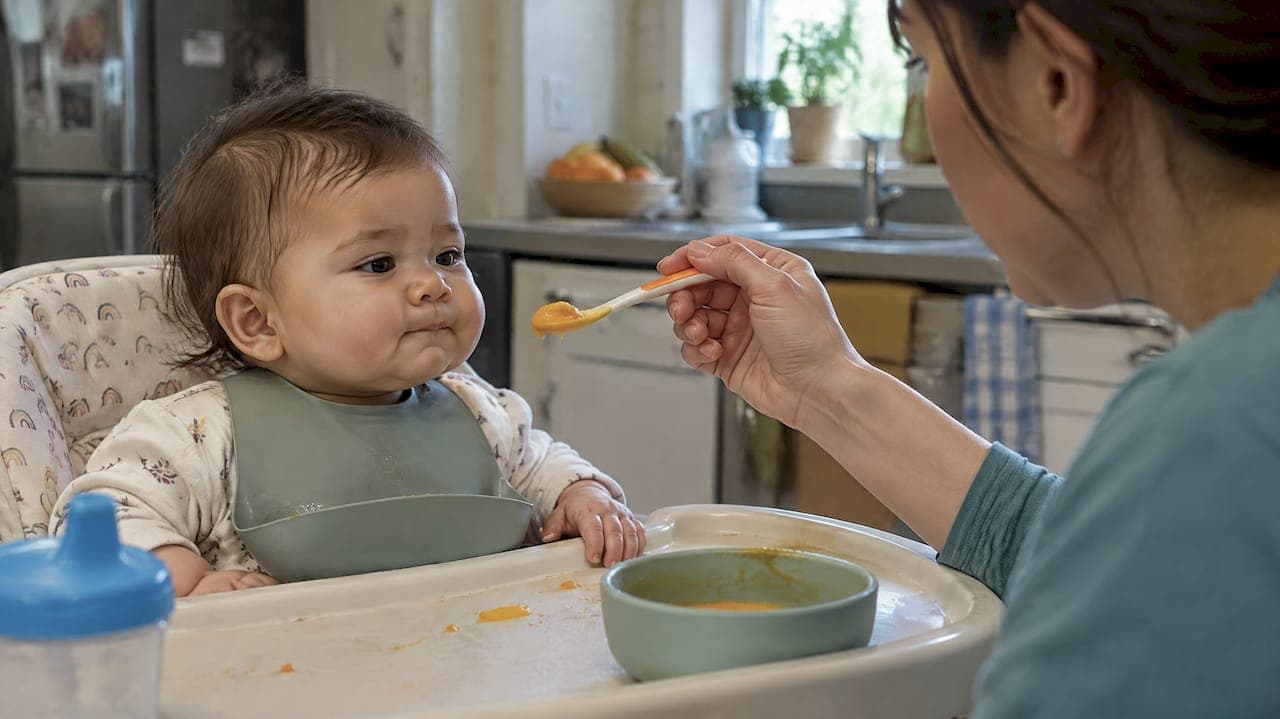
If your baby clamps their mouth shut, swats the spoon away, or lunges to grab it, take a breath. In most cases this is a normal part of learning to eat, not a behavior problem and not a sign that you are doing something wrong. Spoon refusal usually comes down to readiness, timing, texture, or a growing wish to do it themselves. A smaller number of babies are telling us something else, such as a motor, sensory, or medical difficulty, and knowing the difference is what this guide is for.
Below, we walk through why babies refuse the spoon, how to start spoon feeding in a way that builds trust, how to let your baby practice with their own spoon, and the specific signs that mean it's time to call your pediatrician and a feeding specialist.
TL;DR
- Refusing the spoon is common, especially when solids are new, and it is rarely about the food itself. Pressure makes it worse, so pause and try again later.
- Check readiness first: solids start around 6 months, and a baby who pushes food back out with the tongue may simply not be ready yet.
- Offer a second spoon to hold, guide the forearm instead of the hand, and keep meals short and calm.
- Coughing, choking, refusing all feeds, poor weight gain, or meals that regularly run past 30 to 40 minutes are reasons to seek an evaluation, not to wait.
- Our team at Thriving Joy supports families in Pasco and Hillsborough Counties with feeding therapy and parent coaching.
Table of Contents
- Why babies refuse the spoon
- How to start spoon feeding without a battle
- Let your baby practice with their own spoon
- Gagging, choking, and what's normal
- Red flags: when it's more than a phase
- Our perspective at Thriving Joy
- How feeding therapy can help a baby who refuses the spoon
- Support from Thriving Joy in Pasco and Hillsborough Counties
- FAQ
- Sources
Why babies refuse the spoon
A spoon asks a lot of a young baby. Until now, every feed has been liquid. Moving a spoonful of puree from the front of the mouth to the back, closing the lips, and swallowing is a brand-new skill. HealthyChildren.org, the American Academy of Pediatrics parent site, explains that babies may look confused, push food out, or refuse solids at first because they are still learning that movement.
Here are the reasons we see most often.
They are not quite ready
The CDC says children can begin solid foods at about 6 months, and that introducing foods before 4 months is not recommended. Signs of readiness include sitting with support, good head and neck control, opening the mouth when food comes near, and swallowing food rather than pushing it back out with the tongue. If your baby is younger than 6 months and refusing, the most helpful move may be to wait a couple of weeks and try again. Our guide on the three signs to check before starting solids goes through this in more detail.

Pressure, even gentle pressure
Babies read our faces and our tension. Coaxing, airplane noises that turn into pleading, and "just one more bite" can all feel like pressure. The NHS advises against forcing a baby to eat, and notes that there will be days when a baby eats more, days when they eat less, and days when they reject everything. That is normal.
There is also a longer-term reason to back off. Your baby is learning to recognize hunger and fullness. When we override a "no," we can disrupt that internal feedback loop, the one that helps children listen to their bodies for years to come.
They want to be in charge
Somewhere around 8 to 9 months, many babies become very interested in holding the spoon. The Children's Hospital of Richmond at VCU notes that children may want to feed themselves this early, though it typically takes several more months to master. If your baby opens happily for finger foods but turns away from a spoon you are holding, this is likely what you are seeing. It is a developmental step forward, not defiance.
Timing, hunger, and fatigue
A baby who just finished a full bottle or nursing session has little reason to work at solids. A baby who is overtired or ravenous has no patience for a new skill. The sweet spot is usually an alert, content baby who is a little hungry, not starving. The CDC reminds parents that children's bellies are small, so early portions are only 1 or 2 tablespoons, and it is fine for most of those to end up on the bib.
Texture and sensory surprise
Parents are often surprised when a baby rolls the food around, wrinkles their nose, or gags at first. That is usually not rejection of the flavor. It is a confused reaction to a new and complicated sensory experience. The CDC's page on tastes and textures explains why variety matters for development, and the pace at which you add it should follow your baby's comfort.
How to start spoon feeding without a battle
There is no single correct method, but the families we work with tend to have the most success when they treat the first weeks as practice, not as a nutrition project. Milk (breast milk or formula) is still your baby's main source of nutrition early on, so the pressure is off.
- Confirm readiness. Your baby should sit with support, hold their head steady, and show interest in food. If you are unsure, our post on making the transition to solids skill first can help you decide.
- Choose a calm window. Pick a time when your baby is rested and mildly hungry, and sit at their eye level in a seat that supports them upright.
- Start tiny. HealthyChildren.org suggests first portions of around 1 or 2 teaspoons. Use a small, soft-tipped spoon with a shallow bowl.
- Let your baby lead. Bring the spoon near, then stop a few inches from their face. Wait for them to lean in, open, or reach. Resting the spoon gently on the lower lip, without pushing it in, lets them decide.
- Read the no. Turning the head, pressing the lips together, crying, or batting the spoon away all mean "I'm done for now." End the meal calmly.
- Try again later. If a baby cries or turns away, HealthyChildren.org recommends not forcing it, going back to breast milk or formula, and trying again another time.
One new, single-ingredient food at a time is the standard advice. The CDC suggests waiting 3 to 5 days between new foods so you can watch for reactions. If you plan to start with purees, finger foods, or a mix, our overview of baby-led weaning and the research behind it compares the approaches.
What to do after a refusal
When a baby turns down a new food again and again, the instinct is to push harder. Try the opposite. Take the food away without comment, and wait about 5 to 7 days before reintroducing it, a timeline HealthyChildren.org's solid food guidance describes as a way to lower the pressure that can lead to food aversion. It can take a lot of exposures. The AAP says parents may need to offer a food 8 to 15 times before a child accepts it, so persistence without pressure is the goal.
Let your baby practice with their own spoon
This is often the single most useful change for a baby who grabs, bats, or fights the spoon.
The two-spoon method
Give your baby one spoon to hold and mouth while you use a second spoon to offer food. According to the Children's Hospital of Richmond, this approach reduces conflict at meals because the urge to grab is met rather than blocked. The same source suggests that babies tend to accept help more readily when you guide the forearm or elbow rather than taking hold of the hand, which can feel intrusive.
Choosing baby spoons for self-feeding
You do not need special gear, but a few features help early self-feeders succeed:
- A short, wide handle that a small fist can wrap around
- A shallow, soft bowl that is gentle on gums
- A flat or slightly textured surface so thick purees (like yogurt, oatmeal, or mashed avocado) stay put
- Easy-to-wash materials, since you will be washing a lot
Pre-load the spoon with a thick puree, set it in your baby's hand or on the tray, and let them guide it. Much of it will miss. That is learning. The AAP notes that most babies will not master independent spoon feeding until around 15 months, so keep expectations realistic and messes welcome.
Keep the whole table relaxed
Feeding is also emotional. Calm, connected meals matter for a baby's sense of safety, and there are many everyday ways to nurture that connection. If you are looking for a broader read on supporting a child's emotional well-being through food and family routines, this article on nourishing a child's emotional development offers additional ideas to consider alongside your pediatrician's guidance.
Gagging, choking, and what's normal
Many parents panic when a baby gags, and it is understandable. Still, gagging and choking are different. Gagging is a natural protective reflex that helps babies learn to manage textures. It is often noisy. Choking is typically silent because the airway is blocked, and it needs immediate emergency help. HealthyChildren.org's solid food guidance is a good place to review the difference before you begin, and a certified infant CPR class is a worthwhile step for any family starting solids. Learning to tell the two apart is one of the quickest ways to gain confidence at the high chair.
Red flags: when it's more than a phase
Most spoon refusal passes with patience. But feeding is also a safety issue, and some patterns deserve a professional look early rather than a long wait. Pediatric specialists say parents often see refusal as a behavior to fix, when it is sometimes a sign of an underlying medical, motor, or sensory challenge.
See your pediatrician and ask about a feeding evaluation if you notice any of the following. The Feeding Matters When to Refer guide and ASHA's family resources describe many of these:
- Coughing, choking, or gurgly or wet-sounding breathing during feeds
- Labored or noisy breathing while eating
- Refusing all feeds, or not taking enough to grow well
- Weight loss or slowed growth
- Crying or clear distress at most meals, or extreme stress at the sight of the high chair
- Meals that consistently last longer than 30 to 40 minutes
- Feeding well only when drowsy or asleep
- A baby older than 9 months who refuses most solid foods, a point HealthyChildren.org lists as a reason to call the doctor
- Losing feeding skills they once had
If you have any concern about your baby's breathing, choking, or hydration, contact your pediatrician the same day, or call 911 for an emergency. ASHA notes that more than 2 million children in the United States have pediatric feeding disorder (PFD), and recommends a feeding and swallowing evaluation from a certified speech-language pathologist when a child is not progressing or is losing skills.
Trust your instincts here. If something feels off, you do not have to wait for a specific number of weeks. If your baby has had two weeks of feeding trouble, our post on what to do next after two weeks of infant feeding difficulties gives you a practical starting point, and recognizing your baby's feeding red flags covers the signs in more depth.
Our perspective at Thriving Joy
When families walk in with a baby who refuses the spoon, they often arrive tired and worried, and a little guilty. We want to say first: this is not a failure of parenting. Our practice is built around a holistic, family-centered approach that looks for root causes instead of reaching for a quick fix.
That means we do not start with "how do we get more food in." We start with questions. How does your baby sit and move? How do they handle different textures? What do mealtimes feel like for everyone at the table? Is there a medical piece, such as reflux, a tongue tie concern, or breathing, that needs your pediatrician's attention? Sometimes the answer is simply support and timing. Sometimes a child needs skilled therapy to build oral motor skills or to feel safe around food again.

We also see the pattern that experts describe: the more pressure a family feels, the more a baby resists. So we coach parents on low-pressure routines, and we work in the setting where your child eats best, whether that is our office, your home, a daycare, or a preschool. Our founder brings a pediatric healthcare background together with her own experience as a parent, and that shapes how we listen to you.
If you take one thing from this article, let it be this: you know your baby better than anyone. Early support is not overreacting. It is how we protect mealtimes for the long run.
— Thriving Joy
How feeding therapy can help a baby who refuses the spoon
A feeding evaluation is a conversation and an observation, not a test your baby can fail. We watch your baby eat or drink, look at posture, oral motor skills, sensory responses, and your family's routines, and then build a plan around what we find. Therapy is playful and paced to your child. Parents are part of every session, so the strategies carry over to your kitchen table.
For babies and toddlers, therapy might focus on:
- Building the oral motor skills needed to move food from a spoon to the back of the mouth
- Gradually widening comfort with new textures and the feel of a spoon
- Supporting a healthy transition from bottle or breast to solids
- Helping with tube weaning when a child has relied on a feeding tube
- Coaching you through responsive feeding so meals feel safe and connected
You can read more about how this looks in practice in our posts on why some babies struggle with feeding and how therapy addresses it, common feeding challenges in babies, and, for older children, how feeding therapy helps toddlers.
Feeding and communication also overlap, since the same muscles and skills are involved in both. If you are noticing a delay in sounds or words alongside the feeding struggles, it may help to understand what happens during a speech-language evaluation.
Support from Thriving Joy in Pasco and Hillsborough Counties
If spoon refusal has gone on longer than you are comfortable with, or you simply want a second set of expert eyes, we would be glad to help. Thriving Joy Pediatric Therapy offers feeding therapy in Lutz and Wesley Chapel for infants and toddlers, along with lactation counseling if breastfeeding or bottle feeding is part of the picture. Many parents also find our parent coaching and classes useful, including Starting Solids 101, Picky Eating Workshops, and feeding support groups.
We accept private pay, major health insurance plans, and scholarships. Contact us through our website to ask about next steps.
FAQ
What should I do when my baby refuses spoon feeding?
Stay calm, end the meal without pressure, and offer milk as usual. Try again later in the day or the next day, at a time when your baby is alert and a little hungry. Offering a second spoon to hold and letting your baby reach for the spoon themselves often helps.
Is it normal for a 6-month-old to refuse solids?
Yes, it is common. At 6 months, many babies are still learning to move food to the back of the mouth, and some are not quite ready. Keep offering small, calm tries, and check in with your pediatrician if your baby seems unable to swallow food, has trouble breathing, or is not growing well.
How do I start spoon feeding?
Confirm your baby is ready, usually around 6 months, then offer 1 or 2 teaspoons of a single-ingredient food when your baby is calm. Bring the spoon close, let them lean in, and stop when they show you they are done. Introduce one new food at a time and wait a few days between new foods, as the CDC recommends.
At what age do babies stop needing to be spoon fed?
There is no fixed age. Babies often want to hold the spoon by 8 to 9 months, but the AAP notes most do not feed themselves independently until around 15 months. Many families practice with two spoons during that long stretch.
How do I know if my baby has a feeding aversion?
Look for patterns: strong distress at most meals, gagging or coughing with feeds, refusing all feeds, or meals that regularly last past 30 to 40 minutes. These are reasons to talk with your pediatrician and ask about a feeding evaluation with a speech-language pathologist who specializes in feeding.
Sources
- CDC: When, What, and How to Introduce Solid Foods
- CDC: How Much and How Often To Feed
- CDC: Tastes and Textures
- HealthyChildren.org: When Can Babies Start Solid Foods?
- HealthyChildren.org: Solid Foods (Baby Foods) symptom checker
- NHS: Help your baby enjoy new foods
- Children's Hospital of Richmond at VCU: Addressing pitfalls with a learning-to-eat infant
- Feeding Matters: When to Refer
- ASHA: Resources for families on feeding development