

Most medically stable children who rely on a G tube can transition to eating by mouth with the right plan, but it should never start on your own. G tube weaning works best as a structured, multidisciplinary process, and the first move is always medical and swallowing safety clearance. If you're wondering where to begin, contact your child's clinician and a pediatric feeding therapist this week to schedule that evaluation.
TL;DR:
- Weaning from a G tube requires medical stability and swallow safety assessments, including tests like MBSS or FEES, before reducing tube feeds.
- Active caregiver coordination, consistent monitoring, and avoiding pressure or forceful feeding tactics are critical to prevent setbacks.
- The three main weaning models are home-based appetite-guided, intensive hunger programs, and gradual outpatient approaches, matched to each child's needs.
- Effective therapy emphasizes slow, pleasurable exposure, multidisciplinary team communication, and continuous follow-up for sustained progress.
Table of Contents
- What To Do Today: A G Tube Weaning Action Checklist
- Medical Clearance and Swallowing Safety: What Clinicians Actually Check
- The Three Main Approaches to Weaning Off a G Tube
- Inside Feeding Therapy: What Actually Happens During Sessions
- Who's on Your Child's Weaning Team, and How to Keep Them Talking to Each Other
- How Long Does G Tube Weaning Take?
- Daily Monitoring: What To Track and When To Call Your Team
- The Mistakes That Quietly Sabotage a Wean
- What Twenty Years of Feeding Cases Have Taught Us About Timing
- Getting Started With Feeding Therapy Support Near You
- Sources
What To Do Today: A G Tube Weaning Action Checklist
You don't need every answer before you take the first step. You need the right first three calls. Here's what actually moves the needle before you touch feeding volumes or schedules at home.
- Call your child's gastroenterologist or pediatrician and ask directly whether they believe your child is a candidate for oral feeding progression, and request a swallowing safety evaluation if one hasn't been done recently.
- Ask specifically about MBSS or FEES testing (more on what these are in the next section) if anyone, including you, has ever noticed coughing, choking, or wet-sounding breathing during oral attempts.
- Reach out to a pediatric feeding therapist, ideally a speech-language pathologist (SLP) or occupational therapist (OT) with tube-weaning experience, and a pediatric dietitian who can track nutrition during any reduction in tube volume.
- Start a simple daily log now, before you change anything: what your child eats or drinks by mouth, how much, and their weight once a week at the same time of day.
- Do not reduce tube feeds, skip feeds, or attempt to "starve out" hunger on your own. Volume changes belong in a clinician-supervised plan.
- Do not force spoons into your child's mouth or use pressure tactics like withholding a toy until they take a bite. This tends to build aversion rather than appetite.
Pro Tip: Keep your daily log boring and consistent. A simple notebook or phone note with three columns, time, what was offered, what was accepted, tells your feeding team more in one glance than a week of your verbal recollections ever could.
Once these calls are made, you're not waiting passively. You're building the foundation every safe wean is built on: a team that knows your child, and data that shows how they're really doing.
Medical Clearance and Swallowing Safety: What Clinicians Actually Check
Before anyone talks about reducing tube volumes, your child's care team needs to confirm two separate things: that your child is medically stable enough to handle the process, and that swallowing is safe. These are not the same question, and skipping either one is where weaning attempts go wrong.
Medical stability generally means your child's underlying condition, whatever brought the G tube into the picture, is controlled rather than actively in flux. A child mid-treatment for a serious illness, recovering from recent surgery, or dealing with unmanaged reflux is usually not a candidate yet. Common reasons a clinician will pause or delay a wean include:
- Active, uncontrolled gastroesophageal reflux disease (GERD)
- Unstable respiratory status, including recent aspiration pneumonia
- Ongoing acute illness or recent major surgery
- Significant, unaddressed oral aversion without any therapy in place
- Poor growth trends that suggest the child's caloric margin is already thin
Swallowing safety is a separate clinical question, and it's usually answered with one of two tests. A Modified Barium Swallow Study (MBSS), sometimes called a videofluoroscopic swallow study, involves having your child eat and drink foods coated in barium while a radiologist watches in real time on X-ray. It shows whether food or liquid is entering the airway (aspiration) and, critically, whether your child shows any outward sign of it, since silent aspiration, aspiration with no cough or grimace, is common in tube-fed children and is exactly why parental observation alone isn't enough.
Fiberoptic Endoscopic Evaluation of Swallowing (FEES) uses a thin camera passed through the nose to view the swallow directly. It skips the radiation exposure of an MBSS and can be done at bedside, which makes it a good fit for younger infants or children who need repeat testing. Your SLP or ENT will typically recommend whichever test fits your child's age, anatomy, and specific concerns.
Red flags that should pause any wean in progress include a documented aspiration event, a sudden increase in respiratory symptoms like wheezing or congestion tied to feeding times, signs of dehydration, or reflux that worsens rather than improves as oral volumes increase. None of these mean weaning is off the table forever. They mean the plan needs to be adjusted, often with medication changes, positioning changes, or a slower pace, before moving forward again.
Your pediatric dietitian's job throughout this process is to make sure nutrition never becomes the casualty of progress. As oral intake increases and tube volume decreases, the dietitian recalculates calorie and fluid needs, often weekly at first, to confirm your child isn't quietly running a deficit while everyone celebrates smaller feeding-pump numbers. A meta-analysis of pediatric tube-weaning studies backs this up directly: the approaches with the best track records are the ones that keep multidisciplinary, behaviorally informed monitoring in place throughout, not just at the starting line.
The Three Main Approaches to Weaning Off a G Tube
There isn't one script for how to wean off a G tube. There are three broad models, and matching the right one to your child's age, medical picture, and your family's daily reality matters more than picking whichever program has the flashiest name.
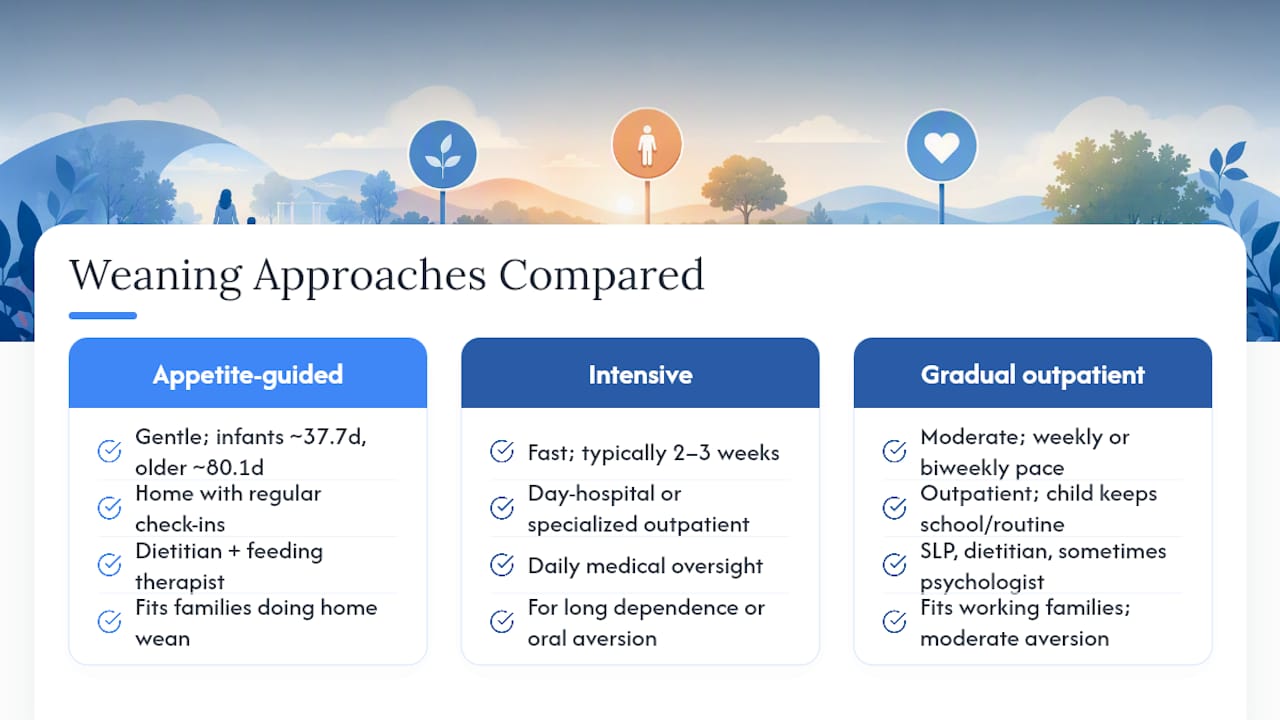
Appetite-guided, home-based weaning is the gentlest and most gradual model. A dietitian and feeding therapist calculate a slightly reduced tube-feeding target designed to let natural hunger cues resurface, and your family implements it at home with regular check-ins. A pilot study on this approach found it works, and it works differently depending on age: infants weaned in a mean of 37.7 days, compared to a mean of 80.1 days for older children. That's a real gap, and it makes sense once you consider that infants have less feeding history to unlearn, while an older child who has associated mealtime with discomfort for years needs more time to rebuild trust in eating. The same study found that a large majority of children who successfully weaned had surpassed their pre-wean weight within several months, which should ease a common fear: that weaning means accepting some lost ground on growth. For most kids, it doesn't.
Intensive hunger-induction programs compress the process into a tightly supervised window, typically two to three weeks, usually in a day-hospital or specialized outpatient setting with daily medical oversight. One retrospective study of a two-week hunger-induced program reported that 90% of participants showed improved oral intake by discharge, and 75% of those tracked at longer-term follow-up were fully weaned from the tube. A related three-phase model, built around a preparation stage, a three-week intensive intervention, and extended follow-up, reported strong overall success rates while stressing that the follow-up phase is what protects those gains long after the intensive weeks end. These programs suit children with a longer history of tube dependence or significant oral aversion, where a slower home approach hasn't gained traction, but they demand daily availability and close medical monitoring that not every family can arrange, especially if the program isn't local.
Gradual outpatient weans sit in between. Your child continues regular life and school while a team, usually the SLP, dietitian, and sometimes a psychologist, meets with your family on a set cadence (often weekly or biweekly) to adjust tube volumes, review the feeding log, and layer in oral-motor and behavioral strategies as tolerance builds. This model tends to fit children with moderate aversion, working families who can't take weeks off for an intensive program, or kids stepping down after an intensive program ends.
One practical marker shows up across programs regardless of model: many teams start by trimming tube volumes by a moderate percentage during a preparatory week, deliberately inducing mild hunger to test how the child responds before committing to a full reduction schedule. It's a controlled experiment, not a leap.
Pro Tip: If you're torn between an intensive program and a gradual outpatient wean, ask your feeding therapist how your child handles new sensory experiences in other contexts, new textures of clothing, new environments. Kids who adapt slowly to sensory change in general often do better with the slower model, regardless of age.
Inside Feeding Therapy: What Actually Happens During Sessions
Parents often picture feeding therapy as "getting my child to eat," but the actual sessions look more like patient skill-building than a feeding attempt. Here's what a typical progression involves.
- Oral-motor exercises come first, often with no food involved at all. Therapists work on lip closure, tongue lateral movement, and jaw strength using tools like textured teethers or vibrating oral devices, skills your child needs before food ever enters the picture reliably.
- Sensory desensitization follows a deliberate sequence: touch, then smell, then taste, then swallow. A child might spend several sessions simply touching a food to their lips or tray before anyone expects a taste, let alone a swallow. Rushing this order is the single most common reason exposure work backfires.
- Play-based exposure keeps the pressure low. Food shows up in sensory bins, art projects, or pretend kitchens long before it shows up on a spoon aimed at a mouth. This is intentional: therapy works better when the food/anxiety connection your child may have built with tube feeding gets replaced with a food/curiosity connection instead.
- Mealtime routines and positioning get standardized. Therapists often recommend a consistent seat, a supportive chair with feet grounded, and a predictable mealtime rhythm, since unpredictability is a known trigger for feeding resistance in tube-dependent kids.
- Utensil progression happens gradually, moving from pre-spoon tools (like a NUK brush or a small silicone dipper) to a real spoon, then to self-feeding, at whatever pace your child's motor skills and comfort allow.
- Behavioral and psychological strategies get layered in when aversion runs deep. A psychologist or behavior-trained therapist may join the team if a child shows strong anticipatory anxiety around food, gagging before food even reaches their mouth, or a pattern of shutting down at mealtimes that oral-motor work alone doesn't resolve.
None of this moves fast, and that's the point. Oley Foundation guidance on tube weaning is explicit that gentle, pleasurable exposure beats any attempt to accelerate through discomfort, and the research on aversion backs that up: force tends to build resistance, not appetite. If you want a closer look at how these techniques play out for younger children specifically, this piece on feeding therapy benefits for babies walks through the early developmental groundwork in more detail.
Pro Tip: If your toddler licks a food, spits it out, and refuses to touch it again for three days, that's not a failed session. That's data. Therapists count repeated low-pressure exposures, not single "wins," as the real marker of progress.
Who's on Your Child's Weaning Team, and How to Keep Them Talking to Each Other
A successful wean rarely comes down to one provider working in isolation. It comes down to a team that actually communicates, and that's often the part families have to push for themselves.
Here's who typically fills each role:
- Gastroenterologist or pediatrician: manages the underlying medical condition, monitors GI symptoms, and signs off on medical readiness.
- Speech-language pathologist (SLP): leads swallowing safety evaluation and oral-motor/sensory feeding therapy.
- Occupational therapist (OT): often works alongside the SLP on sensory processing, self-feeding skills, and positioning.
- Pediatric dietitian: calculates and adjusts nutrition needs as tube volume changes, tracking calories, fluids, and micronutrients.
- Psychologist or behavioral specialist: addresses anticipatory anxiety, aversion patterns, and caregiver stress when they're slowing progress.
- Nursing staff: manage tube site care, feeding equipment, and often serve as the point of contact for day-to-day questions between visits.
Position papers on multidisciplinary feeding teams consistently recommend this full roster for complex cases, though a straightforward, low-aversion wean might only need the core three: physician, SLP, dietitian.
The gap most families hit isn't a missing role. It's missing coordination between the people already on the team. A simple fix: bring a written one-page summary to every appointment, including ones with providers outside the feeding team, listing current tube volume, oral intake trend, weight, and any recent red flags. Ask each provider to initial or note it before you leave.
Virtual visits have become a real option for the dietitian check-ins and some SLP follow-up sessions, particularly useful if your specialized feeding team isn't local. Swallowing studies, initial evaluations, and hands-on therapy sessions still generally require in-person visits.
How Long Does G Tube Weaning Take?
There's no single timeline, but the research gives real ranges to anchor your expectations. In the home-based, appetite-guided pilot study cited earlier, infants weaned in a mean of 37.7 days versus 80.1 days for older children, roughly twice as long. Intensive hunger-induction programs compress the initial gains into two to three weeks, though full weaning, meaning your child sustains adequate oral intake without the tube, often continues to develop over the months following discharge rather than finishing the day the program ends.
Several factors reliably shift how fast or slow the process goes:
- Age at the start of weaning — younger children with shorter feeding histories tend to adapt faster.
- Duration of tube dependence — a child tube-fed since birth typically needs more time than one who needed a tube temporarily after an acute illness.
- Underlying diagnosis — conditions involving significant oral-motor impairment or sensory processing differences often extend timelines regardless of age.
- Family consistency — programs consistently note that households able to maintain the feeding schedule and log data reliably see steadier progress than those with frequent disruptions.
Weight patterns during a wean deserve honest framing. Some temporary plateau or a small dip is common as tube volume decreases and oral intake hasn't fully caught up yet, and this is exactly why weekly weight checks matter. What should reassure you is the recovery data: that same pilot study found 93% of successfully weaned children had surpassed their pre-wean weight within six months. A brief dip is not a red flag by itself. A sustained, unaddressed drop is.
Meta-analytic research on tube weaning also stresses that follow-up needs to extend well past the active weaning phase, often three to six months and sometimes up to a year, specifically to catch late regressions before they become setbacks.
Daily Monitoring: What To Track and When To Call Your Team
Once a wean is underway, your daily job isn't complicated, but it does need to be consistent. Here's what to track and what should trigger a call.
- Log oral intake estimates after every meal or snack, even rough ones ("about half a cup of yogurt, most of the crackers"). Precision matters less than consistency.
- For infants, track wet diapers daily. A drop below six wet diapers in 24 hours is a standard hydration flag worth mentioning to your team promptly.
- Weigh your child weekly, same scale, same time of day, minimal clothing, and log it alongside intake so your dietitian can see the two side by side.
- Watch for respiratory changes tied to feeding, new coughing, wheezing, or congestion that shows up during or shortly after meals, and report it the same day rather than waiting for a scheduled visit.
- Call urgently if you see rapid weight loss (generally more than 2% of body weight in a week), signs of dehydration (sunken eyes, dry mouth, lethargy), or any choking or breathing distress during feeding.
When these numbers move the wrong direction, your team has several adjustment tools before anyone talks about stopping altogether. They might add a supplemental overnight tube feed to protect calorie intake while daytime oral practice continues, step back to a slightly higher tube volume for a week to stabilize, or pause forward progress temporarily without reversing it, essentially holding steady rather than retreating.
Pro Tip: Take a weekly photo of your logbook or app screen and text it to your dietitian between visits. It takes thirty seconds and often catches a trend two weeks before it would surface at your next scheduled appointment.
The Mistakes That Quietly Sabotage a Wean
Most setbacks in tube weaning don't come from a bad protocol. They come from well-meaning habits at the kitchen table that work against the plan without anyone realizing it.
- Forcing or tricking a child into eating (hiding food in a favorite snack, using a spoon to physically push food past resistant lips) tends to build lasting food aversion rather than appetite, since it teaches a child that mealtime means losing control.
- Grazing throughout the day, even small snacks between planned meal or feed times, blunts the hunger cues that make appetite-guided weaning work in the first place. Structured, spaced feeding windows matter more than they seem to.
- Long, pressured meals where a child sits well past the point of engagement rarely produce more calories. They tend to produce more resistance at the next meal.
- Ending sessions on a struggle rather than a small win teaches a child to dread the next mealtime before it starts. A better close: stop while things are still going reasonably well, even if it means less food gets offered that sitting.
- Waiting too long to bring in behavioral support. If your child shows anticipatory distress, gagging or crying before food is even near them, that's a sign to loop in a psychologist or behavioral specialist early, not after months of stalled progress.
Research on family readiness backs up why these patterns matter so much: caregiver stress management and pacing the process to the child, rather than to a calendar, are consistently linked to better outcomes across studies.
What Twenty Years of Feeding Cases Have Taught Us About Timing
Here's an angle that gets underplayed in most tube-weaning guidance: the biggest predictor of a smooth wean often isn't the protocol you choose. It's whether you started the readiness conversation before you felt ready to start it.
Families frequently wait for a moment of certainty, a sign that their child is "clearly ready," before contacting a feeding therapist. That moment rarely arrives cleanly. Readiness is usually a gradual, mixed picture: your child shows curiosity about food one week and refuses everything the next. Waiting for unambiguous readiness often means waiting months longer than necessary, while a skilled feeding therapist can spot early, partial readiness signs that parents miss entirely because they're looking for something more dramatic.
The second underappreciated truth: the programs with the strongest track records aren't necessarily the fastest ones. The three-phase model with extended follow-up and the appetite-guided home approach both point to the same conclusion from different directions, that the follow-up period, not just the active weaning weeks, is where gains either stick or slip. A family that treats the six-month mark after weaning as optional check-in territory is taking on more risk than one that treats it as part of the actual protocol.
Feeding therapy, lactation counseling, and speech therapy are often integrated to treat a child's oral-motor skills, sensory tolerance, and communication development as one coordinated picture, rather than as separate appointments, which can produce steadier progress. Practices that work alongside a child's medical team can translate swallow study results and dietitian targets into daily, doable steps for families.
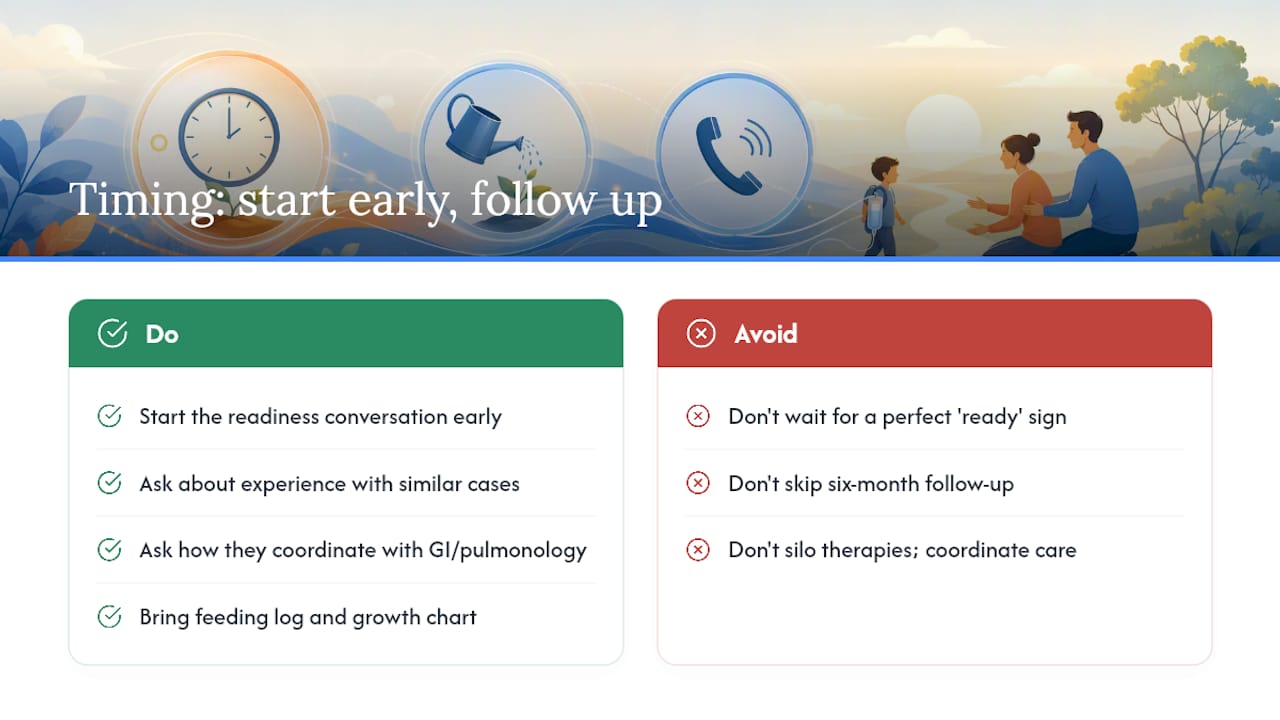
If you're weighing intake, ask your provider three specific questions: what's their experience with children at your child's exact stage of tube dependence, how do they coordinate with your existing GI or pulmonology team, and what does a typical first month of sessions actually look like. Bring your child's feeding log, most recent growth chart, and any swallow study results to that first conversation. The more concrete the starting picture, the faster a real plan comes together.
— Jamie
Getting Started With Feeding Therapy Support Near You
If your child's team has cleared them medically and you're ready to build a plan, Thriving Joy's feeding therapy services give families in the Tampa area a coordinated, hands-on alternative to piecing together separate specialists on your own. Rather than juggling appointments across town with providers who rarely speak to each other, you get a team that treats oral-motor skill-building, sensory work, and mealtime coaching as one connected process, aligned with your child's existing medical clearance and swallow study results.
Feeding therapy fits children working through sensory aversion or oral-motor delays tied to tube dependence, and practical guidance on how to introduce solid foods safely to your baby supports caregivers navigating early feeding transitions, while lactation counseling supports infants navigating a combined tube-and-breastfeeding transition, and speech therapy addresses the overlapping oral-motor demands that feed directly into safe swallowing. For your first appointment, bring your child's feeding log, most recent growth chart, current tube-feeding schedule, and any swallow study results. If your child also has combined breastfeeding needs, lactation counseling can run alongside feeding therapy rather than as a separate track. For families further along the process, techniques covered in this guide to transforming mealtimes at home show what daily practice between sessions can look like. Reach out through the feeding therapy page to schedule an evaluation and start building a plan tailored to where your child actually is right now.
Sources
The guidance in this article draws on a small set of studies and clinical resources worth reading directly if you want the full picture behind any recommendation.
- Appetite‑guided approach to pediatric enteral tube weaning in the home setting: A pilot study
- Pediatric Tube Weaning: A Meta-Analysis of Factors Contributing to Success
This article is general information, not a substitute for advice from a qualified doctor. Consult a qualified healthcare professional about your own circumstances before acting on anything here.