

Sensory food aversion happens when a child's nervous system reacts to a food's texture, smell, appearance, sound, or temperature as genuinely threatening, not just unappealing. Gagging, vomiting, and refusal to be in the same room as a food are common signs, and a 2011 study found that sensory processing differences are significantly related to eating problems in children with autism. If mealtimes are stressful but your child is growing well and eating a reasonable variety, keep watching. If growth has stalled, gagging happens daily, or meals end in tears every time, a feeding evaluation is the right next step.
TL;DR:
- Children with sensory food aversion usually display persistent gagging, refusal to touch or taste specific foods, and a narrow diet that doesn't naturally expand over time.
- Sensory reactions often involve multimodal triggers, including taste, smell, texture, visual cues, or sound, and can cause distress beyond typical picky eating.
- Underlying causes are linked to how a child's brain processes sensory input, with common factors including oral hypersensitivity, previous choking episodes, GI issues, or oral-motor difficulties.
- Early intervention with multidisciplinary feeding therapy focusing on gradual, low-pressure sensory exposure typically results in steady diet expansion and reduced mealtime stress.
- Untreated sensory food aversion can lead to nutritional deficiencies, growth stalls, social withdrawal, and ongoing mealtime anxiety that worsens over time.
Table of Contents
- What Is Sensory Food Aversion, and How Is It Different From Picky Eating?
- What Are the Signs of Sensory Food Aversion in Children?
- What Causes Sensory Food Aversion in Children?
- When Should Parents Seek Professional Help for Feeding Issues?
- What Happens in Feeding Therapy for Sensory Food Aversion?
- What Can Parents Do at Home to Reduce Mealtime Stress?
- What Does the Research Say About Sensory Food Aversion?
- What Happens if Sensory Food Aversion Goes Untreated?
- How Do Doctors Rule Out Other Causes of Feeding Problems?
- How Do Family Habits and Mealtime Environment Affect Sensory Aversion?
- What Is the Long-Term Outlook for Sensory Food Aversion?
- Where Can Families Find Support for Sensory Food Aversion?
- Thriving Joy's Perspective: Treat the Root Cause, Not the Meal
- Ready to Take the Pressure Off Mealtimes?
- Sources
- FAQ
What Is Sensory Food Aversion, and How Is It Different From Picky Eating?
Sensory food aversion is a strong, involuntary reaction to how a food feels, smells, looks, or sounds rather than a simple preference against its taste. A child with this kind of aversion might gag at the smell of fish cooking two rooms away, refuse to let a wet piece of fruit touch their lips, or melt down at the sight of sauce touching another food on the plate. These are not power struggles. They are the nervous system flagging danger where there is none.
Typical picky eating looks different, even though it shares some surface features. Most toddlers go through phases of refusing vegetables, wanting the same five meals on rotation, or turning up their nose at anything green. That is developmentally normal, and it usually resolves with patient, repeated exposure over weeks or months. Sensory food aversion tends to be more intense, more physical, and more stubborn. The distinguishing features generally include:
- Bodily reactions, including gagging, retching, or vomiting at the sight, smell, or texture of a food, not just a verbal "I don't like it."
- Cross-modal spillover, where a food that touches another food on the plate becomes unacceptable, or a sound (crunching, someone else chewing) triggers distress.
- Persistence over time, with the same handful of "safe" foods staying safe for months or years rather than expanding naturally.
- Disproportionate intensity, where the reaction seems far bigger than the situation calls for, and calming down takes real time.
Clinicians sometimes describe a more extreme version of this pattern as avoidant/restrictive food intake disorder, or ARFID, a diagnosis that applies when sensory-driven food avoidance is severe enough to affect nutrition, growth, or daily functioning. Not every child with sensory food aversion meets the criteria for ARFID. The diagnosis becomes relevant when weight, energy, or social participation is suffering because of how narrow the diet has become.
Sensory-based feeding issues show up across a wide age range, from infants transitioning to purées who gag at lumps, to school-age kids who still eat only five foods. The earlier the pattern is recognized, the easier it usually is to work with, since food rules and family habits have had less time to calcify around the aversion.
What Are the Signs of Sensory Food Aversion in Children?
Parents usually notice a pattern long before they have a name for it. The signs tend to cluster in a few recognizable ways, and tracking them for even a week or two gives a much clearer picture than trying to remember details during a stressful appointment.
- Physical reactions at mealtime, such as gagging, retching, spitting food back out, or vomiting when a new or disliked food is presented, tasted, or even smelled.
- Refusal to touch or taste, where a child will not put a food anywhere near their mouth, sometimes not even on their plate, regardless of encouragement.
- A narrow food repertoire, often fewer than 20 accepted foods total, that stays fixed for months without natural expansion.
- Ritualized eating, including insistence on specific brands, specific plates, or foods that cannot touch one another.
- Meltdowns tied to sensory triggers, not just refusal but genuine distress over smell, sound, or visual presentation of food.
Sensory reactions typically show up across specific channels, and recognizing which ones affect your child helps target the right strategies later. Taste sensitivity might mean a child rejects anything bitter or sour, even in tiny amounts. Texture sensitivity often drives rejection of mixed textures, like soup with chunks, or anything slimy, mushy, or crunchy in an unfamiliar way. Smell can be the biggest trigger of all. Some kids gag at the smell of a food before it is even on the table. Visual sensitivity shows up as refusal based on color or how food is arranged, while auditory sensitivity can make crunching sounds, either their own or someone else's, unbearable. Tactile sensitivity extends beyond the mouth to hands touching sticky or wet foods, and temperature sensitivity means a child accepts a food only within a narrow range, refusing it if it's slightly too warm or too cold.
Presentation shifts with age. Infants may resist textured purees or lumps during the transition off smooth foods. Toddlers often show the most visible meltdowns and rigid food rules. School-age children may have learned to mask distress in front of peers, so the reaction shows up at home instead, sometimes hours after a school lunch they barely touched.
What Causes Sensory Food Aversion in Children?
Sensory food aversion usually traces back to how a child's brain processes input from the mouth, nose, and eyes, not to stubbornness or poor parenting. Oral hypersensitivity, where the mouth registers ordinary textures as intense or even painful, is one of the most common underlying mechanisms clinicians identify.
The connection between sensory processing and feeding difficulty is well documented in children with autism. In a study of 95 children with autism spectrum disorder, researchers found 65% showed a definite difference in sensory processing and another 21% showed a probable difference, both significantly related to increased eating problems.
That means roughly 86% of the children studied showed at least a probable sensory processing difference, and those differences tracked closely with how much trouble the child had at mealtimes.
Broader reviews back this up. Research synthesizing sensory processing and eating behavior consistently points to taste and smell sensitivities, along with oral tactile defensiveness, as recurring drivers of food refusal, not limited to any single diagnosis. Sensory food aversion appears in children with autism, ADHD, sensory processing disorder, and plenty of neurotypical kids with no other diagnosis at all.
Several other factors commonly layer on top of sensory sensitivity:
- Anxiety or a history of a scary eating event, such as choking or a severe vomiting illness, which can prime the body to associate food with danger.
- GI disorders, including reflux, constipation, or food allergies, which create real physical discomfort that becomes linked to eating in general.
- Oral-motor difficulties, where chewing and moving food around the mouth is physically hard, making certain textures exhausting rather than just unpleasant.
- Family temperament and heredity, since sensory sensitivity often runs in families and shows up in other domains too, like clothing tags or loud noises.
Because so many systems can be involved, feeding specialists usually recommend a multidisciplinary lens. A gastroenterologist can rule out reflux or allergies, an occupational therapist can assess sensory processing, and a speech-language pathologist can evaluate oral-motor skills. Treating sensory food aversion as a single-cause problem tends to produce single-cause solutions that don't hold up.
When Should Parents Seek Professional Help for Feeding Issues?
Certain red flags mean it's time to move past watching and waiting. Weight loss, a growth curve that has flattened on the chart, or a pediatrician expressing concern at a well visit are the clearest signals. So is dependence on formula, nutritional shakes, or a feeding tube well past the age when solid food should be the primary source of calories. Frequent gagging or vomiting that risks choking, and any visible signs of nutrient deficiency, like unusual fatigue, hair thinning, or slow healing, also warrant an evaluation sooner rather than later.
A thorough feeding assessment typically pulls from several sources of information:
- A medical exam ruling out GI issues, allergies, and other physical contributors
- A review of the growth chart across multiple visits, not just a single snapshot
- A sensory profile assessment, often completed by an occupational therapist
- Direct observation of the child eating, either in person or via video
- Input from a speech-language pathologist on oral-motor skills and swallow safety
- A dietitian's review of nutritional intake and gaps
Knowing which professional to call first can feel confusing. In general, start with the pediatrician for a growth and medical check, then ask for a referral to a feeding therapy team, which may include occupational therapy, speech therapy, or both, depending on the clinic's structure. Before that first appointment, gather what will make the visit useful:
- A three to five day food diary listing everything accepted and refused, including reactions
- Video of a typical mealtime, including a meltdown if one happens naturally
- Growth records from the pediatrician, including recent height and weight
- A list of accepted "safe" foods and any patterns in how they're prepared
Clinicians differentiate sensory food aversion from ARFID largely by severity and impact. Sensory sensitivity that limits variety but leaves growth and daily life intact is usually managed with feeding therapy alone. When the narrow diet starts affecting weight, energy, or the ability to eat at school or with friends, ARFID criteria come into play, which usually means a more coordinated, multidisciplinary treatment plan.
What Happens in Feeding Therapy for Sensory Food Aversion?
Effective feeding therapy rarely relies on a single technique. It tends to combine sensory-based play and exploration, graded exposure sometimes called food chaining, oral-motor exercises, and behavioral supports, all wrapped around consistent parent coaching. A case series of children treated with individualized multicomponent intervention reported increased food acceptance and reduced refusal behaviors, though the sample was small and results should be read as promising rather than definitive.
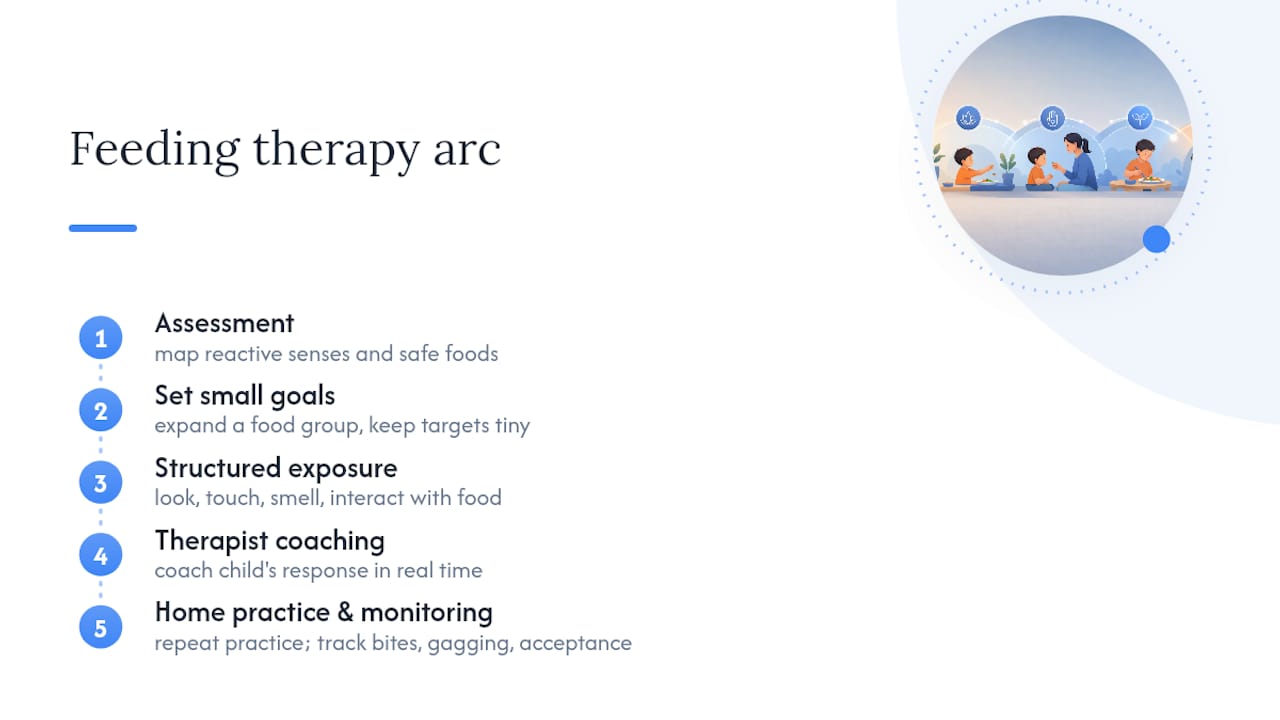
A typical course of therapy follows a recognizable arc. The first sessions focus on assessment, mapping out which sensory channels are most reactive and which foods already feel safe. From there, the therapist and family set specific, small goals, expanding a food group rather than jumping straight to "eat vegetables." In-session work usually involves structured exposure, letting a child look at, touch, smell, or interact with a target food with a therapist coaching the response in real time, followed by a home practice plan the family repeats between visits.
Progress in feeding therapy is rarely measured by a child suddenly eating everything. Clinicians typically track smaller, more honest markers: more bites and licks attempted, fewer gagging episodes, a broader list of accepted foods, and, just as important, a parent who feels less dread at dinner time. An observational study of mealtime behavior found that longer, positive mealtime interactions correlated with increased acceptance of target foods, which is part of why therapists coach parents on pacing and tone as much as on the food itself.
Pro Tip: Ask your feeding therapist to show you exactly what a "successful" session looks like early on. Parents often expect visible eating progress and feel discouraged when week three still looks like sniffing a strawberry. Knowing the real markers of progress in advance changes how you interpret week three.
Teletherapy has become a reasonable option for coaching-heavy sessions, particularly for parent guidance and home practice review, though in-person sessions are usually preferred for hands-on oral-motor work or when safety during eating is a concern. When growth has already faltered, most practitioners prioritize nutritional stabilization first, sometimes with supplement support, before layering in graded sensory exposure. Feeding therapy that skips this step risks pushing a hungry, undernourished child into exposure work their body isn't ready for.
Related reading on what pediatric feeding therapy actually involves walks through the therapy process in more detail, and how feeding therapy helps toddlers cover what to expect at the toddler stage specifically.
What Can Parents Do at Home to Reduce Mealtime Stress?
Home strategies work best when they mirror what happens in therapy: small, staged, low-pressure exposure rather than a leap straight to eating.
- Start with looking, not eating. Put the new food on the table, even the same plate, with zero expectation that it gets touched or tasted that day.
- Move to touching. Let your child handle the food with their hands, poke it, squish it, or use it in play, completely separate from mealtime if that feels safer.
- Progress to smelling and near-mouth contact. A food near the lips, even without tasting, is real progress worth acknowledging.
- Introduce tiny, low-stakes tastes. A lick or a single small bite, framed as optional and pressure-free, comes only after the earlier steps feel comfortable.
- Repeat often, without rushing. Food-play activities like building faces out of vegetables or "painting" with yogurt build familiarity outside the pressure of an actual meal.
Environment matters more than most parents expect. A quiet room without competing sounds, sensory-friendly seating that supports the body properly, and even swapping to a preferred plate or utensil can lower the sensory load enough for a child to engage at all. Some children do better with foods kept strictly separated on a divided plate rather than touching.
Safety and nutrition come first, always. Track what your child is actually eating, not just what you're offering, and loop in a dietitian before adding any supplement so you know it's appropriate for your child's specific gaps. If growth is faltering, calories take priority over variety in the short term. Expanding the diet matters, but not at the expense of a child getting enough to eat.
Avoid forcing, bribing with dessert, or extending meals into long standoffs. Coercive pressure tends to backfire, deepening the aversion rather than resolving it. For guidance on introducing new foods to younger children before aversions take hold, safe strategies for starting solids offers a useful starting point for the earliest stage of feeding.
Pro Tip: Keep a simple log with three columns: food, reaction, and step reached (looked, touched, tasted). It takes thirty seconds after each meal and gives you and any therapist a much clearer picture of real progress than memory alone.
What Does the Research Say About Sensory Food Aversion?
The strongest evidence connects sensory processing differences to feeding problems in children with autism, where the 65% definite plus 21% probable difference finding has been influential in shaping how clinicians approach feeding evaluations. Broader reviews extend the pattern beyond autism, tying taste and smell sensitivity specifically to a wide range of food refusal behaviors across different diagnostic groups.
The evidence base has real limits worth naming honestly. Much of the clinical literature relies on small samples, including case series with single-digit participant counts, and definitions of "sensory food aversion" vary enough between studies that comparing results directly is difficult. Larger, more standardized trials are still needed before anyone can make strong claims about which specific therapy component drives the most change.
What the current research does support clearly:
- Sensory processing differences are measurably and significantly linked to feeding problems, not just anecdotally associated with them.
- Longer, positive mealtime interactions correlate with greater acceptance of targeted foods, supporting the pacing-over-pressure approach used in therapy.
- No medication is proven effective for sensory sensitivity to food on its own, which is why multidisciplinary behavioral and sensory approaches remain the standard of care.
For families, the practical translation is straightforward even if the research is still maturing: expect gradual expansion measured in accepted foods and reduced distress, not a fast cure, and expect the most reliable results from therapy that addresses sensory, behavioral, and nutritional pieces together rather than any single technique in isolation.
What Happens if Sensory Food Aversion Goes Untreated?
Left unaddressed, a narrow, sensory-driven diet carries real nutritional risk. Children eating fewer than 20 foods often miss out on key nutrient groups, particularly iron, zinc, and fiber, since safe foods tend to cluster around beige carbohydrates and a handful of favorites. Growth faltering, low energy, and repeated illness can follow when the gap persists for years rather than months.
The psychosocial cost is just as real, even if it's less visible on a growth chart. Birthday parties, school lunches, sleepovers, and family holidays all revolve around food, and a child who cannot participate without distress starts to feel it socially. Some children develop anticipatory anxiety about eating in front of peers, which can deepen avoidance rather than resolve it over time. Parents carry their own toll too: mealtime dread, exhaustion from constant meal prep negotiations, and guilt that often has nothing to do with anything they actually did wrong.
None of this means the outlook is bleak. It means the risks compound the longer a sensory-based aversion goes unaddressed, particularly through toddler and early school years when social eating expectations rise fast. Early, sensory-informed support tends to prevent the nutritional and social gaps from widening in the first place, which is the core argument for evaluation sooner rather than a "wait and see forever" approach.
How Do Doctors Rule Out Other Causes of Feeding Problems?
Sensory food aversion shares symptoms with several other conditions, and sorting through them properly changes the treatment plan considerably. A thorough evaluation typically rules out or identifies overlapping issues before settling on a sensory-based diagnosis alone.
Gastrointestinal conditions top the list. Reflux, eosinophilic esophagitis, and constipation can all cause a child to associate eating with pain, producing refusal that looks identical to sensory aversion on the surface but responds to medical treatment instead of feeding therapy alone. Food allergies deserve the same scrutiny, since a child who once had a reaction may avoid a food or texture out of learned caution rather than sensory intolerance.
Oral-motor and swallowing disorders are another common overlap. A child who struggles to chew or safely move food to the back of the mouth may refuse textures not because they feel wrong, but because managing them is physically difficult or genuinely unsafe. A speech-language pathologist's evaluation, detailed in this overview of speech-language assessments, often catches this distinction.
ARFID sits at the far end of the spectrum, applied when sensory-driven restriction has grown severe enough to affect weight, nutrition, or daily functioning. Autism spectrum disorder frequently co-occurs with sensory food aversion but is a separate diagnosis with its own broader criteria. Getting the distinction right matters because a GI issue calls for medical treatment, an oral-motor delay calls for speech therapy, and pure sensory aversion calls for sensory-informed feeding therapy. Treating the wrong target wastes time a young, growing child doesn't have to spare.
How Do Family Habits and Mealtime Environment Affect Sensory Aversion?
Caregiver behavior doesn't cause sensory food aversion, but it strongly shapes how it plays out day to day. Pressure to "just try one bite," bribing with dessert, or extending meals into long standoffs tends to increase anxiety around food rather than resolve it, often deepening the very avoidance parents are trying to fix.
The mealtime environment itself carries more weight than most families expect. Bright lights, background television, competing sibling noise, or an uncomfortable chair all add sensory load on top of the food itself, and a child already working hard to tolerate a texture has little capacity left to also manage a chaotic room. Simplifying the environment, quiet background, consistent seating, familiar dishware, frees up sensory bandwidth for the actual eating challenge.

Family food culture matters too. Households where mealtimes are calm, where new foods appear alongside familiar ones without comment, and where a child's "no" is respected without becoming a fight tend to see faster, steadier progress than households locked in daily battles. This isn't about parents doing something wrong; it's about recognizing that the emotional temperature of a meal directly affects a sensory-reactive nervous system's ability to tolerate anything new. The research on longer, positive mealtime interactions correlating with greater food acceptance reflects exactly this dynamic: calm, unhurried, low-pressure meals give the sensory system room to adapt instead of shutting down.
What Is the Long-Term Outlook for Sensory Food Aversion?
Outcomes vary widely, and the biggest single factor tends to be how early and how consistently a child receives sensory-informed support. Many children who receive feeding therapy during the toddler or preschool years show steady expansion in accepted foods over months, with reduced gagging and less mealtime distress as their nervous system adapts through repeated, low-pressure exposure.
Children who go without intervention don't necessarily stay stuck forever, some sensory sensitivities do soften with age and maturation, but the diet often stays narrower for longer, and the psychosocial friction tends to accumulate rather than fade on its own. A teenager who has never expanded past ten foods faces a much harder social landscape than a first grader working through the same list with active support.
For children whose sensory aversion overlaps with ARFID or autism, progress tends to be slower and more gradual, but still real. The realistic goal in most feeding therapy isn't total elimination of sensory sensitivity. It's a wider, more flexible food repertoire, fewer physical reactions at meals, and a family that has genuinely lower stress around eating. That combination, more than a perfectly varied diet, is usually the marker of a successful long-term outcome.
Where Can Families Find Support for Sensory Food Aversion?
Parents navigating sensory-based feeding challenges don't have to piece it together entirely alone. Pediatric feeding therapy clinics provide one avenue, offering direct evaluation and treatment from professionals trained specifically in sensory and behavioral feeding approaches.
Beyond individual therapy, parent coaching sessions and structured workshops give families tools and a place to ask questions without needing a full clinical referral first. Feeding support groups, whether run through a clinic or a broader parenting network, offer something therapy alone can't: the reassurance of hearing from other parents managing the same 3 a.m. worry about whether their child is eating enough.
National organizations focused on feeding disorders and ARFID publish parent-facing guides that can help families understand terminology before a first appointment, and many pediatric hospitals maintain feeding disorder programs with waitlists worth joining early, since demand for specialized feeding therapy tends to outpace availability in most regions. Asking a pediatrician directly for local feeding therapy referrals, rather than searching broadly, often surfaces options faster than a general search.
Thriving Joy's Perspective: Treat the Root Cause, Not the Meal
Sensory food aversion rarely improves through willpower or clever bargaining at the table. Some pediatric therapy providers start by mapping a child's actual sensory profile, not just the list of refused foods, because the food list is a symptom, not the source. Early visits typically include a hands-on feeding assessment and a home plan parents can start using that same week.
When a child's needs cross into medical or educational territory, coordinating with pediatricians, GI specialists, or school teams keeps everyone working from the same information instead of conflicting advice. If mealtimes have become a daily source of dread in your home, scheduling an evaluation for feeding therapy is a reasonable, low-risk next step.
— Thriving Joy
Ready to Take the Pressure Off Mealtimes?
Unlike general parenting advice or trial-and-error at home, some feeding therapy providers build plans around a child's specific sensory profile, not a generic picky-eating checklist. Feeding therapy sessions identify why a food feels unsafe to the child, whether it's texture, smell, or something else entirely, and build gradual exposure around that root cause with family coaching every step of the way.
Sessions are available in the office, at home, or in daycare and preschool settings, whichever fits your child's routine best. Alongside one-on-one feeding therapy, parent coaching and workshops give you tools between sessions, including options like Starting Solids 101 and Picky Eating Workshops for families earlier in the process.
If your child's mealtimes involve daily gagging, a shrinking list of accepted foods, or growth concerns your pediatrician has flagged, view Thriving Joy's feeding therapy services to see how an evaluation works and how to schedule one.
Sources
- Association of Sensory Processing and Eating Problems in Children with Autism Spectrum Disorders
- Mealtime behaviours of young children with sensory food aversions: An observational study
- Avoidant/restrictive food intake disorder in children and young people: an update for clinicians
- Sensory processing and eating behaviours review (Nimbley et al. 2022)
This article is general information, not a substitute for advice from a qualified doctor. Consult a qualified healthcare professional about your own circumstances before acting on anything here.
FAQ
Does ADHD Cause Sensory Issues With Food?
ADHD itself doesn't directly cause sensory food aversion, but sensory processing differences frequently co-occur with ADHD, and children with either condition can show heightened sensitivity to taste, texture, or smell at mealtimes.
Do Kids Outgrow ARFID?
Some children's restrictive eating softens with age and consistent feeding therapy, but ARFID doesn't reliably resolve on its own, especially without intervention, which is why early evaluation matters when growth or nutrition is affected.
Is Oral Sensory Seeking a Sign of Autism?
Oral sensory seeking, like mouthing objects or craving intense flavors and textures, can appear in autism, but it also shows up in sensory processing disorder and in neurotypical children, so it isn't a reliable sign of autism on its own.
Is Food Aversion a Symptom of Autism?
Food aversion is common in autism, with one study finding sensory processing differences in 86% of children with autism significantly linked to eating problems, but sensory food aversion also occurs in children without any autism diagnosis at all.
How Much Does Feeding Therapy Cost?
Pricing for feeding therapy at Thriving Joy is available directly on the feeding therapy services page, where private pay, insurance, and scholarship options are outlined.