

Most medically stable children can begin a supervised NG tube weaning plan, and multidisciplinary programs report success rates around 67% to 69% for full weaning. That said, this is not a solo project. Stopping or cutting tube feeds without a coordinated medical team behind you can lead to dehydration, weight loss, or worse. The safest route always runs through a doctor, dietitian, and feeding specialist working together.
TL;DR:
- About 67% to 69% of children successfully wean from NG tubes after multidisciplinary programs, but individual success depends on medical stability, swallow safety, and behavioral readiness.
- Weaning should be personalized based on each child's health, oral-motor skills, and family environment, with clear thresholds for pausing or modifying the process.
- Outpatient stepwise reduction typically takes several weeks to months, with close monitoring of weight, hydration, and mealtime behavior to ensure safety and progress.
- Programs combining hunger-provocation, gradual reduction, or inpatient approaches have success rates around 68%, but require strict adherence to safety protocols and team collaboration.
- Long-term follow-up for growth, micronutrient levels, and oral skills remains essential after weaning to prevent regression and support ongoing development.
Table of Contents
- What Is NG Tube Weaning, and When Do Families Consider It?
- Is Your Child Ready? A Readiness and Safety Checklist
- How Do Clinical Weaning Approaches Actually Work?
- A Practical Week-by-Week Weaning Plan to Discuss With Your Team
- Who Belongs on Your Child's Tube Weaning Team?
- What Timeline and Success Rate Should You Expect?
- What Are the Warning Signs to Pause or Seek Urgent Care?
- How Thriving Joy Pediatric Therapy Supports Families Through Weaning
- Why Long-Term Follow-Up and Nutrition Monitoring Still Matter
- Supporting Your Child and Yourself Emotionally During Weaning
- Managing Feeding Aversion and Sensory Sensitivity
- What Do Real Weaning Programs Look Like in Practice?
- A Realistic Note From Jamie
- Ready to Start? How to Take the Next Step With Thriving Joy
- Sources
What Is NG Tube Weaning, and When Do Families Consider It?
NG tube weaning is the structured process of reducing and eventually stopping nasogastric tube feeds while helping a child build enough oral intake to meet their nutrition and hydration needs on their own. It's different from decisions around a G-tube (gastrostomy tube), which is surgically placed and generally used for longer-term or more complex feeding needs. An NG tube sits in the nose and throat and is meant to be temporary, which is exactly why so many families start asking about nasogastric tube removal the moment their child's medical picture starts to stabilize.
Families typically start thinking about weaning from an NG tube in a few common scenarios:
- A premature infant who was tube-fed to support growth is now hitting oral-motor milestones and gaining weight steadily.
- A toddler who needed tube support during illness, surgery recovery, or a period of poor growth is now medically stable and curious about food again.
- A child has developed tube dependence in children, meaning they've become so reliant on tube feeding that they've lost interest in or refuse oral eating, even though nothing physically prevents them from eating.
- A care team has flagged that continued tube use may now be doing more harm than good, whether through oral aversion, delayed feeding skills, or simple loss of hunger drive.
Here's the part that surprises a lot of parents: there is no single script for how to wean off NG tube feeding. A multidisciplinary position paper on weaning children from prolonged enteral nutrition is explicit about this. Plans need to be individualized across medical, nutritional, behavioral, and functional domains, because a two-year-old recovering from cardiac surgery has almost nothing in common, feeding-wise, with a former preemie who just needs a nudge toward oral confidence. What works for one child's tube dependence signs might backfire for another's. That's exactly why the checklist and team-based approach later in this guide matter more than any single "method."
Is Your Child Ready? A Readiness and Safety Checklist
Timing matters enormously here. Starting a weaning trial before a child's body and swallowing skills are ready can set back progress by months. Clinicians generally look at four categories before greenlighting a trial.
- Medical stability first. Reflux needs to be controlled, breathing needs to be steady, and any acute illness needs to be resolved. A child fighting a respiratory infection or uncontrolled gastroesophageal reflux is not a candidate for reduced tube feeds yet.
- A formal swallow assessment. A speech-language pathologist should confirm the child can safely manage the textures and volumes you're aiming for, with no signs of aspiration. This step alone catches problems that would otherwise surface mid-trial. Learn more about what happens during a speech-language evaluation for children if you haven't had one recently.
- Weight and hydration tracking. Your dietitian will set a target range for acceptable weight fluctuation during the trial, typically monitoring closely enough to catch a downward trend within days, not weeks.
- Behavioral and sensory readiness. Does your child show curiosity about food, tolerate mealtime routines without extreme distress, and have a home environment that can support consistent, low-pressure meals?
Logistics deserve just as much attention as the clinical criteria. Before day one, you should know exactly who to call if intake drops, who's tracking your child's weight log, and what the plan is if things don't go as expected. Ask your team to write down an emergency contact and a clear "pause" threshold before you start, not after a rough day forces the question.
Pro Tip: Keep a simple shared notes app or paper log that your dietitian, SLP, and pediatrician can all see. Weaning trials often stall not because of the child, but because three specialists are working off three different sets of notes.
How Do Clinical Weaning Approaches Actually Work?
Ask five feeding programs how they wean a child off a tube, and you'll get five slightly different answers, but most fall into a handful of recognized approaches.
Hunger-provocation programs work on a straightforward principle: reduce or pause tube feeds enough that natural hunger drives the child toward oral intake, all under close medical monitoring. A retrospective study of a two-week hunger-induced program found that 90% of participants showed improved oral intake by the end of the two weeks, and 78% remained weaned off tube feeding at long-term follow-up. These programs move fast, but they require daily weight checks, hydration monitoring, and a team ready to intervene if a child's intake doesn't recover quickly enough.
Hunger-induction methods can work quickly, but a Frontiers review on hunger induction and multidisciplinary therapy cautions that speed only helps if behavioral and sensory therapy run alongside it. Skip that piece, and you risk trading tube dependence for a different feeding problem.
Gradual, stepwise reduction takes the slower route. Tube volumes get trimmed incrementally, often starting with daytime feeds while overnight tube feeds continue as a safety net. This outpatient-friendly model suits families who can't take weeks off work or travel to an intensive program, and it gives a child's appetite time to catch up without the sharper hunger swings of provocation-based methods.
Intensive day-hospital or inpatient programs compress the process into a tightly supervised window, often one to two weeks, with medical staff on-site to respond immediately to weight loss or dehydration. A retrospective look at ALYN Hospital's multidisciplinary weaning program found that over half of the children were successfully weaned using a three-phase model: preparation, an intensive intervention phase, and structured follow-up. Outpatient therapy, by contrast, spreads the same core work over weeks or months through regular clinic visits, which suits medically fragile children or families who need a gentler pace.
Whichever model your team chooses, behavioral and sensory therapy should never be an afterthought. Oral aversion doesn't resolve on its own just because tube volumes drop. Feeding therapists work in parallel with the nutrition plan, using play-based exposure and desensitization to rebuild a child's relationship with food while their body relearns hunger cues.
A Practical Week-by-Week Weaning Plan to Discuss With Your Team
No plan should launch without your team's sign-off, but having a concrete framework in hand makes that conversation far more productive. Here's a sample outline many outpatient plans resemble, built for discussion, not self-directed use.
Before you start, request these three assessments:
- A current weight and growth trajectory review from your pediatrician or dietitian.
- A swallow and oral-motor evaluation from an SLP, confirming your child can safely handle target textures.
- A written feeding plan from your dietitian that sets calorie and fluid minimums for each phase.
Week one: observation and baseline. Keep tube feeds at their current volume, but start logging everything, oral attempts, appetite cues, mealtime behavior, and stool and urine output. This week is about data, not reduction. Your team uses this baseline to calibrate everything that follows.
Week two: first reduction. With clinical approval, daytime tube volumes typically drop by a percentage your dietitian sets, often starting modestly, while mealtimes shift to a relaxed, no-pressure structure. Offer preferred foods first. Overnight or backup feeds usually stay in place as a safety net during this phase.
Week three: consolidation. If weight and hydration remain stable, further daytime reductions may follow, with oral intake tracked meal by meal. This is typically when your team decides whether to continue reducing, hold steady, or step back to the prior week's volumes.
Daily monitoring should include four things without exception:
- Morning weight, logged at the same time each day for consistency.
- Total oral and tube intake in ounces or milliliters, written down after every feed.
- Diaper output or urination frequency as a hydration marker.
- Notes on mood, energy, and any mealtime distress.
Set clear stop-and-modify thresholds with your team before day one. Most programs treat a specific percentage of body weight loss, or several days of significantly reduced urine output, as an automatic trigger to pause the trial and call the care team, not wait until the next scheduled appointment.
Pro Tip: Photograph your daily log pages or use a shared spreadsheet. When you call your dietitian with a concern, having three days of numbers ready speeds up the decision on whether to hold, adjust, or pause.
If you're also navigating breastfeeding or bottle feeding as part of the oral transition, a partner guide on introducing solid foods safely offers useful groundwork for pairing new textures with your child's growing appetite.
Who Belongs on Your Child's Tube Weaning Team?
A safe weaning from NG tube plan is a team sport, and knowing each role helps you ask better questions at appointments.
- Pediatrician or gastroenterologist: Oversees overall medical stability, manages reflux or motility issues, and signs off on whether your child is cleared to begin or continue a trial.
- Speech-language pathologist (SLP): Assesses swallow safety, treats oral-motor delays, and works on the mechanics of chewing and swallowing new textures.
- Registered dietitian: Sets calorie and fluid targets, calculates safe reduction increments, and tracks growth trends against expected curves.
- Behavioral therapist or psychologist: Addresses feeding-related anxiety, mealtime power struggles, and any learned aversion behaviors tied to tube feeding.
- Nursing staff: Handles day-to-day tube care, monitors vitals during intensive programs, and often serves as the first point of contact for parent questions.
These specialists work from shared benchmarks, not separate agendas. Weight targets, intake milestones, and hydration markers get set collaboratively so a dietitian's numbers match what the SLP is seeing at the table. If your outpatient plan stalls for more than a few weeks with no meaningful gains in oral volume, that's usually the signal to ask about referral to an intensive day program. General overviews of how pediatric therapy services coordinate care can help you understand what a referral pathway typically looks like before you're in the middle of one.
What Timeline and Success Rate Should You Expect?
Numbers help set realistic expectations, and the research here is more encouraging than most parents assume going in.
Across meta-analytic reviews, roughly 67% to 69% of children with feeding tube dependency achieve full weaning after multidisciplinary intervention. That's not a guarantee, but it's a strong baseline for a well-run, individualized program.
Timelines vary widely by program type. Intensive hunger-provocation models often show measurable oral intake gains within two weeks, while outpatient stepwise reduction can take several weeks to a few months to reach full weaning. A few factors reliably predict how smoothly things go:
- Younger children and those with less medical complexity tend to wean faster.
- Prior oral feeding experience, even brief, gives a head start over children who have never eaten by mouth.
- Consistent follow-up after the initial trial period strongly correlates with sustained success rather than relapse into tube dependence.
The financial picture matters too, especially for families weighing whether an intensive program is worth the investment. An economic analysis of Medicaid-insured children found cumulative costs over several years are substantially higher for ongoing G-tube care compared with multidisciplinary intervention, reflecting potential long-term economic benefits of weaning programs. Viewed over years rather than weeks, successful weaning tends to pay for itself.
What Are the Warning Signs to Pause or Seek Urgent Care?
A weaning trial should never proceed on hope alone. Know these red flags before you start, not after they show up.
- Significant weight loss, generally a drop your dietitian flags as concerning for your child's age and baseline, warrants an immediate call, not a wait-and-see approach.
- Signs of dehydration, including noticeably fewer wet diapers, dry mouth, sunken eyes, or unusual lethargy, need same-day medical attention.
- Respiratory changes during feeds, such as coughing, choking, wheezing, or color changes, point to possible aspiration and require stopping oral attempts and contacting your SLP or pediatrician right away.
- Extreme mealtime distress, including prolonged crying, gagging that seems to escalate rather than settle, or a child who becomes fearful of the high chair or table, signals the pace may be too fast.
If any of these appear, pause the trial and call your care team the same day, not at the next scheduled visit. A good team would rather field an extra phone call than have a family push through a warning sign alone. Keep your pediatrician's after-hours line and your feeding team's contact information somewhere visible, not buried in an app you'd have to search for during a stressful moment.
How Thriving Joy Pediatric Therapy Supports Families Through Weaning
Thrivingjoy works alongside your medical team as the feeding therapy and communication piece of your child's weaning plan. Rather than treating tube dependence as an isolated feeding problem, the practice looks at oral-motor skills, sensory patterns, and family mealtime dynamics together, since those pieces usually move as one.
Families typically start with an intake that reviews growth history, prior feeding attempts, and current tube volumes, followed by a hands-on feeding evaluation to map out oral-motor strengths and sensory triggers. From there, a personalized therapy plan sets weekly goals that sync with your dietitian's and pediatrician's targets, with regular reassessment as tube volumes shift.
| What Thrivingjoy Offers | How It Fits the Weaning Process |
|---|---|
| Feeding therapy evaluation | Identifies oral-motor and sensory barriers before or during a trial |
| Speech-language assessment | Confirms swallow safety for target textures |
| Lactation counseling | Supports breastfeeding or bottle transitions alongside solids |
| Parent coaching sessions | Builds confidence handling mealtime resistance at home |
Services that map most directly onto weaning needs include feeding therapy, speech-language evaluation, lactation counseling for younger infants, and parent coaching for families managing day-to-day mealtime stress.
Why Long-Term Follow-Up and Nutrition Monitoring Still Matter
Weaning off the tube isn't the finish line. It's a milestone inside a longer process of making sure your child's growth and nutrition stay on track without that safety net. Programs with the strongest outcomes build in structured follow-up, not a single celebratory appointment once the tube comes out.
Expect your dietitian to keep tracking weight and growth curves for months after weaning, watching for the kind of slow plateau that can signal your child isn't quite meeting calorie needs through food alone. Bloodwork checking for iron, vitamin D, and other micronutrients often gets rechecked periodically in the first year post-weaning, since oral diets during the transition period tend to be narrower and less varied than a fully balanced diet.
Feeding skills also keep developing well past the point of "eating enough." A child who's technically meeting calorie targets at twelve months might still need ongoing SLP support to expand texture tolerance, chew efficiently, or manage new foods without gagging. Regular check-ins, whether monthly at first and then quarterly, let your team catch small regressions before they become bigger setbacks.
Growth isn't always a straight upward line, and that's normal. What matters is the trend over months, not any single weigh-in. Keep your child's growth chart and food diary on hand for pediatrician visits well into the following year, even once things feel stable. It's far easier to spot a slow drift with data than with memory alone.
Supporting Your Child and Yourself Emotionally During Weaning
Weaning is as much an emotional process as a clinical one, for your child and for you. Hunger can bring out frustration, tears, or clinginess in a toddler who doesn't yet have words for what their body is asking of them. That's not a sign of failure. It's a normal response to a genuinely hard transition.
Keep mealtime pressure low. Praise attempts, not amounts. A child who touches a new food, licks it, or takes one bite has made real progress, even if the plate looks mostly untouched. Turning meals into a battleground tends to backfire, often deepening food refusal rather than resolving it.
For parents, the emotional load is real too. Watching a weigh-in dip, even within an expected range, can trigger real anxiety after months of tube-dependent reassurance. Give yourself permission to lean on your team for reassurance between visits rather than carrying every worry alone. Peer-support communities like KidsWithTubes connect families who've been through the same uncertainty, offering practical tips and the kind of understanding that only comes from someone who's lived it.
Consider building a small, low-stakes ritual around meals, one that has nothing to do with volume or calories. A favorite song during setup, a consistent seat, or a five-minute play session before the plate arrives can lower the emotional stakes enough for both of you to get through the meal with less tension.
Managing Feeding Aversion and Sensory Sensitivity
Tube-fed children often miss the developmental window where infants typically learn to associate the mouth with food, texture, and taste. That gap can produce real oral aversion, not stubbornness, and treating it as a behavior problem alone usually misses the point.
Sensory sensitivity commonly shows up as gagging at certain textures, refusing anything beyond purees, or physically turning away when food approaches the mouth. Feeding therapists typically address this with graded exposure. Introducing new textures in tiny, low-pressure steps rather than expecting a jump from tube to full meals.
Oral desensitization exercises, often guided by an SLP or feeding therapist, help recalibrate a child's response to touch around the mouth and inside it. These might include gentle play with different textured tools, flavored dips a child can explore without swallowing, or exposure to food smells and textures during non-mealtime play. None of this should feel like a test. The goal is comfort first, intake second.

Consistency at home carries real weight here. A child who sees new foods only during stressful clinical exercises builds a different association than one who sees the same foods calmly, repeatedly, in everyday family meals. Coordinating your home routine with your therapist's exposure plan, rather than running two separate tracks, tends to produce faster, steadier gains.
What Do Real Weaning Programs Look Like in Practice?
Looking at how actual programs structure their approach makes the abstract advice above much more concrete.
The hunger-induced two-week program referenced earlier followed a tight structure: initial tube reduction under close monitoring, daily multidisciplinary check-ins, and a defined discharge point once oral intake hit target thresholds. That intensity produced fast results, with 90% showing improved intake by program end, but it required daily clinical oversight most outpatient families can't replicate at home without a program's infrastructure.
ALYN Hospital's three-phase model offers a different template: a preparatory phase to build readiness and family buy-in, an intensive behavioral intervention phase, and a structured follow-up period to catch regressions. Its 68.3% success rate over 82 children suggests that phased, patient models can rival the speed of hunger-provocation approaches while spreading risk across more manageable steps.
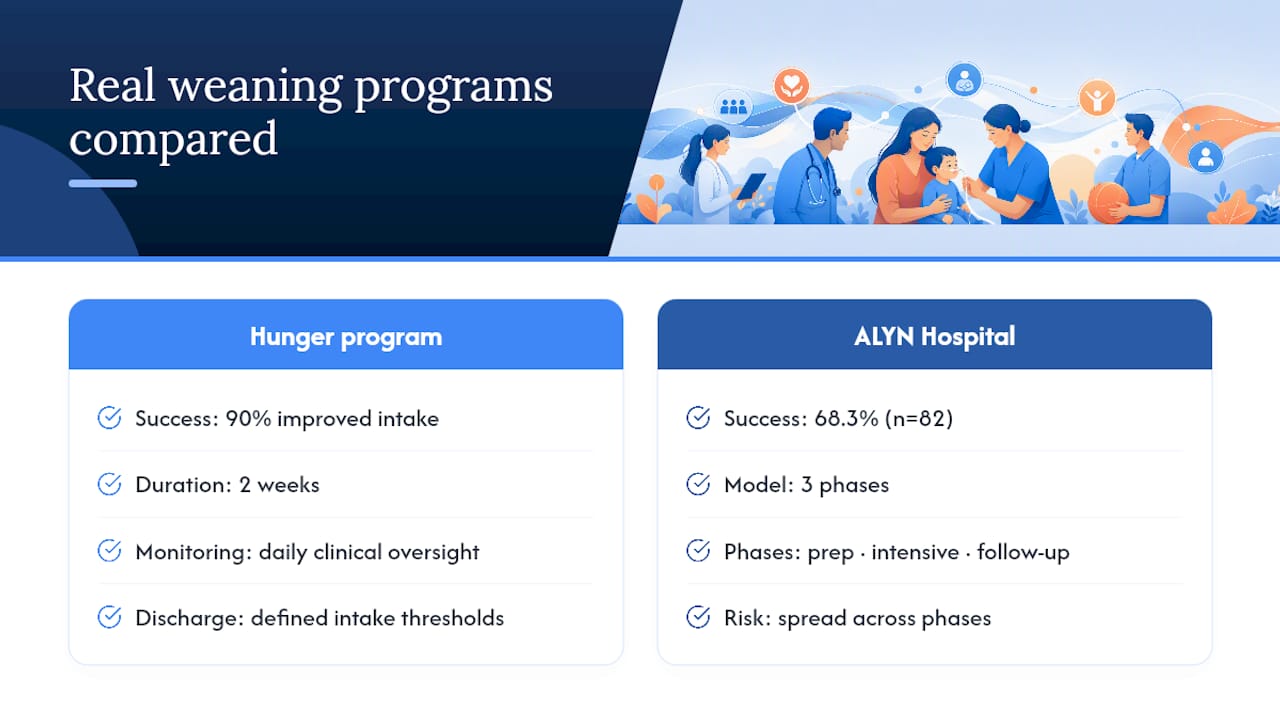
What both programs share matters more than their differences: clear entry criteria, daily data tracking, defined stop points, and dedicated follow-up. Families adapting either model at home, with clinical supervision, should borrow that structure rather than trying to invent one from scratch. A written plan with checkpoints beats an informal "let's just see how it goes" approach every time.
A Realistic Note From Jamie
Patience matters more here than any specific method. Parents often arrive expecting a clean, linear countdown to tube-free, and the reality is messier. Progress often looks like two steps forward, one step back, especially in the first few weeks of any trial.
One habit worth adopting early: build a five-minute, pressure-free sensory ritual before each meal. Something as simple as letting your child touch, smell, or play with the food before any expectation of eating it. This small routine helps decouple food from anxiety long before volume becomes the goal.
Overwhelm is common, and it's not a sign you're doing this wrong. If you find yourself dreading mealtimes or losing sleep over a data point, that's the moment to lean harder on your team rather than push through solo. A good multidisciplinary team expects to carry some of that weight with you.
— Jamie
Ready to Start? How to Take the Next Step With Thriving Joy
If you're ready to move from research to action, Thrivingjoy's feeding therapy services are built specifically for families navigating exactly this transition, without the wait times or generalized approach you'd find at a larger, less specialized practice. Because effective therapy focuses on root causes rather than one-size-fits-all protocols, plans are built around each child's specific sensory patterns and swallowing needs from the very first visit.
Before your intake appointment, gather a few things that speed up planning: recent growth and weight records, a current feeding log showing tube volumes and any oral attempts, and notes from your pediatrician or gastroenterologist on medical clearance. If breastfeeding or bottle feeding is part of your child's transition, lactation counseling can run alongside feeding therapy to support that piece too.
The next step is simple: reach out through the feeding therapy page to schedule an intake and start building a coordinated plan with your child's broader medical team.
This article is general information, not a substitute for advice from a qualified doctor. Consult a qualified healthcare professional about your own circumstances before acting on anything here.
Sources
- Pediatric Tube Weaning: A Meta-Analysis of Factors Contributing to Success
- An Economic Analysis of Intensive Multidisciplinary Interventions for Treating Medicaid-Insured Children with Pediatric Feeding Disorders
- Weaning children from prolonged enteral nutrition: A position paper