
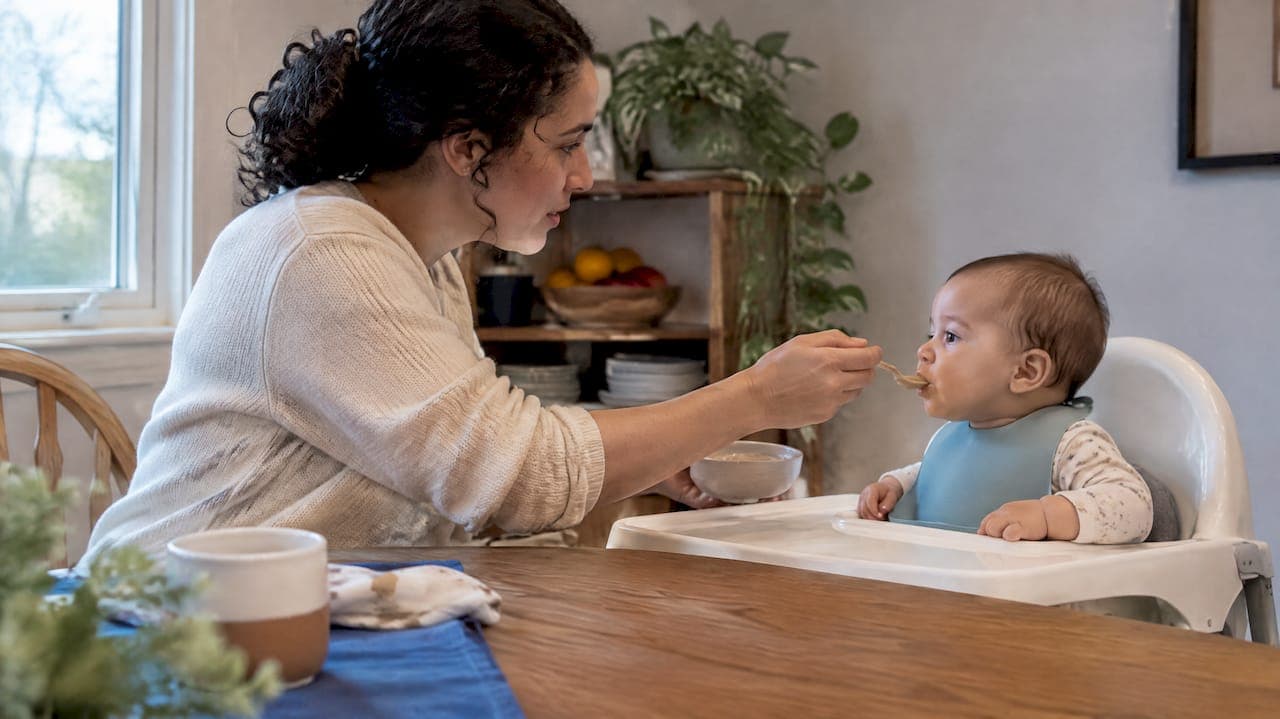
For most babies, the best time to introduce common allergens like peanut and egg is around 6 months, once your baby is ready for solids and not before 4 months. Offer one new allergen at a time, in a small, age-appropriate form, and keep it in the diet regularly. Current allergy consensus guidance no longer recommends routine allergy testing before you begin, even for many higher-risk babies.
If you feel nervous, you are in good company. Almost every parent we talk with at Thriving Joy has the same worry: what if my baby reacts? The reassuring news is that a calm plan makes this step far more manageable, and that early introduction is one of the most effective things families can do.
TL;DR
- Start allergens around 6 months, when your baby shows readiness signs, and not before 4 months.
- Introduce one new allergen at a time, in a small amount, then keep it in the diet a couple of times a week.
- Routine allergy screening before introduction is no longer the standard of care. Babies with severe eczema or an existing egg allergy should have a plan made with their pediatrician first.
- Never give whole peanuts or other choking hazards. Use thinned purees, soft textures and properly prepared forms.
- Know the difference between a mild skin irritation and a true reaction, and know who to call.
Table of Contents
- Why early introduction matters
- Is your baby ready for solids?
- Which foods count as common allergens?
- A simple allergen introduction schedule
- Choosing safe forms and textures
- Babies with eczema or an existing egg allergy
- Do you need allergy testing first?
- What a reaction looks like, and what to do
- Our perspective at Thriving Joy
- When extra support helps
- A quick checklist before the first try
- FAQ
- Sources
Why early introduction matters
For many years, parents were told to hold back the foods most likely to cause allergies. The research has moved a long way from that advice. In a large follow-up study, NIAID reported that feeding children peanut products regularly from infancy to age 5 reduced peanut allergy in adolescence by 71%, even when the children ate or avoided peanut as they chose in later years. Earlier results from the same research showed an 81% reduction at age 5.
That second finding eases a common worry. Many parents assume that once they introduce a food, they must serve it every single day for life. Consistency in infancy and early childhood matters most, and the protective effect appears to be more forgiving as children grow. You do not need a perfect streak.
The goal, as allergy specialists describe it, is to build a varied diet as early as your baby is developmentally ready, rather than steering around allergens out of fear. Waiting longer than necessary does not protect your baby, and it can mean missing the window that offers the most benefit.

Is your baby ready for solids?
Allergen timing starts with readiness for solid food in general. The recommended window is usually around 6 months and not before 4 months. Within that window, your baby's skills matter more than the calendar.
We look for a few things:
- Sitting with good support and holding their head steady
- Showing interest in food, such as watching you eat or reaching for your plate
- Opening their mouth when food approaches
- Moving food to the back of the mouth rather than pushing everything out with the tongue
If you want a closer look at readiness, our guide to the three signs to check before starting solids walks through each one. And if you are curious how the first bites should look, see our skill-first approach to the 6-month transition.
A baby who is not yet ready to handle food safely is not ready for allergen introduction either, since gagging and choking risks go up when the oral skills are not there. It is fine to wait a couple of weeks and try again.
Which foods count as common allergens?
The foods most often involved in childhood food allergy include milk, egg, wheat, soy, sesame, tree nuts, peanut, fish and shellfish. You do not need to introduce them all at once, and you do not need to rush through the list. Most families focus first on peanut and egg, since those have the strongest evidence behind early introduction, and then add the others over the following weeks and months.
A gentle starting point, as HealthyChildren.org suggests, is to begin solids with a few low-risk foods such as infant cereal or puréed fruit, then move to allergens once your baby is comfortably eating. That gives your baby practice with spoon, swallow and texture before you add the foods that make you nervous.
A simple allergen introduction schedule
There is no single mandated calendar, so think of this as a framework you can adapt with your pediatrician. It follows the principles in the guidance we cite: one new allergen at a time, small first amounts, then regular repeats.
| Week | What to offer | How to offer it |
|---|---|---|
| 1 | A few low-risk first foods (cereal, fruit, vegetables) | Build comfort with the spoon and swallowing |
| 2 | Peanut | Thinned smooth peanut butter or peanut powder mixed into a puree, never whole nuts |
| 3 | Egg | Well-cooked egg, mashed or mixed into a puree |
| 4 | Dairy | Plain yogurt or cheese, in small portions |
| 5 | Wheat or soy | Infant cereal containing wheat, or a small portion of soft tofu |
| 6 | Sesame | Thinned tahini stirred into a puree |
| 7 and on | Tree nuts, fish, shellfish | Smooth nut butters thinned out, well-cooked flaked fish, finely prepared shellfish |
Two notes on the table. First, the order is flexible. If egg suits your household better than peanut, start there. Second, if your baby is on the early or late edge of the readiness window, shift everything accordingly.
One at a time, in small amounts
The practical advice from health agencies is to introduce these foods one at a time and in very small amounts so you can spot any reaction. If something happens, you will know which food was responsible. There is no longer a strict clinical rule to wait several days between each new food, but offering them one at a time remains a low-stress way to keep track.
Pediatric health guidance from New South Wales suggests starting with about a quarter teaspoon, increasing gradually as your baby tolerates it, and keeping the food in the regular diet at least twice a week once it has been introduced.

Keep it in the rotation
After a successful first try, the work is making the food a normal part of your baby's week. A spoonful of thinned peanut butter in oatmeal on Tuesday and Saturday is plenty for many families. If a food drops out of the menu for weeks, do not panic. Offer it again in a small amount and carry on, and ask your pediatrician if you have questions about the gap.
Choosing safe forms and textures
Safety has two sides here: allergic reactions and choking. Both deserve attention.
The NIAID parent summary of peanut allergy prevention guidelines states that infants and small children should never be given whole peanuts because of the choking risk. It also advises introducing other solid foods before trying peanut-containing foods.
In practice that means:
- Peanut: thin smooth peanut butter with warm water, breast milk or formula until it is runny, or stir peanut powder into a puree. Do not serve a spoonful of thick peanut butter straight from the jar.
- Egg: cook it thoroughly and mash it, or mix into a puree.
- Tree nuts and seeds: use smooth, thinned butters or finely ground forms.
- Fish and shellfish: cook well, remove bones and flake or mash finely.
If you are interested in baby-led approaches, our article on starting solids at 6 months with baby-led weaning explains how to adapt textures safely.
Breast milk and formula still carry most of your baby's nutrition at this age. If you are combining the two, this practical guide on how to start mixed feeding with confidence can help you plan the daily rhythm around new foods.
Babies with eczema or an existing egg allergy
Some babies have a higher chance of developing peanut allergy, especially those with severe eczema, an existing egg allergy, or both. For these babies, the guidance is to introduce peanut earlier, as early as 4 to 6 months, and to talk with your pediatrician before you start. Health-claim guidance quoted by Google's top results and the AAAAI consensus statement both stress that these babies are not meant to be left out of early introduction.
This is the point where a call to your pediatrician or a pediatric allergist makes sense. They can tell you whether your baby's eczema counts as severe, whether any testing is appropriate in your baby's case, and whether the first dose should happen in the office. If your baby has already had a reaction to a food, has a diagnosed food allergy, or has very severe eczema, do not start at home until you have that conversation.
One caution that surprises many parents: do not rub or dab food on your baby's skin as a "test." According to guidance from Anaphylaxis UK, food on broken or inflamed skin can increase the risk of sensitization instead of revealing an allergy. Always offer the food by mouth.
That same flyer recommends, for UK babies with eczema, introducing peanut and egg from 17 weeks once the baby is ready for food. U.S. guidance uses a window of 4 to 6 months, so follow your pediatrician's advice for your own baby.
Do you need allergy testing first?
For most families the answer is no. The AAAAI says the standard of care now is not to screen before peanut introduction. Some parents still ask for testing because it brings peace of mind, and that is a reasonable conversation to have with a doctor.
There is a good reason for the shift. Pediatric allergist Dr. Jacqueline Pongracic has explained that allergy tests are sensitive but not very specific, which means they produce many false positives. In a 2021 AAAAI discussion of food allergy prevention, that is why routine screening is discouraged: a positive result for a food your baby may tolerate can lead to unnecessary avoidance and a narrower diet.
What a reaction looks like, and what to do
Knowing what to look for makes you far calmer at the table. Stay with your baby during and after the meal, and offer new foods when you can watch closely, not just before a nap or a car ride.
Mild and common
Redness around the mouth right after eating is often skin irritation from acidic foods or textures rather than an allergy. Pediatric health guidance notes that this is common and not necessarily a systemic reaction. If you are unsure, pause, watch your baby, and call your pediatrician.
When to get help right away
Signs that need urgent medical attention include repeated vomiting, widespread hives, swelling of the lips, face or tongue, a cough or wheeze, difficulty breathing, unusual paleness or floppiness, or sudden sleepiness. Call 911 for trouble breathing, swelling of the face or tongue, or a baby who becomes limp or unresponsive. For anything that is not an emergency but worries you, call your pediatrician the same day and avoid giving that food again until you have spoken.
Feeding trouble that is not an allergy
Sometimes a baby who gags, refuses, coughs or struggles with new foods is dealing with a feeding skill issue, not an allergy. If mealtimes have been hard for two weeks or more, read what to do next about infant feeding difficulties and our list of feeding red flags.
Our perspective at Thriving Joy
We work with families every day who are anxious about food, and we see how much that anxiety shapes the early months of feeding. Some parents delay solids long past readiness because the allergy question feels too big. Others rush in because they are afraid of waiting. Both are understandable, and both are easier to resolve with a plan.
Our approach is holistic and family-centered. We look at the whole picture: your baby's oral skills, how they sit, how they handle textures, how mealtimes feel for you, and what is going on with reflux, eczema or nursing. Introducing allergens works best when your baby can move food safely in the mouth and when you feel steady enough to offer it. That is why we pair the medical guidance with practical coaching on pacing, positioning and texture.
We also meet families where they are. Therapy can take place in our office, at home, or in daycare and preschool settings, so you can practice with real meals in the place your child eats.
One more thing we say often: a nervous first try is a normal first try. You are not doing it wrong. Take it a spoonful at a time, and ask for help when something feels off.
— Thriving Joy
When extra support helps
Most babies move through allergen introduction without trouble. But a few signs suggest it is worth having a feeding specialist in your corner alongside your pediatrician:
- Your baby gags, coughs or chokes often on purées or soft solids
- Your baby refuses most textures or spits out nearly everything
- You are avoiding foods because of fear, and the diet is getting narrow
- Your baby is breastfed and you suspect a reaction through your milk (see our article on testing for maternal dairy allergy without weaning)
- Your family has a history of picky eating or feeding challenges that you want to get ahead of
At Thriving Joy, we offer feeding therapy for infants and children, lactation counseling for nursing parents, and Starting Solids 101 and other parent classes if you would like guided practice before the big day. We serve families in Pasco and Hillsborough Counties, and we accept private pay, major health insurance plans and scholarships. Your pediatrician stays in charge of medical decisions about allergy, and we support the feeding side.
A quick checklist before the first try
- Confirm your baby is ready for solids and is at least 4 months old, ideally around 6 months.
- Check with your pediatrician if your baby has severe eczema, an egg allergy, or a prior reaction.
- Choose a morning or early afternoon meal when you can watch for a few hours.
- Offer a safe form: thinned, smooth, cooked or finely prepared.
- Begin with a small amount and let your baby set the pace.
- Keep the food in the diet regularly if all goes well.
- Know your emergency plan and keep your phone nearby.
FAQ
Can I introduce more than one allergen on the same day?
It is easier to offer one new allergen at a time, so that you can tell which food caused a problem if a reaction happens. There is no strict rule to wait several days between new foods. Many families add a new allergen every few days or once a week, depending on comfort.
What if my baby has a mild rash around the mouth?
Redness right around the mouth is often skin irritation from acidic foods or textures, not an allergy. Wipe the area, watch your baby, and pause new foods if you are unsure. Call your pediatrician if the rash spreads, if hives appear, or if your baby seems unwell.
Do I need to keep serving the allergen every day?
You do not need a rigid daily routine. Once a food has been introduced, offering it regularly, around twice a week, is a practical goal. Research on peanut suggests that protection lasted into adolescence even when later eating habits varied.
Should my baby be tested for allergies first?
Usually not. Current consensus guidance says screening before introduction is not the standard of care, since tests often produce false positives. If your baby has severe eczema, a known egg allergy or a prior reaction, talk with your pediatrician or allergist about the safest way to begin.
My baby is 5 months old. Can we start now?
The window opens at 4 months, but readiness is what matters most. If your baby sits with support, holds their head steady and shows interest in food, ask your pediatrician about starting. If not, waiting until closer to 6 months is perfectly fine.
Sources
- Allergy testing prior to peanut introduction in children (AAAAI, 2024)
- Prevention of food allergy (AAAAI, 2021)
- Introducing Peanut in Infancy Prevents Peanut Allergy into Adolescence (NIAID)
- Peanut allergy prevention guidelines: summary for parents and caregivers (NIAID)
- When to Introduce Egg, Peanut Butter and Other Common Food Allergens (HealthyChildren.org)
- Introducing allergens (Sydney Children's Hospitals Network)
- How to introduce solid foods to babies for allergy prevention (ASCIA)
- Baby food allergies (NHS)
- Preventing Food Allergies in Babies: A Practical Guide for Parents (Anaphylaxis UK)