
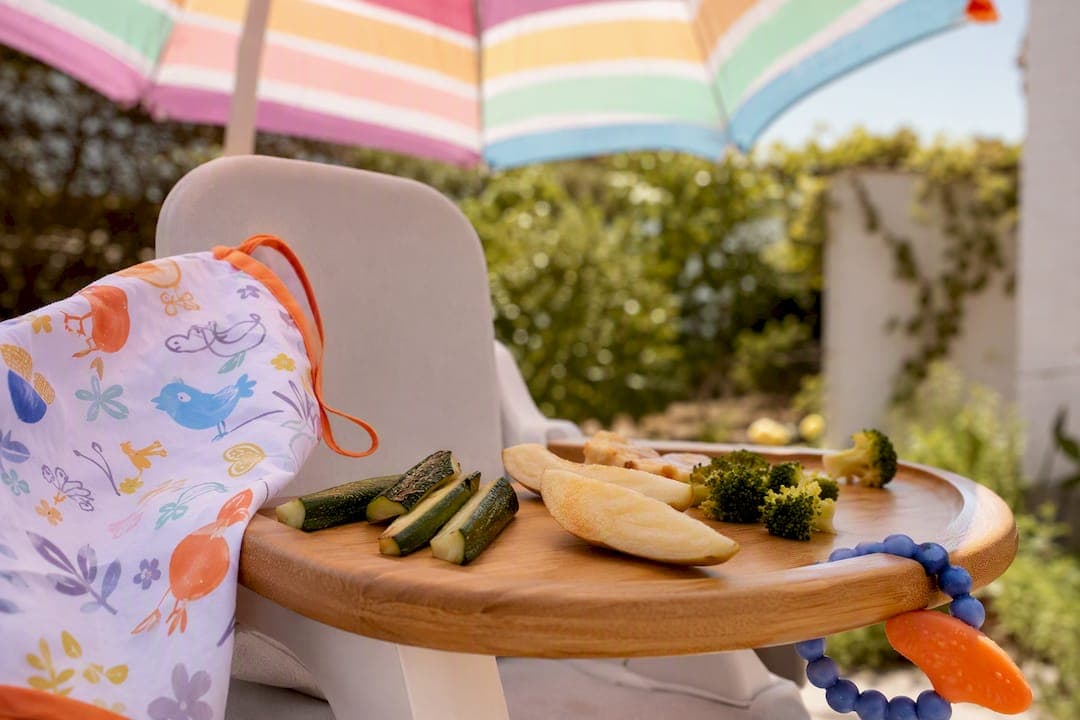
Baby-led weaning means skipping purees and letting your baby self-feed soft, appropriately shaped finger foods from the start of solids. It's a safe approach once your baby shows real readiness signs, typically around 6 months, and you know how to prepare food properly and supervise every bite. If your baby was born early or has health concerns, check with your pediatrician before you begin.
TL;DR:
- Proper food preparation and vigilant supervision are essential for safe baby-led weaning, especially when offering choking hazards like grapes or raw vegetables.
- Indicators of readiness include sitting upright, showing interest in food, and losing the tongue-thrust reflex, with adjustments needed for preterm or medically vulnerable infants.
- Offering a variety of soft, iron-rich, energy-dense, and fruit or vegetable foods in stick shapes supports nutritional needs and self-feeding development.
- Research shows no increased choking risk when caregivers follow age-appropriate food prep and safety guidelines, emphasizing the need for deliberate food choices.
- Combining baby-led weaning with purees remains a flexible approach, with continued responsiveness to cues and avoidance of high-risk foods necessary for safety.
Table of Contents
- What Is Baby-Led Weaning, and How Does It Compare to Purees?
- What Are the Signs Your Baby Is Ready for Solids?
- How Do You Start Baby-Led Weaning?
- What First Foods Work Best for Baby-Led Weaning?
- Is Baby-Led Weaning Safe? What Does the Research Say About Choking?
- How Do You Introduce Allergens Safely With BLW?
- Can You Combine Baby-Led Weaning With Purees?
- When Should You Get Professional Feeding Help?
- A Clinician's Honest Take on the Mess and the Worry
- How Thriving Joy Supports Families Starting Solids
- Where to Learn More About Baby-Led Weaning
- Sources
What Is Baby-Led Weaning, and How Does It Compare to Purees?
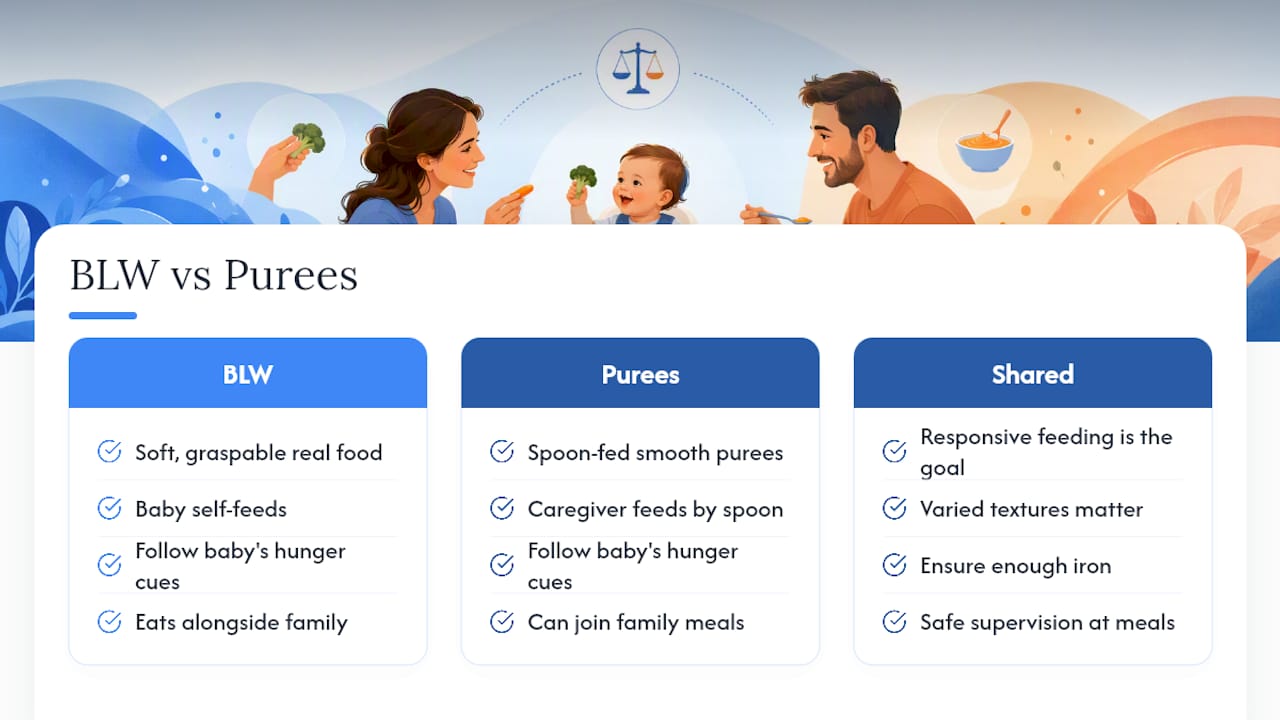
"Weaning" trips a lot of parents up. In this context, it doesn't mean stopping breast milk or formula. It means the gradual shift to complementary foods, the solids that join milk in your baby's diet starting around 6 months. Baby-led weaning (BLW) is one path to get there. Instead of spoon-feeding smooth purees, you offer soft, graspable pieces of real food and let your baby pick them up, explore them, and feed themselves at their own pace.
Three ideas sit at the center of BLW. Your baby self-feeds rather than being fed. You follow their cues on hunger and fullness instead of pushing "one more bite." And meals happen alongside the family table, so your baby sees you eating the same textures and flavors they're learning to manage.

Traditional spoon-feeding with purees isn't the opposite of good feeding. It's simply a different delivery method, and plenty of babies thrive on it. The honest comparison isn't BLW versus purees as rival philosophies. It's responsive feeding as the real goal, meaning you watch your baby's signals and adjust, no matter which method delivers the food. Clinical overviews consistently point out that no formal North American guideline explicitly endorses one method over the other. What matters more than the label is whether your baby is getting varied textures, enough iron, and safe supervision at every meal. Many families land somewhere in between, and that's a legitimate choice, not a compromise.
What Are the Signs Your Baby Is Ready for Solids?
Readiness isn't about hitting a date on the calendar. It's about your baby's body and behavior lining up together. The CDC notes that most babies show these signs around 6 months, though the exact timing varies.
Look for:
- Sitting upright with only minimal support, rather than slumping or needing to be propped
- Steady head and neck control, holding their head level without wobbling
- Reaching for food, grabbing at your plate, or opening their mouth when they see you eat
- Genuine interest in food, leaning toward it or watching intently during your meals
- Loss of the tongue-thrust reflex, so food doesn't get automatically pushed back out
If your baby was born prematurely, use their corrected age (based on due date, not birth date) rather than chronological age when judging these signs. A baby born eight weeks early isn't developmentally 6 months old at the calendar's 6-month mark; they're closer to 4 months. When in doubt, or if your baby has a medical condition affecting muscle tone or development, ask your pediatrician before starting solids. That conversation costs you nothing and can save real worry later.
How Do You Start Baby-Led Weaning?
The first few meals set the tone, and a little preparation up front makes them far less stressful.
- Set up the seat. Use a stable highchair with a footrest if possible, and buckle your baby in upright, hips at roughly 90 degrees. A slumped posture makes swallowing harder and increases risk.
- Clear the space. Remove bibs with loose strings, choking hazards on nearby surfaces, and anything that isn't the meal itself.
- Stay within arm's reach. Never leave your baby alone with food, even for a few seconds. This is non-negotiable at every meal, every time.
- Offer three food types. Put one iron-rich food, one energy-dense food, and one fruit or vegetable on the tray. Variety from day one builds a broader palate faster than you'd expect.
- Cut for the grasp, not the mouth. Offer stick-shaped pieces about the length of an adult pinky finger so your baby can hold them in a fist before they develop a pincer grasp, usually a few months later.
- Eat together. Sit down and eat your own food at the same time. Babies learn chewing patterns partly by watching, and family meals make the whole process feel normal rather than clinical.
- Let them explore, don't rush intake. Expect squishing, dropping, and licking more than swallowing for the first several weeks. Milk still provides most of your baby's nutrition at this stage.
Before you plate anything, run the mash test: press the food between your thumb and forefinger. If it squashes easily without resistance, it's soft enough. If it doesn't, steam it longer, mash it, or skip it for now.
Pro Tip: Keep a small notebook or phone note of what you've offered and how your baby reacted. It sounds tedious for two weeks, but it becomes an easy reference for allergen tracking and for spotting real patterns versus one bad day.
What First Foods Work Best for Baby-Led Weaning?
Iron stores that babies are born with start to drop around 6 months, right when solids begin, so iron-rich foods deserve a spot at nearly every meal, not just an occasional appearance.
Reliable first foods, with prep notes:
- Steamed vegetable florets (broccoli, carrot, sweet potato) cooked until they mash easily, cut into stick shapes
- Avocado spears, ripe enough to hold gently without slipping, no cutting needed
- Banana strips, left slightly underripe so they don't turn to mush in tiny hands
- Shredded or shredded-then-slow-cooked chicken, moist enough to gum without drying out
- Scrambled egg, cooked soft, cut into strips your baby can grip
- Soft tofu strips, easy to gum and naturally soft enough for early meals
- Well-cooked, mashed beans or lentils, either loose on the tray or preloaded on a spoon
- Toast strips with a thin layer of nut butter spread flat, not gobbed
The simplest way to build a balanced plate: one iron-rich food, one energy-dense food (avocado, full-fat yogurt, tofu), and one fruit or vegetable. If your baby isn't taking in much of the iron-rich item yet, a preloaded spoon with iron-fortified infant cereal or mashed lentils works as a bridge while their self-feeding skills catch up.
Is Baby-Led Weaning Safe? What Does the Research Say About Choking?
Gagging looks alarming and sounds worse, but it's your baby's built-in safety mechanism, not a sign of danger. It happens further forward in the mouth than choking, usually comes with coughing, retching, or a red face, and resolves on its own within seconds. Choking is different: it's often silent, can involve a blocked airway, blue-tinged lips, and requires immediate action. Every caregiver introducing solids, whichever method you use, should take an infant CPR and choking first-aid course before starting.
What the research actually shows: A 2024 systematic review found no statistically significant difference in choking risk between baby-led weaning and traditional spoon-feeding when caregivers followed age-appropriate food prep. The BLISS trial, one of the most cited studies on this approach, found no higher choking rates for BLW babies compared to spoon-fed babies, but only when the protocol explicitly coached parents on offering high-iron foods and avoiding known choking hazards.
That detail about BLISS matters. The trial's safety record wasn't automatic; it came from deliberate food-prep coaching built into the study design. Translate that into your kitchen with these rules:
- Avoid whole grapes, nuts, popcorn, hot dogs, and hard raw vegetables in their unmodified form
- Cut round foods like grapes and cherry tomatoes lengthwise, not into small round coins
- Skip foods that stay firm no matter how you cut them, like raw apple slices
- Run the mash test before serving anything new
Done this way, BLW isn't inherently riskier. It's a method that demands the same vigilance spoon-feeding does, just applied to different food shapes.
How Do You Introduce Allergens Safely With BLW?
Delaying allergenic foods used to be common advice. Current guidance flips that: early, regular exposure in safe formats is now the recommended approach, per clinical overviews on infant feeding.
- Offer peanut butter thinned with water or breast milk and spread thinly, never a spoonful straight from the jar
- Serve fully cooked egg, scrambled or hard-boiled and mashed, rather than raw or undercooked
- Include plain whole-milk yogurt as an easy, low-risk dairy introduction
- Introduce one new allergen at a time and watch for reactions over the next 3 to 5 days before adding another
- Once a food is tolerated, keep it in regular rotation rather than a one-time trial
If your family has a strong history of anaphylaxis or severe food allergy, talk to your pediatrician about an allergy referral before introducing high-risk foods at home. That's a case where professional guidance beats guesswork every time.
Can You Combine Baby-Led Weaning With Purees?
Plenty of families do, and it works fine. This isn't an all-or-nothing decision.
- Alternate: offer purees at breakfast, finger foods at dinner
- Preload a spoon with puree or mashed food and let your baby bring it to their own mouth, keeping the self-feeding element intact
- Spoon-feed iron-rich purees (like meat or lentil purees) while offering a finger-food version of the same ingredient for exploration
- Lean on purees more when intake is low, when a medical issue calls for closer tracking, or simply when it fits your schedule better that day
Whichever mix you land on, keep responsive feeding as the constant. Watch for hunger and fullness cues, and don't push extra bites once your baby turns away or closes their mouth.
When Should You Get Professional Feeding Help?
Most babies figure out solids with time, mess, and repetition. Some don't, and that's worth taking seriously rather than waiting out.
- Poor or stalled weight gain over several weeks
- Persistent coughing, gagging, or watery eyes during most meals, not just occasional new-food reactions
- Refusal of nearly all textures past the early adjustment period
- Signs of aspiration, like a wet or gurgly voice after swallowing
A pediatric feeding therapist assesses oral-motor skills (how your baby chews, moves food, and coordinates swallowing), evaluates mealtime routines, and coaches parents through specific strategies rather than generic tips. Lactation counselors fill a similar role earlier on, when breastfeeding or bottle-feeding challenges complicate the transition to solids. If you're noticing red flags, start by writing down what you're seeing, mention it to your pediatrician, and ask whether a feeding evaluation makes sense.
Pro Tip: Bring a two-week log of meals, reactions, and growth measurements to that pediatrician visit. Specific data gets you a faster, more useful referral than "my baby doesn't seem to be eating much."
A Clinician's Honest Take on the Mess and the Worry
The floor covered in mashed sweet potato isn't a failure. It's exploration doing exactly what it's supposed to do. Most of the anxiety around baby-led weaning comes from expecting neat progress when the real thing looks chaotic for months. Mixing methods, backing off when a food scares you, asking for help sooner rather than later: none of that means you're doing it wrong. It means you're paying attention.
— Jamie
How Thriving Joy Supports Families Starting Solids
Reading about readiness signs and food shapes only gets you so far when your baby is gagging more than swallowing, refusing every texture, or not gaining weight the way you'd expect. That's where an individualized evaluation changes the picture. Thrivingjoy's pediatric feeding therapy looks at your baby's specific oral-motor skills, mealtime patterns, and growth trajectory instead of applying a generic checklist.
If breastfeeding or bottle-feeding challenges are tangled up with the move to solids, lactation counseling addresses that piece directly, often before it complicates the whole feeding relationship. Consider booking an evaluation if you're seeing persistent choking, coughing, weight concerns, or near-total food refusal past the early adjustment weeks, or if you simply want a professional to confirm you're on the right track. Visit Thrivingjoy's feeding therapy page to see how an assessment works and schedule a first appointment for your family in the Tampa area.
Where to Learn More About Baby-Led Weaning
For deeper reading, the CDC's solid food introduction guidance, the BLISS study summary, and EatRight's BLW overview cover the clinical detail behind this guide. For meal ideas that adapt easily to family cooking, Burrito Splendido's guide to kid-friendly burritos offers practical, baby-friendly modifications worth trying.
This article is general information, not a substitute for advice from a qualified doctor. Consult a qualified healthcare professional about your own circumstances before acting on anything here.
Sources
- CDC — When, What, and How to Introduce Solid Foods
- Systematic review (2024) on complementary feeding approaches and choking risk
- Practical tips for paediatricians: Baby-led weaning (BLISS study summary) — PMC
- EatRight — Baby-Led Weaning: What it is, whether it's safe and how to start