

True cow's milk allergy affects roughly 0.5% of exclusively breastfed infants, so dairy in your diet is rarely the cause of your baby's symptoms, and breastfeeding should almost always continue. If your baby shows sudden swelling, hives, or breathing trouble, seek emergency care now. Otherwise, track symptoms for a few days and call your pediatrician before starting any elimination, since a supervised 2 to 4 week dairy free trial with calcium and vitamin D support is the safer next step than guessing on your own.
TL;DR:
- Cow's milk allergy is rare in exclusive breastfeeding infants, affecting about 0.5%, and typically not caused by breast milk itself but trace dairy proteins passed through milk.
- Immediate reactions such as hives, swelling, or breathing difficulties require emergency care, while delayed symptoms include mucus stools, eczema, and fussiness that follow a consistent pattern.
- Diagnosis relies on a detailed symptom history, symptom diaries, and reintroduction tests, with no single blood test confirming the allergy, especially for non-IgE reactions.
- An elimination diet should be targeted and lasts 2 to 4 weeks, focusing on dairy avoidance without stopping breastfeeding, supported by calcium and vitamin D supplementation to maintain nutrition.
- If symptoms don't improve after elimination, or in cases of severe reactions, further assessment by specialists and reintroduction under medical supervision are necessary to confirm or rule out cow's milk allergy.
Table of Contents
- Signs and Symptoms of Dairy Allergy in Breastfed Babies
- How Do Doctors Diagnose Cow's Milk Allergy in a Breastfed Baby?
- When Should You Try a Maternal Elimination Diet?
- How to Safely Reintroduce Dairy to Confirm the Diagnosis
- Red Flags That Need Urgent Medical Attention
- Can You Keep Breastfeeding Through a Dairy Allergy Diagnosis?
- Label-Reading and Nutrition Tips for a Dairy-Free Breastfeeding Diet
- Growth and Development: Does Dairy Allergy Affect Your Baby's Progress?
- What If Eliminating Dairy Doesn't Fix Your Baby's Symptoms?
- Coping Emotionally With Dietary Restrictions While Breastfeeding
- Could Other Foods in Your Diet Cross-React With Dairy?
- Long-Term Outlook for Babies With Dairy Allergy
- Jamie's Take: Why Breastfeeding-First Thinking Matters Here
- How Thriving Joy Supports Families Through a Dairy Elimination Trial
- Sources
Signs and Symptoms of Dairy Allergy in Breastfed Babies
Cow's milk protein allergy shows up in two very different ways, and knowing which pattern you're watching for changes everything about how urgently you act. Immunoglobulin E, or IgE-mediated reactions, happen fast, often within minutes to two hours of a feed. Non-IgE reactions build slowly, sometimes over days, and are far more common in breastfed infants with suspected cow's milk protein allergy, or CMPA.
Immediate (IgE-mediated) signs tend to be dramatic and hard to miss:
- Hives or a raised, blotchy rash appearing within minutes to two hours
- Swelling of the lips, face, or eyelids
- Sudden vomiting shortly after a feed
- Wheezing, coughing, or audible difficulty breathing
- In rare severe cases, anaphylaxis, which is a medical emergency
Delayed (non-IgE-mediated) signs develop more gradually and are easier to mistake for normal infant fussiness:
- Bloody or mucus-streaked stools without other illness
- Chronic diarrhea or unusually loose stools lasting more than a week
- Persistent eczema that doesn't respond well to standard skin care
- Excessive crying, gas, or apparent stomach pain during or after feeds
- Poor weight gain or falling off the growth curve
Here's the part most parents don't hear enough: garden-variety spit-up, occasional gassiness, and evening fussiness are extremely common in healthy babies and usually have nothing to do with what you ate. What actually raises suspicion for a true allergy is a pattern that repeats. If your baby reliably gets worse a day or two after you eat dairy and calms down when you cut it out, that reproducibility is the strongest clue you have, well before any lab test.
Context matters here too. Cow's milk allergy is about 0.5% during exclusive breastfeeding, rising closer to 2% within the first year of life, largely because formula introduction and mixed feeding raise exposure. That's a meaningfully lower rate than what's seen in exclusively formula-fed infants, which is one reason pediatric feeding and lactation programs push back gently when parents assume breast milk itself is the problem. It almost never is. Trace amounts of dairy protein your body passes into milk are the trigger in true CMPA, not the breast milk itself.
How Do Doctors Diagnose Cow's Milk Allergy in a Breastfed Baby?
There's no single blood test that confirms or rules out cow's milk protein allergy in a breastfed infant, and that surprises a lot of parents who expect a quick lab answer. Diagnosis is a process, not a single appointment, and it usually unfolds in this order.
- A detailed history first. Your pediatrician will ask what you're eating, when symptoms appear relative to feeds, whether the pattern repeats, and whether anyone in the family has eczema, asthma, or food allergies. They're listening for reproducibility. A one-time rash after a chaotic day tells them less than three separate episodes that all followed a dairy-heavy dinner.
- Skin-prick or serum-specific IgE testing, when appropriate. These tests are genuinely useful for immediate, IgE-mediated reactions like hives or swelling, but they have real limits. A positive result shows sensitization, not necessarily a clinical allergy, and a negative result doesn't rule out non-IgE disease at all. Testing is often skipped entirely for delayed-type symptoms because it simply won't give a useful answer.
- A symptom diary. Before or alongside any dietary change, writing down the date and time of your dairy intake alongside your baby's feeds, stool patterns, skin changes, and fussiness gives your clinician something concrete to evaluate. This is one of the most practical tools available, and it costs nothing.
- A maternal elimination trial, if history and symptom pattern support it. This is covered in detail below.
- Reintroduction, or an oral food challenge. This is the actual gold standard for confirming the diagnosis. If symptoms improve on elimination and then return on reintroduction, that's a real answer. If nothing changes either way, cow's milk protein allergy is unlikely to be the cause.
For non-IgE presentations especially, allergists often lean less on testing and more on this observed cause-and-effect pattern over time. That can feel unsatisfying if you're hoping for a definitive lab result, but it's actually the more reliable method for this particular condition. If your pediatrician suspects a genuinely complex picture, or if there's any history of severe reaction, referral to a pediatric allergist for a supervised oral food challenge is the appropriate next step rather than continued guessing at home.
When Should You Try a Maternal Elimination Diet?
An elimination trial isn't a first-line response to every fussy evening. It's a targeted tool used when symptoms are persistent, multisystem (affecting skin, gut, and behavior together), or severe enough that watching and waiting isn't reasonable, especially with eczema that won't clear or a baby who seems unwell on breast milk alone. Clinical guidelines generally recommend reserving elimination for infants whose history and symptom pattern genuinely support cow's milk protein allergy, not for routine fussiness or reflux.
Single food or broader elimination?
Most clinicians start with cow's milk alone rather than a broad exclusion of multiple foods at once. It's easier to sustain, easier to interpret, and avoids unnecessary nutritional restriction. A broader elimination, sometimes including soy, is occasionally used when history strongly suggests multiple triggers, but it carries more nutritional risk and should really only happen with dietitian guidance. Starting narrow and expanding only if needed protects both your nutrition and your sanity.
The step-by-step protocol
- Pick a start date and remove all cow's milk protein from your diet completely, not just "less dairy."
- Continue for 2 to 4 weeks. Guideline-aligned recommendations from the Breastfeeding Network and clinical reviews both point to this window as long enough to see a real effect without dragging out unnecessary restriction.
- Keep the symptom diary going the entire time. Note stool changes, skin condition, sleep, and fussiness daily.
- Read every label, every time, even on foods you've bought before. Manufacturers reformulate products more often than you'd think.
- Do not stop breastfeeding. The goal of this trial is to identify a trigger, not to replace breast milk.
Watch for these hidden dairy names on ingredient labels:
- Casein, caseinates, and sodium caseinate
- Whey and whey protein concentrate
- Lactalbumin
- Milk solids and milk protein isolate
- Butter flavor or milk by-products
Pro Tip: A "lactose-free" label only means the milk sugar has been removed. The milk protein that actually triggers CMPA is usually still there, so lactose-free dairy products are not safe substitutes during an elimination trial.
Protecting your own nutrition
Cutting dairy for a few weeks isn't nutritionally trivial when you're also breastfeeding. Clinical programs typically advise around 1,000 mg of calcium daily plus vitamin D during the elimination period, since dairy is most people's default source of both. Extended elimination without support raises the risk of increased bone turnover and inadequate energy or protein intake, which is exactly why a referral to a registered dietitian matters if the trial needs to run longer than a few weeks or expand beyond dairy alone. This isn't a step to skip, even if it feels like "just" a supplement conversation.
How to Safely Reintroduce Dairy to Confirm the Diagnosis
Skipping reintroduction is one of the most common mistakes in managing suspected cow's milk protein allergy, and it's an understandable one. If your baby improved during elimination, going back to dairy feels like undoing progress. But without reintroduction, you can't actually confirm the diagnosis, which means you could end up avoiding dairy indefinitely based on a coincidence rather than a real allergy.
- Choose a stable window. Reintroduce only when your baby is otherwise well. Skip it if they're sick or recently vaccinated, since either can muddy your read on symptoms.
- Build up gradually. A commonly used clinical schedule has you reintroducing dairy into your own diet starting with a small amount on day one and building to about three normal portions by day five, while continuing your symptom diary.
- Watch closely and compare. If symptoms return in the same pattern you saw before elimination, that's a strong confirmation of cow's milk protein allergy. If nothing changes, the allergy is unlikely, and you can return to your normal diet with real confidence rather than lingering doubt.
Home reintroduction is not appropriate for every family, though. If your baby had a prior severe or immediate reaction, including any signs of anaphylaxis, or if there's a history suggestive of severe FPIES (food protein-induced enterocolitis syndrome), reintroduction needs to happen under medical supervision as a formal oral food challenge, not at home on your own timeline. Your pediatrician or allergist can tell you which category your baby falls into, and that conversation is worth having before you start rather than after a scare.
Red Flags That Need Urgent Medical Attention
Most CMPA symptoms are uncomfortable but not dangerous, and that distinction matters when you're deciding whether to call 911 or just mention something at the next checkup.
Call emergency services immediately if your baby has:
- Sudden difficulty breathing, wheezing, or persistent coughing
- Swelling of the lips, tongue, or face
- Repeated, forceful vomiting right after a feed combined with lethargy or paleness
- Any combination of skin, breathing, and gut symptoms appearing together suddenly, which can signal anaphylaxis
Contact your pediatrician promptly (same day or next available) for:
- Bloody stools that persist beyond one or two episodes
- Signs of dehydration, such as noticeably fewer wet diapers or a sunken soft spot
- Weight gain that has stalled or a drop off the growth curve
- Severe, unrelenting eczema that isn't responding to usual skin care
Given that true CMPA affects only about 0.5% of exclusively breastfed babies, most of what you're seeing day to day is not an emergency. But if you're partway through a home reintroduction and any of the signs above appear, stop the reintroduction, note the timing, and call your pediatrician before continuing. Recognizing these feeding-related red flags early makes the whole diagnostic process faster and less stressful.
Can You Keep Breastfeeding Through a Dairy Allergy Diagnosis?
Yes, and in nearly every case, you should. Lactation professionals consistently prioritize keeping breastfeeding going, treating dietary elimination as a targeted tool rather than a reason to wean. An elimination trial changes what you eat. It doesn't have to change how or whether you feed your baby at yourself.
Protecting your milk supply during an elimination trial:
- Keep feeding on your baby's usual schedule; stress and dietary changes sometimes tempt parents to space out feeds, which can quietly reduce supply.
- If you're worried about supply dipping while you adjust your diet, a pump session or two can help you track output and reassure yourself.
- Reach out to a lactation counselor early rather than waiting until supply feels affected. Small adjustments are much easier to make proactively.
Feeding therapy fits into this picture too, though it addresses a different piece of the puzzle. If your baby has latch difficulties, seems uncoordinated during feeds, or if you're feeling anxious every time you nurse because of the symptom-watching, feeding therapy can help address the mechanics and the emotional loop together. It's not a substitute for medical diagnosis of CMPA, but it works alongside it, especially when feeding struggles and allergy concerns overlap.
In the small number of cases where breastfeeding truly isn't sustainable, or where a baby needs additional nutritional support, your pediatrician may discuss a specialized hypoallergenic formula. That decision belongs to your medical team based on your baby's specific presentation, not something to self-select from a store shelf. The goal throughout is the same: support breastfeeding wherever possible, and bring in formula only when there's a clear clinical reason to.
Label-Reading and Nutrition Tips for a Dairy-Free Breastfeeding Diet
Grocery shopping while eliminating dairy gets easier once you know exactly what you're scanning for. The tricky part isn't avoiding the obvious stuff like milk and cheese. It's catching dairy protein hiding in foods that don't look dairy at all, from crackers to deli meat to protein bars.
Ingredient names that mean dairy is present:
- Casein, caseinates, sodium caseinate
- Whey, whey protein concentrate, whey powder
- Lactalbumin and milk protein isolate
- Milk solids, nonfat milk solids, and "natural butter flavor"
Remember that lactose-free products remove the sugar, not the protein, so they're still off-limits during a true elimination trial.
Calcium-rich foods that don't rely on dairy include canned salmon or sardines with bones, fortified orange juice, tofu made with calcium sulfate, almonds, and leafy greens like kale and bok choy. Fortified plant milks (calcium and vitamin D added) are a practical daily swap for cereal or coffee. If you're eating a genuinely varied diet, food alone can cover a good portion of your needs, though most clinicians still recommend a calcium and vitamin D supplement during elimination as a safety net, particularly if the trial runs past four weeks. For a broader look at postpartum nutrition strategies and fortified alternatives, this recovery-focused nutrition guide is a useful companion resource.
Pro Tip: Batch-cook a big pot of dairy-free chili or lentil soup early in your elimination trial. Having a reliable, filling meal ready in the fridge removes the daily "what can I even eat" stress at the exact point in the day when you have zero energy left to solve it.

For quick snacks, think roasted chickpeas, hummus with vegetables, nut butter on rice cakes, and fortified plant yogurt. None of it requires special shopping trips or expensive specialty products, just a shifted grocery list.
Growth and Development: Does Dairy Allergy Affect Your Baby's Progress?
Parents often worry that a suspected allergy means their baby is falling behind, and that fear is understandable but usually not borne out. Most infants with cow's milk protein allergy who continue breastfeeding, with or without a maternal elimination trial, grow and develop on track once the trigger is identified and managed. The symptoms themselves, like disrupted sleep from gut discomfort or reduced feeding from reflux-like symptoms, are what occasionally slow weight gain, not the allergy in some direct, mysterious way.
That said, unmanaged or unidentified CMPA over weeks or months can show up as poor weight gain or a flattening growth curve, which is exactly why pediatricians track growth at every visit rather than relying on parent-reported symptoms alone. If your baby's growth trajectory has already dipped, that's not a sign of permanent damage. It's a signal to move diagnosis and management along a bit faster, not a reason to panic.
Development in other domains, motor skills, language, and social engagement, is not typically affected by CMPA itself. Where you do sometimes see a ripple effect is in feeding behavior. A baby who has associated feeding with discomfort may become fussier or more resistant at the breast, which is where feeding therapy can help untangle a learned aversion from an ongoing medical issue. Once the dietary trigger is managed, most babies return to their expected growth pattern within weeks.
What If Eliminating Dairy Doesn't Fix Your Baby's Symptoms?
This happens more often than parents expect, and it's actually useful information, not a failure. If two to four weeks of strict dairy elimination brings no real improvement, cow's milk protein allergy probably isn't the cause, and you should reintroduce dairy rather than continuing to restrict your diet indefinitely on a hunch.
The next step is going back to your pediatrician with your symptom diary in hand. A few possibilities typically get explored at this point: another food entirely (soy is a common secondary suspect), a non-food cause like reflux or a gut motility issue, or a feeding mechanics problem that mimics allergy symptoms, such as an inefficient latch causing excess air intake and gassiness.
Broader elimination diets are sometimes trialed next, but only under dietitian supervision given the nutritional stakes of cutting multiple food groups while breastfeeding. Referral to a pediatric gastroenterologist or allergist becomes reasonable if symptoms are persistent and severe enough to warrant specialist input. The key principle holds throughout: don't keep restricting your diet without evidence that it's actually helping. An elimination diet that isn't working is costing you nutritionally and emotionally for no benefit.
Coping Emotionally With Dietary Restrictions While Breastfeeding
Nobody prepares you for how isolating a dairy-free breastfeeding diet can feel, especially layered on top of an already exhausting newborn stretch. Meals that used to be easy, a quick grilled cheese, cereal with milk, a latte on the way out the door, suddenly require planning. That mental load is real, and it's worth naming rather than pushing through silently.
Some practical anchors help. Connect with other parents who've navigated CMPA elimination, whether through a lactation counselor's referral network or an online support group, since hearing "yes, this is genuinely hard" from someone who's lived it can be more grounding than any meal plan. If you notice restriction diets tipping into anxiety around every meal or guilt over minor slip-ups, that's worth mentioning to your pediatrician or a mental health provider, not something to white-knuckle through alone.
It's also fair to grieve, briefly, the loss of ease around food, even while feeling relieved to have an answer for your baby's symptoms. Both feelings can be true at once. Lactation counselors and feeding therapists who work with CMPA regularly see this emotional layer and can help you build a realistic, sustainable version of the diet rather than a punishing one. Working with a feeding-focused support resource rather than going it alone tends to shorten the adjustment period considerably.
Could Other Foods in Your Diet Cross-React With Dairy?
Cow's milk protein allergy doesn't automatically mean other foods are off-limits, but there's one pairing worth knowing about. Soy protein allergy co-occurs with cow's milk protein allergy in a meaningful subset of infants, which is part of why some clinicians start broader eliminations with both dairy and soy removed together when history suggests multisystem involvement, rather than treating them as unrelated.
Beef is occasionally flagged as a lower-risk cross-reactive concern, since it shares some protein structure with cow's milk, though clinical reaction to beef in infants with CMPA is far less common than the soy overlap and isn't something most families need to preemptively restrict.
Outside of soy, true cross-reactivity with other common allergens like egg, wheat, or peanut is not well supported by current evidence specifically in the context of cow's milk protein allergy. If your baby seems to react to multiple unrelated foods, that pattern is more suggestive of a broader atopic tendency (a family history of eczema, asthma, or multiple allergies) than a direct cross-reaction, and it's a good reason to loop in an allergist rather than trying to sort it out through trial and error at home.
Long-Term Outlook for Babies With Dairy Allergy
The prognosis here is genuinely reassuring, and it's worth sitting with that if you're deep in the anxious, symptom-tracking phase right now. The overwhelming majority of infants with cow's milk protein allergy outgrow it, most commonly by their first or second birthday, and many well before that if the allergy is non-IgE mediated rather than the more persistent IgE type.
Breastfeeding through the diagnostic and management process doesn't appear to change that trajectory negatively. If anything, continued breastfeeding is consistently supported as the preferred feeding method throughout, precisely because it protects the broader nutritional and immune benefits of breast milk while you sort out the specific trigger. Mothers who complete a properly supervised elimination and reintroduction process, with dietitian support for their own nutrition, generally see their babies return to a normal diet and normal growth without lasting effects.
The one thing worth planning for is a periodic recheck. Pediatricians typically reassess tolerance every six to twelve months with a supervised reintroduction, since outgrowing the allergy often happens quietly, with no dramatic before-and-after, just a baby who simply tolerates dairy again when you test it under guidance.
Jamie's Take: Why Breastfeeding-First Thinking Matters Here
The biggest mistake I see in how dairy allergy and breastfeeding gets discussed online is the framing that eliminating dairy is the "safe" default while continuing to breastfeed normally is somehow the riskier choice. It's backwards. The actual evidence points the other way: most fussiness, gas, and reflux-like symptoms in breastfed babies have nothing to do with maternal dairy intake, and unwarranted elimination carries real costs, nutritionally for the parent and psychologically for the whole family, with no upside if there's no true allergy driving the symptoms.
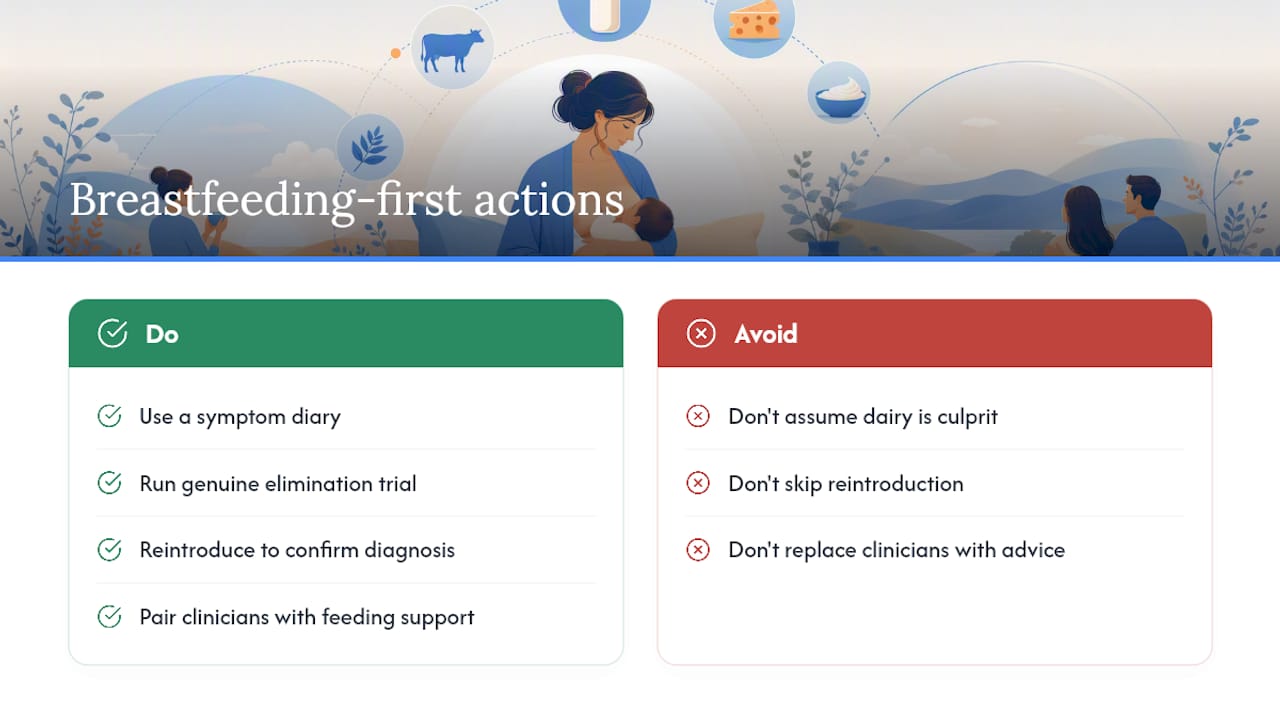
What gets underestimated is how much the diagnostic process itself, done properly with a symptom diary, a genuine elimination window, and a real reintroduction, protects you from months of unnecessary restriction. Skipping reintroduction because you're scared to "test" your progress is understandable, but it's also how families end up dairy-free for a year over what might have been a coincidence.
Some lactation and feeding therapy providers work alongside pediatricians, allergists, and dietitians rather than trying to replace that medical relationship. These providers often support the practical aspects underneath the diagnosis: protecting milk supply during an elimination trial, addressing latch or feeding mechanics that can mimic or worsen allergy symptoms, and giving parents a realistic, sustainable plan instead of a panicked one. That combination, medical diagnosis paired with hands-on feeding support, is what actually gets families through this faster and with breastfeeding intact.
— Jamie
How Thriving Joy Supports Families Through a Dairy Elimination Trial
If you're in the middle of a maternal elimination trial or trying to protect your milk supply while you sort out whether dairy is really the trigger, you don't have to manage the feeding side of this alone. Lactation counseling and pediatric feeding therapy can work as a practical complement to your pediatrician's diagnostic plan, not a replacement for it, focusing on the parts that a fifteen-minute checkup often can't cover: latch mechanics, supply protection during dietary changes, and coordinating your symptom diary observations into something useful for your next appointment.
This isn't the place for a diagnosis of a severe allergic reaction or an emergency, and if your baby shows any of the urgent signs covered earlier, call your pediatrician or emergency services first. But for the everyday work of keeping breastfeeding going through weeks of elimination and reintroduction, lactation counseling gives you a dedicated set of eyes on feeding mechanics and supply, while feeding therapy can address any aversion or coordination issues that developed while your baby was symptomatic. If you want a session to talk through where you are in the process, consider booking a consultation and bringing your symptom diary with you.
Sources
For deeper background on cow's milk protein allergy and breastfeeding, these sources informed this guide and are worth reading directly:
- Cow's Milk Allergy in Breastfed Infants: What We Need to Know About Mechanisms, Management, and Maternal Role
- Cow’s milk allergy clinical review (Nutrients)
- Breastfeeding and baby food allergies — Children’s Hospital of Philadelphia (CHOP)
- Cows’ milk protein allergy (CMPA) and breastfeeding — The Breastfeeding Network