

Most babies are ready to try solids when three developmental signs show up together: steady head and trunk control while sitting with minimal support, hand to mouth coordination like reaching and grasping food, and the ability to swallow, rather than push food back out with the tongue. These signs typically emerge around 6 months, and pediatric guidance advises against starting solids before around 4 months. If your baby was born prematurely or has a medical condition, talk to your pediatrician before making the call.
TL;DR:
- Babies need to sit upright with minimal support and hold their head steady for about 15 minutes to be physically ready for solids.
- Reaching for food and bringing it to the mouth indicates motor coordination, but the tongue extrusion reflex must also weaken before solids are safe to introduce.
- Signs of readiness should all appear on the same day, as mixing partial signs over time can be misleading and premature.
- Using a supported, upright seat and progressing textures gradually from purées to soft finger foods are essential for safe feeding practices.
- Behaviors like fist-chewing or increased night waking are common but usually unrelated to actual readiness for solids and often linked to teething or growth spurts.
Table of Contents
- What Are the Real Starting Solids Signs?
- How Do You Check These Signs Safely at Home?
- Behaviors That Look Like Readiness but Aren't
- What About Premature Infants or Medical Conditions?
- Getting Positioning and Textures Right
- When Should You Introduce Allergenic Foods?
- When Should You Seek Help From a Feeding Specialist?
- Why Mealtime Is Social Learning, Not Just Intake
- Getting Individualized Support for Feeding Challenges
- Sources
- FAQ
What Are the Real Starting Solids Signs?
Age gives you a rough window. Signs give you the real answer. A baby who hits 6 months but still flops forward without support, or one who can sit up at 5 months and reaches for your fork with real intent, are not on the same timeline, even though a calendar says otherwise. Pediatric guidance from the CDC frames 6 months as the typical starting point precisely because that's when most infants develop the three physical skills solids actually require.
Postural stability means your baby can sit upright, either alone or with light support at the hips, and hold their head steady without it bobbing or falling to one side. "Minimal support" doesn't mean propped stiffly in a nest of pillows. It means enough trunk support that your baby can hold that position for roughly 15 minutes while staying alert and engaged, according to guidance from the NHS. A baby who needs constant readjusting or tips over within a minute isn't there yet.
Motor coordination shows up as a sequence you'll actually watch happen in real time: your baby notices food, reaches toward it, closes a fist around it, and brings it to their own mouth. This is different from swatting at a spoon or grabbing at your plate out of curiosity. Genuine motor readiness looks deliberate. It's the same reach-and-grasp pattern you'd see if you handed your baby a toy.
Oral motor function is the one parents most often miss, because it happens inside the mouth. Newborns are built with an extrusion reflex, an automatic tongue thrust that pushes anything solid back out. This reflex protects against choking before a baby can safely manage textures, but it also has to fade before solids make sense. Once that reflex loses its grip, a baby can move food to the back of the mouth and swallow it instead of spitting it forward.
- Head and trunk stay steady when sitting with light support
- Baby reaches for, grabs, and brings objects toward the mouth
- Tongue no longer pushes soft food back out automatically
- Baby watches your food or utensils with clear interest
- Baby opens their mouth or leans forward when food approaches
Pro Tip: Watch for all three signs on the same day, not spread across a week of "sort of" moments. A baby who sits well but still thrusts every spoonful back out isn't ready yet, even if the calendar says 6 months.
How Do You Check These Signs Safely at Home?
You don't need special equipment to test readiness — just use this solid food introduction checklist for first-time parents to guide you through each step. You need about 10 minutes, a calm moment, and a willingness to try more than once if the first attempt doesn't go anywhere.
- Set up the high chair first. Buckle your baby in with hips at the back of the seat, feet resting on a footplate or support, and the tray at roughly elbow height. This positioning matters more than most parents expect. It's not about comfort. A stable pelvis and supported feet make swallowing mechanically easier and lower choking risk.
- Offer one tiny taste on a soft spoon. A pea-sized amount of a smooth purée is plenty. Watch what happens in the first few seconds, not the whole feeding.
- Give a safe finger-food piece to hold. A soft-cooked stick of steamed carrot or a strip of ripe banana lets you watch the reach, grasp, and mouth sequence in action without any real choking risk if the piece is soft enough to squash between two fingers.
- Read the response, not just the mess. Leaning forward, opening the mouth, and swallowing (even messily) point toward readiness. Repeated gagging past the first few tries, or the tongue shoving everything straight back out, points to more time needed.
If your baby extrudes the food every single time, don't force a second or third round that day. Guidance from the NHS suggests waiting three to seven days and trying again, since the extrusion reflex fades on its own timeline for every baby.
Pro Tip: Try the spoon offer when your baby is calm and mildly hungry, not starving and not freshly fed. A baby who's overtired or overfull will reject almost anything, readiness signs or not.
Behaviors That Look Like Readiness but Aren't
Fist-chewing, sudden nighttime waking, and a baby who suddenly wants to nurse every hour all feel like clear signals. They usually aren't. These behaviors are far more often tied to teething, growth spurts, or a developmental leap that has nothing to do with digestion or oral motor skills. The NHS is direct about this: these cues don't substitute for the three physical signs, and starting solids to "fix" increased night waking or fussiness rarely works, because that isn't what's driving the behavior.
- Chewing on fists or toys: usually teething, not hunger for solids
- More frequent night waking: often a sleep or growth phase, not a feeding gap
- Sudden increase in milk demand: commonly a growth spurt, especially around 3 to 4 months
- Watching you eat with interest: a genuine early cue, but only meaningful alongside sitting and grasping skills
The quickest confirming check is simple: does your baby also sit with reasonable stability and reach for objects with real coordination? If the answer is no, what you're seeing is a phase, not a milestone.
What About Premature Infants or Medical Conditions?
Readiness timelines shift for babies born early or dealing with certain health conditions, and chronological age stops being a useful marker. Clinicians recommend using corrected age (age calculated from the original due date, not the birth date) for infants born prematurely, since development tracks closer to corrected age than to the calendar, according to guidance from Children's Hospital of Philadelphia.
Conditions like reflux, low muscle tone, a history of NICU feeding support, or suspected tongue tie can all change the picture and usually call for pediatric input before starting solids. A few questions worth bringing to that appointment:
- Should we use corrected age or chronological age to judge readiness?
- Are there specific oral motor concerns we should watch for?
- Would a referral to a feeding specialist make sense before we start?
Getting Positioning and Textures Right
A supported, upright seat is non-negotiable once you start. Trunk upright, straps secured, feet resting on something solid rather than dangling. That foot support isn't decorative. It stabilizes the pelvis, which makes safe swallowing noticeably easier.
Texture progression should move slowly: thin purées first, then thicker mashed textures, then soft finger foods your baby can gum or gently mash with their gums. Avoid anything hard, round, sticky, or small enough to block an airway, including whole grapes, popcorn, hard raw vegetable chunks, and hot dog rounds. Reviewing infant choking first aid before you start, and knowing basic infant CPR, is worth the time it takes.
| First-food safety basics | What to do |
|---|---|
| Seating | Upright trunk, buckled straps, feet supported |
| Early textures | Smooth purées, then soft mashes, then gummable finger foods |
| Avoid | Hard, round, sticky, or whole small foods |
| Supervision | Always within arm's reach during feeding |
Milk (breast milk or formula) stays the main source of nutrition for months after starting solids. According to Healthychildren, early solids are exploratory, not a calorie replacement, and pediatric organizations generally recommend continuing milk feeds through at least the first year.
When Should You Introduce Allergenic Foods?
Current guidance points toward introducing common allergenic foods, including peanut, egg, and tree nuts, sometime between about 4 and 11 months once your baby shows developmental readiness, rather than waiting or avoiding them. Delaying these foods is not considered protective against allergy development, according to the Merck Manual.
- Offer a smooth, thinned form first, like peanut butter mixed into puree, not whole nuts or chunks
- Introduce one new allergenic food at a time and watch for reaction over the next couple of hours
- Keep introducing that food regularly once tolerated, rather than a single one-off try
- Talk to your pediatrician or an allergist before introducing allergens if your baby has severe eczema or a close family member with a food-related anaphylactic reaction
When Should You Seek Help From a Feeding Specialist?
Most babies move through starting solids without major issues, but certain patterns deserve a closer look rather than a wait-and-see approach.
- Choking or gagging episodes that escalate, rather than the occasional mild gag most babies experience while learning texture.
- Poor or stalled weight gain once solids are introduced, which can point to an underlying feeding difficulty.
- Persistent tongue thrust well past the usual window, where every texture keeps coming back out no matter how many times you try.
- Coughing, watery eyes, or a wet-sounding voice during or after feeds, which can signal silent aspiration.
A feeding evaluation, usually done by a pediatric feeding therapist or speech-language pathologist, looks at oral motor strength, coordination, and swallow safety in a hands-on session. Before that appointment, jot down what you noticed: which foods trigger the reaction, how often it happens, and whether it's improving or getting worse. Specific notes help a feeding specialist pinpoint the issue faster than a general "mealtimes are hard" description ever could.
Why Mealtime Is Social Learning, Not Just Intake
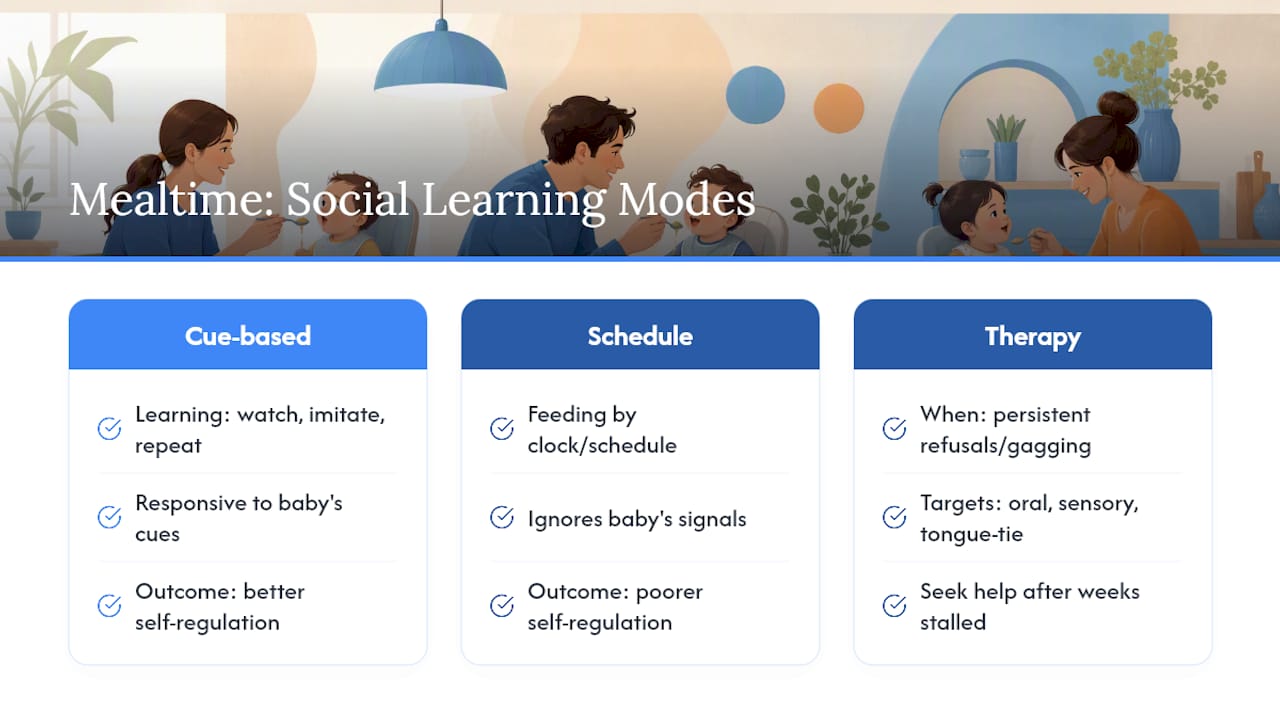
Babies learn to eat the way they learn everything else: by watching, imitating, and getting comfortable through repetition. A responsive mealtime where you follow your baby's cues to slow down, speed up, or stop, tends to build better long-term eating habits than one measured purely by how many ounces went in. Research on cue-based feeding backs this up: babies who get consistent, responsive feedback from caregivers learn self-regulation around food more reliably than babies fed on a strict schedule regardless of their signals.
Families often come to feeding therapy after weeks of a baby refusing textures, gagging on nearly everything, or showing red flags that don't resolve with time. Therapy targets the underlying skill gap, whether that's oral motor strength, sensory tolerance, or an undiagnosed issue like tongue tie, rather than pushing through with more pressure at the table. If progress stalls for more than a few weeks despite trying different textures and timing, that's a reasonable point to bring in outside support.
— Jamie
Getting Individualized Support for Feeding Challenges
If your baby is showing mixed signals, missing a milestone, or you've hit a wall trying to move past purees, a general internet checklist can only take you so far. Specialized feeding therapy providers offer in-person feeding evaluations that look at your baby's oral motor skills, posture, and swallow safety, then build a plan based on what's actually happening at your table.
An initial consult typically involves watching your baby eat, assessing oral motor and postural skills, and talking through your history and concerns before mapping out next steps together. For breastfeeding families navigating the same transition, lactation counseling covers the feeding side that starts before solids ever do. If solids have stalled, if gagging feels more severe than typical, or if you simply want a professional set of eyes before you move forward, book a feeding therapy evaluation and get a plan built around your baby, not a generic timeline.
This article is general information, not a substitute for advice from a qualified doctor. Consult a qualified healthcare professional about your own circumstances before acting on anything here.
Sources
- Baby’s first solid foods — NHS
- When, What, and How to Introduce Solid Foods — CDC
- Nutrition and fluids for your baby — Children’s Hospital of Philadelphia (CHOP)
- Solid foods in infancy — Merck Manual
FAQ
What Are the Signs Your Baby Is Ready to Start Solids?
Look for steady head and trunk control while sitting with minimal support, reaching and grasping food to bring it to the mouth, and swallowing food rather than pushing it back out with the tongue.
Is 4 Months Too Early to Introduce Solids?
Yes, for most babies. Pediatric guidance from the CDC advises against starting solids before around 4 months, and most infants don't show all three readiness signs until closer to 6 months.
What Is the 3 Day Rule for Introducing Solids?
Many pediatric sources recommend introducing one new food at a time and waiting a few days before adding another, so you can spot any reaction. If a baby repeatedly rejects or extrudes a food, waiting three to seven days before retrying gives oral motor skills more time to develop.
Is 7 Months Too Late to Start Solids?
No. Some babies, especially those born prematurely, show readiness signs closer to 7 months, and that's within a normal range as long as the three core signs are present. If your baby is past 6 months and showing no readiness signs at all, mention it to your pediatrician.
How Do I Know if My Baby's Extrusion Reflex Is Fading?
Offer a tiny taste of smooth puree on a spoon. If your baby swallows more than they push back out, even messily, that reflex is fading; if food comes straight back out every time across several tries, it likely hasn't yet.