
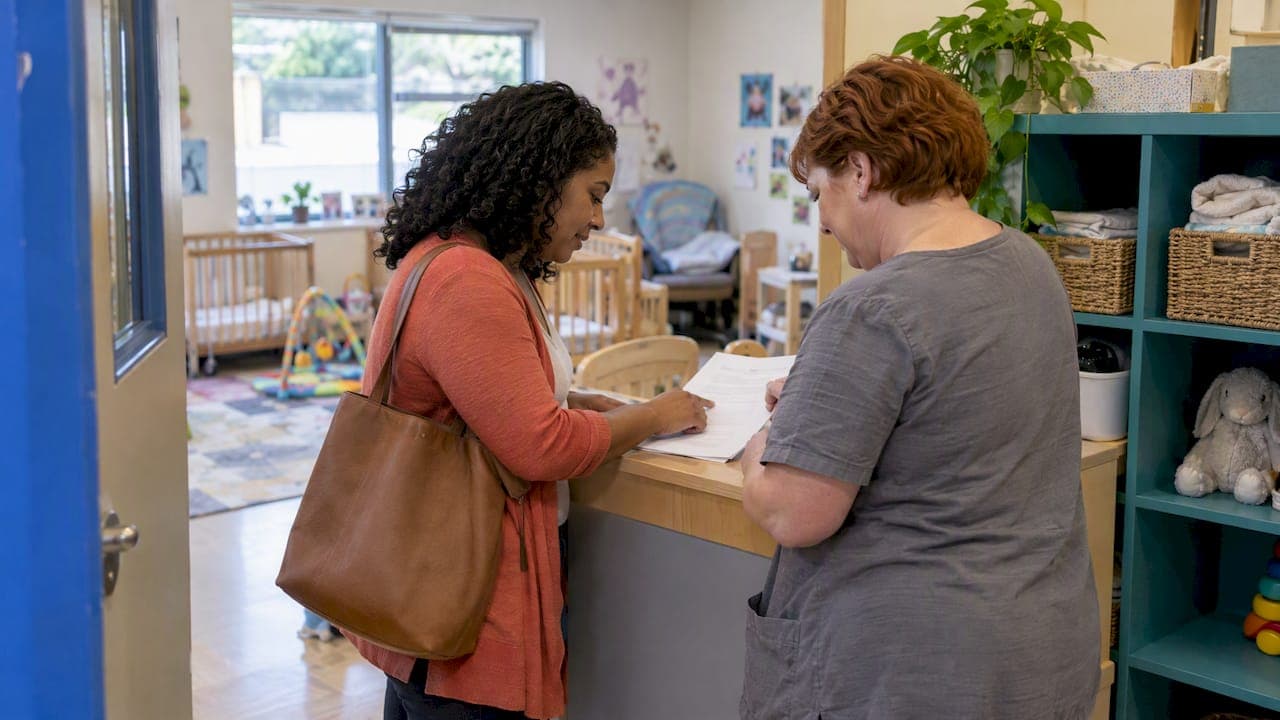
A daycare feeding plan is a written record of how your child eats, so every caregiver feeds them the way you would. It covers what your baby drinks or eats, how much, how often, how they show hunger and fullness, and any allergies or medical needs. If your child is under 15 months, many programs will ask you to complete one before the first day. Even when they don't, writing one is the easiest way to feel calm about handing over mealtimes.
We work with Tampa Bay families every week on feeding, and we hear the same worry again and again: "Will they know what my baby needs?" This guide walks you through what to put in the plan, how to handle breast milk and formula, how to bring up solids and allergies, and what to do when your child's feeding is anything but typical.
TL;DR
- A feeding plan documents your child's usual feeding behaviors and how the program will support them. Fill it out with your caregiver, not just for them.
- Include milk or formula type, amounts, timing, hunger and fullness cues, solid-food status, allergies and soothing preferences.
- Ask for responsive feeding: feed on cue, hold babies for bottles, and let your baby stop when they are full.
- Label every bottle with your child's name and the date, and follow current CDC storage guidance for breast milk.
- If your baby coughs, gags, refuses feeds or isn't gaining well, the plan needs your pediatrician and possibly a feeding therapist, not just a form.
Table of Contents
- What a daycare feeding plan actually is
- What to include in an infant feeding plan
- Agreeing on a schedule: follow cues, not the clock
- Breast milk and formula: labeling, storage and handling
- Starting solids with daycare in the picture
- Allergies and medical needs
- Keep the plan alive
- When feeding isn't going smoothly
- Our perspective: a plan should reflect the child, not just the form
- How Thriving Joy can help
- FAQ
- Sources
What a daycare feeding plan actually is
The UNC Center for Women's Health and Breastfeeding describes the plan as a formal way for a program to document information from families and health care providers about a child's usual feeding behaviors and how the program will support them. Think of it as a shared script. You know that your daughter takes four ounces after a nap and fusses if the bottle is too warm. The plan puts that knowledge where a substitute caregiver can find it.
It is also a conversation starter. Filling it out together shows you how the room really runs: who feeds your baby, where, and what happens when your child cries before the scheduled time.
Is a feeding plan required?
It depends on the program and the state. The federal Caring for Our Children Basics standards are voluntary, and states vary widely in their health and safety rules and in how they check compliance. In Florida, licensed centers follow the state Child Care Facility Handbook (December 2019 edition), which covers meal supervision, handling of breast milk and formula, and solid foods for infants. Many centers add their own infant feeding form on top of that, often required for children under 15 months.
Centers that take part in the federal food program (CACFP) have extra rules too. For example, infant formula served must be iron-fortified and mixed in the recommended proportions. Ask your center whether it participates, and whether it supplies formula or expects you to bring it.
What to include in an infant feeding plan
The UNC toolkit's infant feeding plan template gives a solid skeleton. Use it, or your center's own form, and make sure these items are covered.
The basics
- Your child's name and birthday
- The type of milk: breast milk, which formula (brand and type), or both
- Usual feeding frequency and approximate amount per feeding
- Whether your child has started solids, and which foods
- Any known allergies and the dietary changes that go with them
How your baby communicates
This is the part forms often leave out, and it matters most. The template asks how your baby shows hunger. Go further and write it in plain language:
- "Roots and brings hands to mouth first, then fusses. Crying means we are late."
- "Turns head away and pushes the bottle out when finished. Please don't coax the last ounce."
- "Takes a pause halfway through to burp and look around. This is normal for her."
Also list soothing instructions: swaddled or not, pacifier or not, whether a bottle is a comfort for falling asleep (many programs will ask that babies not sleep with bottles, so talk it through).
Nursing and pumping plans
If you breastfeed, note whether you will nurse at drop-off or pick-up, whether the caregiver should call you if your baby is hungry near the end of the day, and how much milk you will send. A feeding plan is also the place to say that formula should not be given to your breastfed baby without your okay. Florida's handbook says providers must have procedures that prohibit formula for a breastfed infant without parental consent, and it is still worth writing on your form.
A quick sample entry
Here is how one section might read for a four-month-old:
| Item | Example entry |
|---|---|
| Milk | Breast milk, bottles of 3 to 4 oz |
| Pattern | About every 2 to 3 hours, earlier if she shows cues |
| Hunger cues | Hands to mouth, rooting, then fussing |
| Fullness cues | Turns away, slows down, relaxes hands |
| Solids | None yet |
| Allergies | None known |
| Soothing | Swaddle for naps, no pacifier at feeds |
These numbers are an illustration, not a recommendation. Your own baby's pattern and your pediatrician's guidance set the real entries.
Agreeing on a schedule: follow cues, not the clock
Many parents arrive with a strict schedule written out. A better approach is a loose rhythm plus a promise to respond to cues. The CDC's standards for healthy infant feeding call for responsive feeding: feed infants on cue and allow them to stop when they show signs of fullness. Caring for Our Children Basics also says infants should be held while being fed bottles for emotional support and safety, and Florida's handbook says the same until a baby can sit in an age-appropriate chair with good head control.
So in practice, ask your caregiver:
- Who will feed my baby most days? (Consistency helps babies feel secure.)
- What do you do when a baby cries between planned feeds?
- Do you ever prop a bottle or put cereal in a bottle? (The answer should be no.)
- How do you tell when a baby is full?
If these ideas are new to you, our guide to the four principles of responsive feeding you can practice at home shows how to use the same approach in your own kitchen, so home and daycare match. Breastfed babies, especially, often feed in clusters during certain hours, so read about on-demand breastfeeding before you insist on three-hour gaps.
If you are mixing breast milk and formula to make daycare work, our combination feeding routines that protect milk supply can help you decide how many bottles to send.
Breast milk and formula: labeling, storage and handling
This is where small mistakes can have real consequences, so be specific on your plan and in your daily routine.
Labeling and transport
The CDC's guidance for early care settings says bottles should be labeled with your child's name and the date. Many centers also ask for a second label on the bag. Never assume a bottle is obviously yours. If the wrong milk reaches the wrong baby, Florida requires the provider to tell both families right away and document it. Ask your center what their process is.

Storage times
According to the same CDC document, freshly expressed breast milk keeps:
| Where | How long |
|---|---|
| Room temperature (up to 77°F) | Up to 4 hours |
| Refrigerator | Up to 4 days |
| Freezer | Up to 6 months for best quality, up to 12 months acceptable |
Source: CDC storage and handling guidance for early care and education.
Warming and leftovers
The CDC says to warm milk in warm water, not in a microwave, and to use leftover milk within 2 hours after the feeding. Put these two points in your plan if you want to be sure they are honored. Also remember that Florida's handbook says previously opened baby food jars can't be accepted at the center, so send unopened jars or ask what the center prefers.
Starting solids with daycare in the picture
Solids are a decision for you, your pediatrician and the program together. Caring for Our Children Basics says solid food introduction should be decided in consultation with the parent and health care provider, generally starting around 6 months. The UNC toolkit suggests discussing signs of readiness with the family and getting documentation if solids are recommended before 6 months. Florida's handbook adds that solid foods may not be fed to an infant younger than 4 months unless a physician directs it, and food for infants must be cut into pieces a quarter inch or smaller.
Two more rules belong on your plan. The CDC says infants should not be given formula mixed with cereal, juice or other foods without the primary care provider's written instruction. And any new food should be tried at home first, so you are the one watching for a reaction, not a caregiver juggling six babies.
Readiness comes before the calendar
A birthday that says "6 months" is not enough. Look for steady head control, sitting with support, and real interest in food. Our post on three signs to check before starting solids walks through them, and a skill-first transition to solids explains what to practice while you wait. If you plan to offer finger foods, our baby-led weaning guide covers safe starts. For a handy list to tape to the fridge, this solid food introduction checklist pairs well with the daycare form.
Once your baby is eating solids, update the plan. List each food that has been tried, textures your child can handle, and foods the caregiver should not offer yet.
Allergies and medical needs
For a child with a food allergy, a line on the form is not enough. Caring for Our Children Basics says the plan must include a written record of the allergen, steps to avoid it, and a detailed emergency medical treatment plan. Ask your pediatrician or allergist for the emergency plan, give copies to the director and classroom teachers, and confirm who is trained to act on it.

Other needs belong in the plan too: special formulas, thickened liquids, reflux precautions, a feeding tube, or positioning your therapist recommended. If your child has any of these, ask your health care provider to write instructions the program can keep on file.
Keep the plan alive
Babies change fast. The UNC toolkit recommends reviewing and updating feeding plans regularly to account for new developmental milestones. A practical rhythm:
- Review monthly in the first year, and any time something changes (new food, teething, a growth spurt, a new caregiver).
- Ask for a short daily note: how much your baby took, how it went, anything unusual.
- Bring concerns early. "She seemed to cough more on the bottle today" is a useful observation, not a complaint.
When feeding isn't going smoothly
A plan works well for a baby who eats typically. For some children, the real issue is the feeding itself. Signs worth raising include coughing, choking or gagging during feeds, milk leaking from the mouth, arching or pulling away, frequent refusal, very long feeds, or concerns about weight gain. A written plan does not fix these, and it should not be asked to.
First, call your pediatrician, who can check growth and rule out medical causes. If the trouble has lasted about two weeks, our guide on what to do after two weeks of infant feeding difficulties lays out the next steps. A feeding evaluation looks at the whole picture, and our explanation of the feeding evaluation process shows how a mealtime diary and short videos help find causes. Bring those videos from home and from daycare if you can.
If you are in Pasco or Hillsborough County, this is where we come in.
Our perspective: a plan should reflect the child, not just the form
We see two kinds of feeding plans. One is a checklist filled in on the first morning and forgotten. The other is a living agreement between a family and a caregiver that gets adjusted as the child grows. The second is the only one that helps.
Our approach is holistic and family-centered. We look for root causes instead of quick fixes, and we combine pediatric healthcare training with real experience as a parent. When a family brings us a child who struggles at daycare, we rarely find the problem is the daycare. More often it is a skill the child hasn't built yet, such as oral coordination, tolerating new textures or reading their own fullness, or a feeding rhythm that works at home but not in a busy classroom. Once we understand the cause, the plan can be specific: this seat, this pace, this cup, this way of offering new foods.
We can also meet your child where they eat. We offer therapy in our office, at home, and at daycare or preschool, so the people who feed your child every day can learn the strategies alongside you. If the plan is going to be followed, the people following it need to feel confident, and so do you.
— Thriving Joy
How Thriving Joy can help
If your child needs more than a form, we offer feeding therapy for infants and children, including tube weaning support, and lactation counseling for prenatal preparation and postpartum breastfeeding, including planning to return to work or daycare. Our parent coaching and workshops, such as Starting Solids 101 and Picky Eating Workshops, help you and your caregivers use the same strategies. We accept private pay, major health insurance plans and scholarships. Reach out through our site and we will talk through where your child is and what would help.
FAQ
When should I give the daycare an infant feeding plan?
Give it to the director before your child's first day, and go over it with the classroom teacher who will actually feed your baby. Many centers require one for all children under 15 months. Update it whenever your baby's feeding changes.
Can the daycare feed my baby on a set schedule instead?
You can agree on a general rhythm, but current guidance is to feed infants based on hunger cues rather than a rigid schedule. Ask the center how caregivers respond when a baby shows cues early. A good answer is that they feed the baby.
How long can I leave breast milk at daycare?
Freshly expressed milk can stay at room temperature (up to 77°F) for up to 4 hours and in the refrigerator for up to 4 days, according to CDC guidance for early care settings. Most programs refrigerate bottles on arrival. Label every bottle with your child's name and the date.
What if my child has a food allergy?
The plan should name the allergen, explain how to avoid it, and include a detailed emergency treatment plan from your child's health care provider. Make sure every adult in the room has seen it and knows where medication is kept.
What if my baby struggles to eat at daycare?
Start with your pediatrician, then ask about a feeding evaluation if coughing, gagging, refusal or weight concerns continue. Share what daycare staff observe, since they see your child eat in a different setting. We can work with you and the program to build strategies that fit both places.
Sources
- Sample feeding plan form: UNC CGBI Infant Feeding Plan
- Supporting Families' Feeding Choices: UNC CGBI toolkit
- CDC: Healthy Infant Feeding standards for early care and education
- CDC: Storage, Handling, and Preparation of Breast Milk in Early Care and Education
- ACF: Caring for Our Children Basics
- USDA FNS: Creditability of Infant Formulas in CACFP
- Florida Child Care Facility Handbook, December 2019