

Yes, combination feeding can be a reliable, sustainable routine. The single rule that makes it work: protect breast stimulation, through nursing or pumping, every time a feed gets replaced by formula. Skip that step and supply drifts downward without warning. Follow it, and you can build a flexible routine with sample schedules for newborns, working parents, and exclusive pumpers.
TL;DR:
- Protect breast stimulation during every feed replacement with formula, as skipping this step causes a gradual drop in milk supply.
- Start combination feeding after three to six weeks of established breastfeeding unless the baby isn't gaining weight or medication contraindicates exclusive breastfeeding.
- Introduce bottles gradually using paced feeding, preferably with someone other than the mother, to avoid nipple confusion and supply dips.
- Maintain roughly six to eight nursing or pumping sessions per day, including overnight, to support milk production effectively.
- Adjust schedules as the baby grows, with flexible routines and professional support for feeding issues or mechanical challenges beyond schedule tweaks.
Table of Contents
- What Is a Combination Feeding Routine, and Why Do Families Choose It?
- When Should You Start Combination Feeding?
- How Do You Introduce Bottles Without Hurting Latch or Supply?
- How Do You Protect Your Milk Supply While Formula Feeding?
- Sample Combination Feeding Schedules You Can Copy
- What Should Combination Feeding Look Like Overnight?
- Pumping Rhythm and Safe Milk Storage
- Building a Return-to-Work Feeding Routine
- Troubleshooting Common Combination Feeding Problems
- Why Combination Feeding Deserves More Credit Than It Gets
- When a Feeding Routine Needs More Than a Schedule
- Sources
What Is a Combination Feeding Routine, and Why Do Families Choose It?
Combination feeding, sometimes called mixed feeding or combo feeding, means giving a baby both breastmilk (from the breast or pumped) and formula on a regular basis. It is not the same as an occasional bottle during a rough week. A true combination feeding routine is intentional: you decide in advance which feeds are breast, which are formula, and how that pattern repeats day to day.
Families land here for different reasons, and none of them require justification.
- A pediatrician recommends supplementing because of slow weight gain or jaundice.
- A parent is returning to work or school and can't be the one feeding every session.
- Milk supply is genuinely low, and formula fills the gap.
- Co-parents or partners want to share the feeding load overnight or on weekends.
The distinction that matters most is short-term versus long-term. Supplementing for a few days while supply catches up is a different project than building a combo feeding schedule you'll rely on for months. This guide is built for the second scenario, though the tactics work for both.
When Should You Start Combination Feeding?
Most lactation guidance points to waiting until breastfeeding is established, usually around three to six weeks, before adding regular formula feeds. By that point, your milk supply has calibrated to your baby's demand, and your baby has generally figured out how to latch and transfer milk efficiently. Introducing bottles before that window can sometimes complicate things, though it isn't a hard rule.
There are real exceptions. If your baby isn't gaining weight adequately, or you're taking a medication incompatible with exclusive breastfeeding, your pediatrician may recommend supplementing sooner. Clinical protocols on supplementary feeding stress evaluating latch and milk transfer first, then choosing a method that supports continued breastfeeding rather than replacing it outright, according to the ABM Clinical Protocol on supplementary feedings. Whatever your timeline, introducing formula gradually, one feed at a time, gives your supply a chance to adjust instead of dropping suddenly.
How Do You Introduce Bottles Without Hurting Latch or Supply?
The order you introduce things matters less than the pace. Rushing is what tends to cause bottle refusal, nipple confusion, or a supply dip nobody saw coming.
- Pick a calm, low-stakes moment. Avoid introducing the first bottle when your baby is overtired or already hangry.
- Let someone other than the nursing parent offer it. Babies often refuse a bottle from the person whose breast they expect. A partner, grandparent, or sitter has better odds on the first try.
- Use paced bottle-feeding. Hold the bottle horizontally, let your baby control the flow, and pause every 20 to 30 seconds. This mimics the stop-start rhythm of nursing and helps prevent overfeeding, a technique Healthline's supplementation guidance recommends specifically for babies moving between breast and bottle.
- Decide: top-up or full swap. Nursing first and offering a small formula top-up preserves more stimulation than swapping an entire feed for a bottle. Reserve full swaps for feeds you truly can't be present for, like a workday session.
- Try a couple of nipple shapes if the first one gets rejected. Slow-flow nipples usually work best early on.
Pro Tip: Hold your baby in a different position for bottle feeds than you use for nursing. That small physical cue helps some babies stop expecting the breast every time they're offered something to suck on, which can reduce confusion on both ends.
Avoid mixing formula directly into pumped breastmilk as a routine habit. Keeping them separate makes it easier to track exactly how much of each your baby is getting, which matters once you start troubleshooting.
How Do You Protect Your Milk Supply While Formula Feeding?
Milk production runs on demand. Your body reads stimulation, whether from nursing or pumping, as a signal to keep making milk, and it reads the absence of stimulation as a signal to slow down. Swap a nursing session for a bottle without pumping in its place, and you're telling your body to make less, according to clinical literature on lactation physiology.
That is the whole mechanism behind supply drops during combination feeding, and it's also the fix.
- To maintain a full milk supply, aim for roughly 6 to 8 nursing or pumping sessions across 24 hours.
- Fewer sessions throughout the day can typically sustain a partial supply, which is often the goal for families who want breastmilk as part of the mix rather than all of it.
- WIC's breastfeeding guidance recommends 8 to 12 sessions a day in the early weeks specifically to establish and protect supply before you start subtracting feeds.
- Overnight sessions carry outsized value because prolactin, the hormone driving milk production, peaks at night.
- When you can't nurse a session, pump instead. Treat the pump as a placeholder, not an afterthought.
Short, frequent pumping sessions tend to signal demand more effectively than occasional long ones. If you're replacing an afternoon nursing session three times a week, a 10 to 15 minute pump at roughly that same time keeps your body reading consistent demand, even though the milk goes to a bottle for later rather than straight to your baby.
Sample Combination Feeding Schedules You Can Copy
These three templates cover the situations families ask about most. Adjust volumes based on your pediatrician's guidance and your baby's cues, not the clock.
Schedule A: Breast-first with formula top-up (newborn to 6 weeks) Nurse at every feed, then offer 1 to 2 ounces of formula afterward if your baby still seems hungry. A rough day might look like: 7 AM nurse plus top-up, 10 AM nurse plus top-up, 1 PM nurse plus top-up, 4 PM nurse plus top-up, 7 PM nurse plus top-up, overnight nursing on demand. This approach preserves the most stimulation because every session includes nursing first.
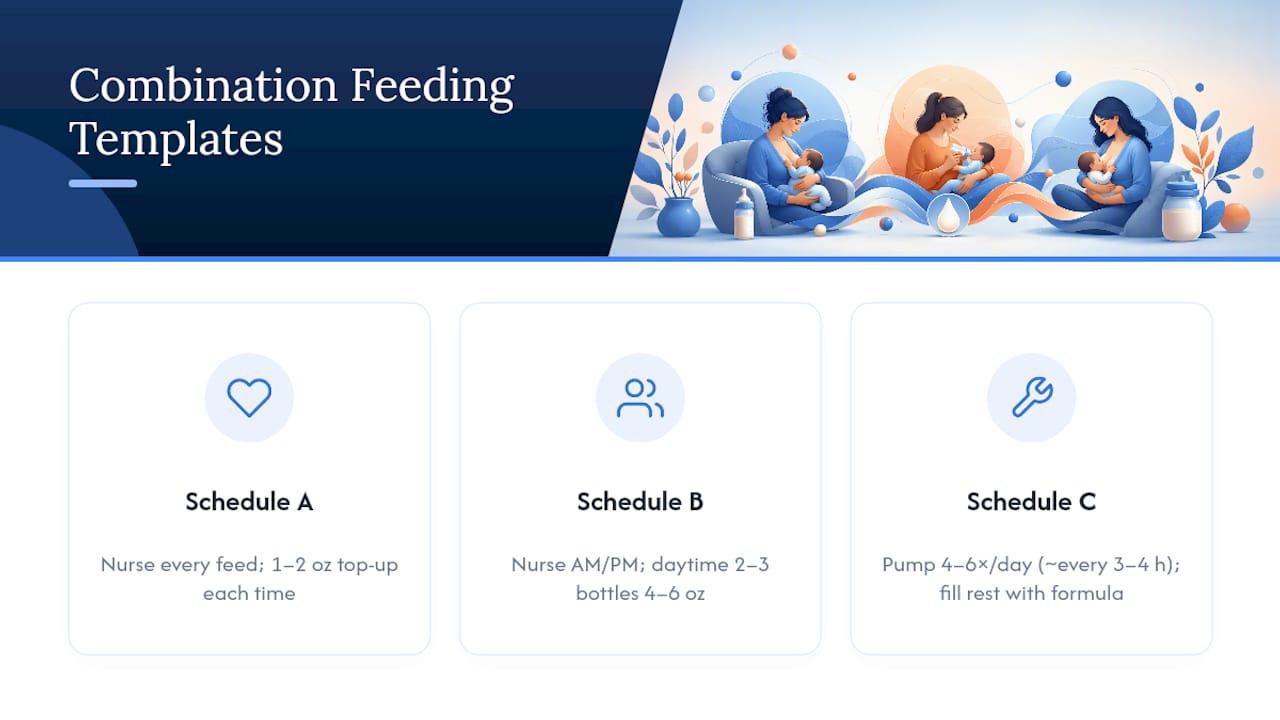
Schedule B: Alternating full feeds (working parent or daycare pattern, 2 to 6 months) Nurse morning and evening when you're home; daycare or a caregiver gives 2 to 3 formula bottles of 4 to 6 ounces during the day. Pump once or twice during the workday at the times you'd normally nurse, both to relieve fullness and to protect supply, following combo feeding templates from PumpingSchedule.
Schedule C: Pump plus formula (exclusive pumpers adding formula) Pump 4 to 6 times a day, roughly every 3 to 4 hours, and fill any remaining feeds with formula. This pattern works well for parents who can't or don't want to nurse directly but still want breastmilk in the rotation.
As your baby grows, volumes climb (often 4 to 8 ounces per bottle feed by 4 to 6 months) and, once solids start around 6 months, some bottle or nursing sessions naturally get replaced by food rather than formula. Cluster feeding stretches, common in the early weeks and again around growth spurts, can temporarily throw any of these schedules off. That's normal, not a sign your plan failed, as explained in Serenity Doula's guide to cluster feeding in bottle-fed newborns.
What Should Combination Feeding Look Like Overnight?
Overnight feeds deserve special protection because prolactin peaks during those hours, making nighttime stimulation disproportionately valuable for supply. If you nurse only once or twice a day due to work or preference, an overnight session is often the highest-value one to keep.
Two workable patterns: nurse overnight yourself while your partner handles daytime formula bottles, or let your partner give one occasional overnight formula bottle while you pump in that window instead of skipping it entirely. Either way, keep at least one overnight touchpoint with your own breast or pump for the first several months if maintaining supply matters to you.
Standard infant sleep safety applies no matter which feeding method is in play: baby on their back, alone in an empty crib or bassinet, no loose bedding.
Pumping Rhythm and Safe Milk Storage
Match your pump sessions to your supply goal, not a generic number pulled from somewhere else. Full supply generally means pumping every time you'd otherwise nurse; partial supply allows you to pump less often and let formula fill the rest.
- Empty each breast as fully as comfortable. Milk removal, not just time on the pump, is what signals your body to keep producing.
- Hands-on pumping, massaging while pumping, often increases output more than passive pumping alone.
- Freshly expressed breastmilk keeps at room temperature for up to 4 hours, in the refrigerator for up to 4 days, and in a standard freezer for up to 6 months, per guidance from the Office on Women's Health.
- Thaw frozen milk in the refrigerator overnight or under cool running water, never in a microwave, which creates hot spots and can destroy beneficial components.
- Once thawed, use milk within 24 hours and never refreeze it.
Building a Return-to-Work Feeding Routine
Give yourself one to two weeks before returning to work to introduce bottles and let caregivers practice, rather than testing everything on day one.
- Start with a single formula bottle per day, offered by someone other than you, about 10 to 14 days before your return date.
- Write out daycare instructions covering paced feeding, exact ounces per bottle, and how to warm milk safely.
- Build a realistic pumping schedule around your actual workday, typically every 3 hours, and expect output to fluctuate week to week.
- Ask your employer about pumping accommodations; many workplaces are required to provide reasonable break time and a private space for expressing milk.
Pro Tip: Send a small backup bottle of formula to daycare even on days you plan to send only breastmilk. It prevents a supply hiccup from turning into a hungry, frustrated baby waiting on you.
If you're preparing for this transition, working through your feeding plan with a prenatal lactation consultation before you're back at work gives you a head start on troubleshooting.
Troubleshooting Common Combination Feeding Problems
Most combination feeding hiccups fall into a handful of categories, and most have a fairly quick fix.
- Bottle refusal: try paced feeding, a different caregiver, a slower nipple flow, or offering the bottle at a slightly different time of day.
- Breast refusal after bottles start: this shows up more in older babies who've gotten used to fast bottle flow; slowing bottle pace and increasing skin-to-skin nursing time often helps.
- Worry about overfeeding: watch your baby's hunger and fullness cues, turning away, slowing down, closing their mouth, rather than pushing to finish a bottle. The CDC's guidance on hunger and fullness signs is a useful, simple reference for this.
- Stool changes: formula-fed stools are typically firmer, more formed, and stronger smelling than exclusively breastfed stools. This shift is expected and not usually a problem on its own.
- Call your pediatrician for blood in stool, signs of dehydration, persistent refusal to feed, or if weight gain stalls.
If problems persist beyond simple adjustments, a certified lactation consultant or pediatric feeding specialist can look at what's actually happening at the breast and bottle, rather than guessing from a checklist.
Why Combination Feeding Deserves More Credit Than It Gets
The loudest voices in infant feeding tend to frame it as a binary: breastfeed or formula feed, succeed or fail. That framing does real damage, because it pushes parents to hide the fact that they're combination feeding instead of asking for help optimizing it. Clinical guidance doesn't treat supplementation as a failure state at all. It treats it as a tool, a bridge that, handled well, can extend breastfeeding rather than end it.
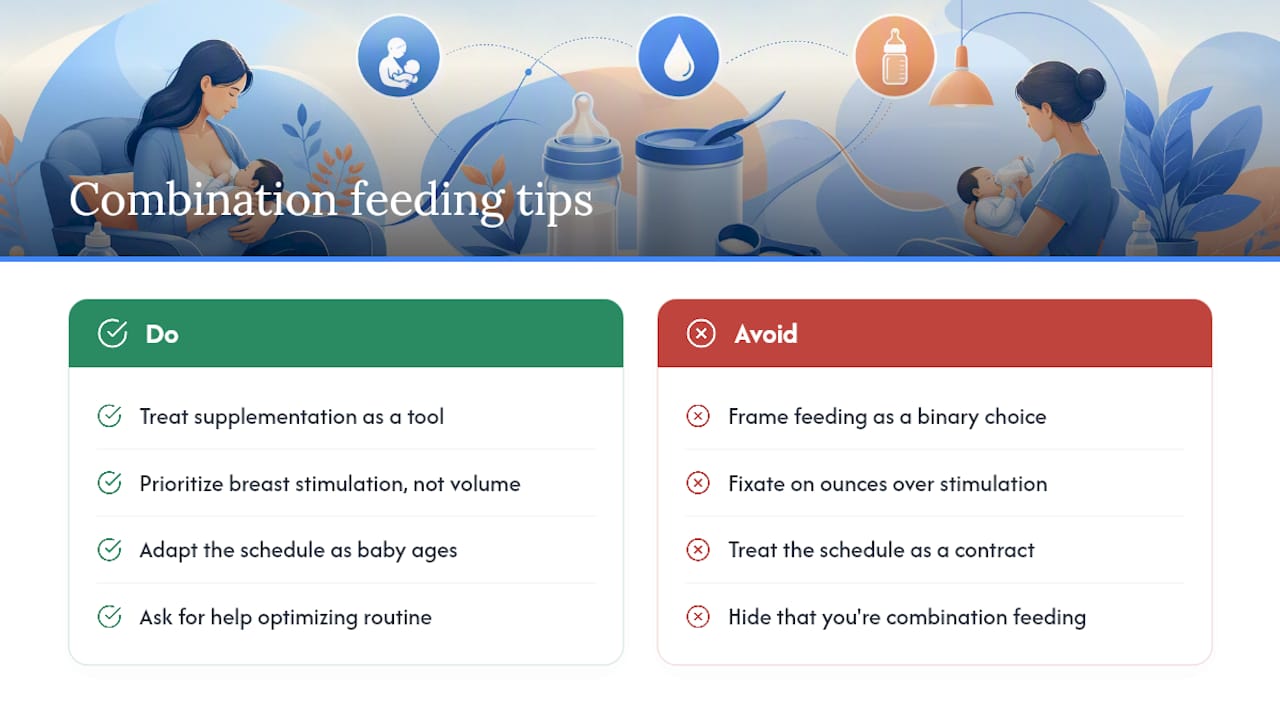
What's underappreciated is how much the order of operations matters more than the amount. Two families giving the exact same three ounces of formula a day can have completely different supply trajectories, depending on whether that formula replaced a fed breast or a pumped one. Parents fixate on volumes when they should be fixating on stimulation. Fix the stimulation side, and the volumes tend to sort themselves out.
The other thing conventional advice underplays is timing flexibility. A combo feeding schedule doesn't have to look the same at six weeks and six months. The families who stick with combination feeding longest are the ones who treat the schedule as a living document, not a contract.
— Jamie
When a Feeding Routine Needs More Than a Schedule
Sometimes the schedule isn't the problem. A baby who consistently arches away from the breast, struggles to coordinate sucking and swallowing, or seems to be in pain while feeding needs eyes on the actual mechanics, not just a new timing chart. That's where individualized lactation counseling and feeding therapy through Thriving Joy Pediatric Therapy's feeding therapy services come in.

Thriving Joy's approach looks at root causes, oral-motor patterns, latch mechanics, persistent low supply, rather than handing you a generic printout and sending you home. An initial consult typically includes a feeding observation, a supply and history review, and a plan built around your baby's actual presentation. Sessions are available through private pay, most major insurance plans, and scholarship options for families who qualify. If your combination feeding routine has hit a wall that schedule tweaks haven't solved, book a lactation counseling session and get a plan built around your baby instead of a generic template.
This article is general information, not a substitute for advice from a qualified doctor. Consult a qualified healthcare professional about your own circumstances before acting on anything here.
Sources
- PubMed: clinical literature on lactation physiology and supplementary feeding
- Combination Feeding and Maintaining Milk Supply | WIC Breastfeeding Support
- CDC: Signs your child is hungry or full / infant nutrition guidance