
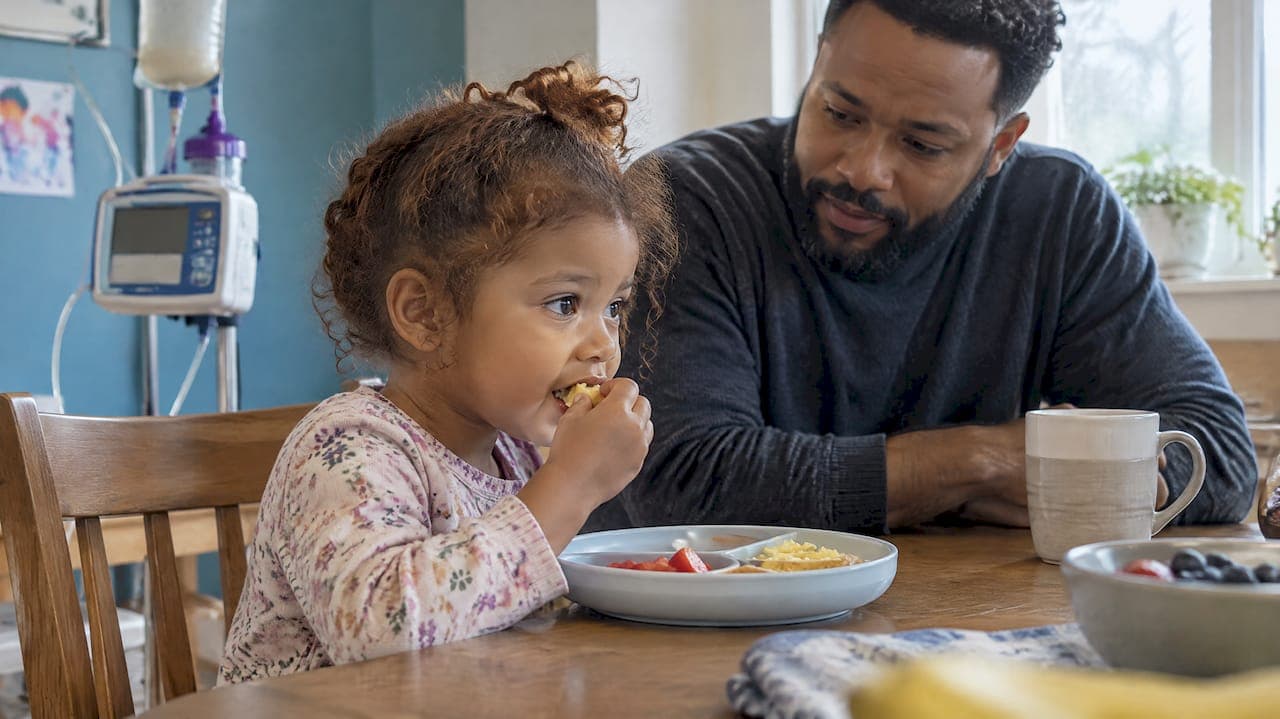
Moving from tube to oral feeding is a gradual, team-guided process. A child's medical team first confirms that eating by mouth is safe. Then the child practices small, low-pressure oral experiences while the tube keeps supplying nutrition. Tube feeds are reduced only as the child takes more by mouth, and the tube comes out when oral eating reliably supports growth and hydration. If you are in the middle of this, or just starting to wonder about it, we want you to know that it can feel overwhelming and that you do not have to figure it out alone.
TL;DR
- Weaning starts with a readiness check by your child's medical team: stable health, safe swallowing, steady growth, and a family that is ready.
- Your child can keep getting tube feeds while learning to eat by mouth. The tube is usually removed only once oral intake meets all nutrition and fluid needs.
- Timelines vary a lot, from days or weeks for some children to months or years for others. Slow and steady usually wins.
- Weight loss, breathing trouble, choking, or heavy stress at meals are reasons to call your care team promptly.
- A speech-language pathologist or feeding therapist can coach you in small steps so you are never handed a pile of recommendations at once.
Table of Contents
- What the transition from tube to oral feeding involves
- Is my child ready to start weaning?
- The steps of tube weaning
- Can my child keep tube feeds while learning to eat?
- How long does tube weaning take?
- What outcomes can families hope for?
- Who is on the team, and what do they do?
- Warning signs to watch for
- Our perspective at Thriving Joy
- How Thriving Joy can help
- Frequently asked questions
- Sources
What the transition from tube to oral feeding involves
A feeding tube exists because, for a period of time, eating by mouth could not keep a child nourished. The American Speech-Language-Hearing Association (ASHA) describes the transition process as a team assessment of medical stability, swallowing safety, oral-motor and feeding skills, nutrition and hydration, growth, positioning, and how ready the child and family are. After that, the team introduces positive, developmentally appropriate oral experiences with caregiver-supported practice, monitors intake and safety, adjusts tube feeds as oral intake rises, and removes the tube only when eating by mouth reliably supports growth and hydration.
In plain terms, three things have to come together:
- Safety. Your child can swallow without food or liquid going into the airway.
- Skill. Your child can chew, move food, and drink with enough efficiency that meals do not exhaust them.
- Motivation and comfort. Your child feels okay around food, and feels hungry enough to want it.
That third piece surprises many parents. After a long stretch of non-oral feeding, food can feel unfamiliar or even unpleasant. ASHA notes that intervention includes time to become comfortable around food after extended nonoral feeding, along with caregiver training and adjustments to positioning and feeding technique. Comfort is not a detour on the way to eating. It is part of the path.
Is my child ready to start weaning?
There is no single universal checklist. A scoping review of pediatric gastrostomy weaning notes that no standard guidelines exist on who should be weaned, when, where, or how. That is why the decision belongs to your child's medical team and not to a calendar.
That same review says clinicians may consider a child eligible when:
- the underlying condition is not progressing,
- nutritional status is age-appropriate or stable,
- swallowing is functional and safe, and
- the child and parents are ready.
The Oley Foundation adds that the team should look at the whole child before weaning, including adequate nutrition and hydration, stable lung status, controlled reflux, aspiration risk, and oral skills. A hospital protocol from the United Kingdom takes a similar view: children should be reasonably stable medically and nutritionally before tube feeds are reduced, though a stable, long-standing medical issue does not automatically rule weaning out.
A note about family readiness
Parents are part of the readiness equation, and that is not a judgment. Weaning asks you to tolerate some uncertainty: a child who eats less at first, meals that may be messy, and a plan that changes week to week. If you feel nervous, that is normal. Tell your team. A good plan accounts for your confidence and your family's schedule, not just your child's mouth skills.
The steps of tube weaning
Approaches differ, but the pieces are remarkably consistent. Alberta Health Services describes weaning approaches as behavioral, child- and family-centered, or biomedical, and says successful models are tailored to the child, involve an interdisciplinary team, and support safe swallowing and oral sensorimotor skills. Here is how those pieces usually look at home.
Step 1: Keep the mouth involved from the start
The University of Washington's feeding resource describes transition as something that begins when tube feeding starts. That means keeping up oral-motor stimulation, including your child at family mealtimes, and building normal meal and snack routines, even if the tube is doing most of the nutritional work.
If your child is already well into tube feeding, it is not too late. Sitting together at the table, letting your child touch, smell, and play with food, and offering tiny tastes all count.
Step 2: Offer short, calm oral practice
The Oley Foundation suggests brief practice sessions, often two or three times a day, commonly before tube feeds. The rest of the nutrition continues through the tube, so your child is never relying on how well a practice session goes.
The goal here is not volume. A UK hospital protocol on moving infants from nasogastric to oral feeding says the focus should be on developmental readiness and feed quality rather than how much is taken.
Step 3: Let hunger do some of the teaching
Many programs build in a carefully supervised reduction of tube feeds so that a child can actually feel hungry. The Graz program, studied in Austria, rests on two principles: letting the child feel hunger through supervised feed reduction, and encouraging autonomy through play-based, non-pressured food interactions.
A scoping review summarized by ASHA found that this kind of hunger provocation resulted in a 25% to 50% reduction in tube feedings and lower dependency in the short and long term. A pediatric tube feeding guide for parents also advises stopping tube feeds at least one hour before scheduled oral mealtimes to help stimulate appetite.
This is the step that most needs medical supervision. Reducing tube feeds on your own, without a plan for weight checks and hydration, is not safe. Your pediatrician, gastroenterologist, or dietitian should set the reduction schedule.
Step 4: Adjust as oral intake grows
As your child eats more, the team lowers tube volumes in small steps, tracks weight and fluids, and tweaks positioning, textures, and utensils. Here the plan stays flexible. If growth dips, the team can slow down and hold at a step for a while.
Step 5: Remove the tube when eating supports growth
The tube comes out when your child can eat and drink enough by mouth to keep growing and stay hydrated. A pediatric guide for caregivers notes it is common practice to keep the tube in place until a child consistently meets all nutrition and hydration needs orally, and that close monitoring helps prevent weight loss along the way.
Can my child keep tube feeds while learning to eat?
Yes, and in most plans that is exactly what happens. The tube acts as a safety net while your child builds skills. The same caregiver guide describes tube feeding as often continued as a supplement until nutritional requirements are met by mouth. The Oley Foundation likewise advises a gradual shift: keep nutrition steady through the tube, offer low-stress oral practice, and give the remainder by tube.
That safety net is also what lets everyone relax a little. When you know your child is getting what they need, a refused bite is just a refused bite, not an emergency.
How long does tube weaning take?
Honestly, it depends. A peer-reviewed review of feeding tube dependency reports that weaning may take days or weeks for some children but months or years for others. Follow-up periods in published studies range widely too, from 2 weeks to 6 years.
What shapes the timeline:
- Why the tube was placed. Medical complexity, reflux, airway issues, and prematurity all play a role.
- How long your child has been tube-fed. Longer reliance often means more time building comfort and skill.
- Oral aversion. A child who is wary of food needs more gradual exposure.
- Consistency of practice at home. Short, regular sessions tend to beat occasional marathon ones.
- Support around the family. Coaching, check-ins, and a coordinated team.
A 2026 Austrian study of tube-dependent children with congenital heart disease compared a telemedical coaching approach with on-site treatment. Both worked, with a median duration of 2.23 months for coaching versus 1.48 months on site. That is a single study in one group of children, not a promise for yours, but it shows that structured programs can reach their goals within months and that remote support can be a real option.
What outcomes can families hope for?
Results are encouraging when children get structured, team-based support. In the Graz study, 95.3% of 64 children with esophageal atresia or tracheoesophageal fistula moved to exclusive oral intake. ASHA's summary of the economic value of speech-language pathology cites that 61% of children who were orally defensive and tube-dependent were fully weaned, and that infants born preterm reached full oral feeds two weeks sooner and were 42% less likely to need a feeding tube at discharge.
We share these numbers with care. They come from specific groups of children in specific programs. Not every child will be fully weaned, and the scoping review reports that in 42% of studies, patients took all calories by mouth or had the tube removed during follow-up, while some studies noted ongoing tube dependency, weight loss, and chronic malnutrition. The honest takeaway: progress is common, and the right plan matters.
Who is on the team, and what do they do?
Tube weaning works best as a shared effort. An ASHA Leader article on weaning from a G-tube describes an interprofessional team that coordinates medical, nutritional, motor, and behavioral care. Speech-language pathologists support safe oral intake and oral-motor skills, and caregivers are trained in small steps. The academic review of feeding tube dependency recommends involvement from pediatrics, dietetics, psychology, speech-language pathology, and/or occupational therapy.
In practice that often looks like:
| Team member | What they usually contribute |
|---|---|
| Pediatrician or gastroenterologist | Medical clearance, growth monitoring, tube feed orders |
| Registered dietitian | Calories, fluids, formula and feed schedule |
| Speech-language pathologist or feeding therapist | Swallow safety, oral-motor skills, mealtime strategies, caregiver coaching |
| Occupational therapist or psychologist | Sensory comfort, behavior and anxiety around food |
| You | Daily practice, observations, and the final say on what works for your family |
Oral comfort matters too. For some children, a gentle visit with a pediatric dentistry team is a helpful addition to the circle that looks after the mouth, teeth, and gums that your child is learning to use for eating.
The same ASHA Leader piece stresses that slow and steady is key and that caregivers should not be overwhelmed with too many recommendations at once. We agree wholeheartedly. One or two changes a week is plenty.
Warning signs to watch for
During weaning, keep an eye out for weight loss, breathing difficulty, choking, or heavy stress during feeds. A pediatric tube feeding guide for caregivers lists these as signs to contact your care team, especially if you suspect food or liquid is going into the airway, so the feeding plan can be adjusted or readiness reassessed.
Some practical guidance:
- Breathing trouble, repeated coughing or choking with eating, or blue or gray color around the lips: stop the feed and call your pediatrician right away, or 911 in an emergency.
- Fewer wet diapers, unusual sleepiness, or visible dehydration: call your pediatrician or dietitian the same day.
- Weight that is flat or dropping: let your team know before the next scheduled visit, as they may pause the reduction.
- Meals that have become tearful or battles of will: ask your feeding therapist to help you reset. Pressure tends to work against progress.
Our perspective at Thriving Joy
We see tube weaning as a family journey, not a procedure. The families we meet are usually tired, hopeful, and carrying a lot of worry. Our pediatric feeding therapy is built on a holistic, family-centered approach that looks for the root causes behind a feeding challenge rather than reaching for a quick fix. That is especially important with tube weaning, where a rushed plan can set a child back.

We also believe parents are the most important members of the team. You know your child's cues better than anyone, and our job is to turn clinical knowledge into small, doable steps for your kitchen table. We can work with families in our office, at home, or at daycare or preschool, because a child's skills only count if they show up in the places where your child actually eats. Our founder brings both a pediatric healthcare background and personal parenting experience, so we understand the clinical side and the emotional side.
We work alongside your child's physician and dietitian, never in place of them. Medical decisions such as when to reduce feeds and when to remove a tube stay with your medical team, and we help your child build the oral skills and comfort to make those steps possible.
— Thriving Joy
How Thriving Joy can help
If your child in Pasco or Hillsborough County is working toward eating by mouth, our feeding therapy and tube weaning support are designed to meet you where you are. We accept private pay, major health insurance plans, and scholarships, and you can explore our parent coaching, support groups, and workshops if you would like guidance in a group or one-on-one setting. For a closer look at how we think about weaning, you can read our guides to NG tube weaning and G tube weaning. To start a conversation, visit our home page.
Frequently asked questions
Do all tube-fed children eventually eat by mouth?
Not every child, and the answer depends on the medical reasons behind the tube. Many children do make progress, and some are weaned fully, but published results vary by diagnosis and program. Your medical team can give you a realistic picture for your child.
Is it safe to wean my child at home?
Tube weaning should be supervised by your child's medical team, because feed reductions need weight, hydration, and swallowing safety checks. Home is where most daily practice happens, and that practice is valuable. Just make sure a physician or dietitian is guiding the schedule.
Will my child lose weight during weaning?
Some children do dip, which is why monitoring is built into every good plan. If weight drops, the team can slow the reduction or hold at the current step. Tell your team promptly about any weight loss rather than waiting to see if it passes.
What if my child refuses food completely?
Refusal is common after long periods of tube feeding, and it does not mean weaning has failed. A feeding therapist can help with gradual, pressure-free exposure, sensory comfort, and positioning. Keeping meals calm and playful usually helps more than insisting on bites.
Sources
- Pediatric Feeding and Swallowing, ASHA
- Pediatric gastrostomy feeding tube weaning strategies, scoping review
- Weaning Preparation for Children Fed by G-Tube, Oley Foundation
- Tube weaning protocol, Royal Alexandra Children's Hospital
- Transition from Nasogastric to Oral Feeding, 2022 protocol
- Tube Weaning: Transition from Enteral to Oral Feeding, Alberta Health Services
- Feeding resource, University of Washington
- Efficacy of a standardized tube weaning program, Graz model
- Pediatric Gastrostomy Feeding Tube Weaning Strategies, ASHA Evidence Map
- Pediatric Tube Feeding Guide for Parents and Caregivers, 2024
- Development, prevention, and treatment of feeding tube dependency
- Standardised tube weaning in children with CHD, telemedical Netcoaching
- The Economic Value of Speech-Language Pathology Services, ASHA
- Teamwork to Wean a Child From G-Tube to Food, ASHA Leader