
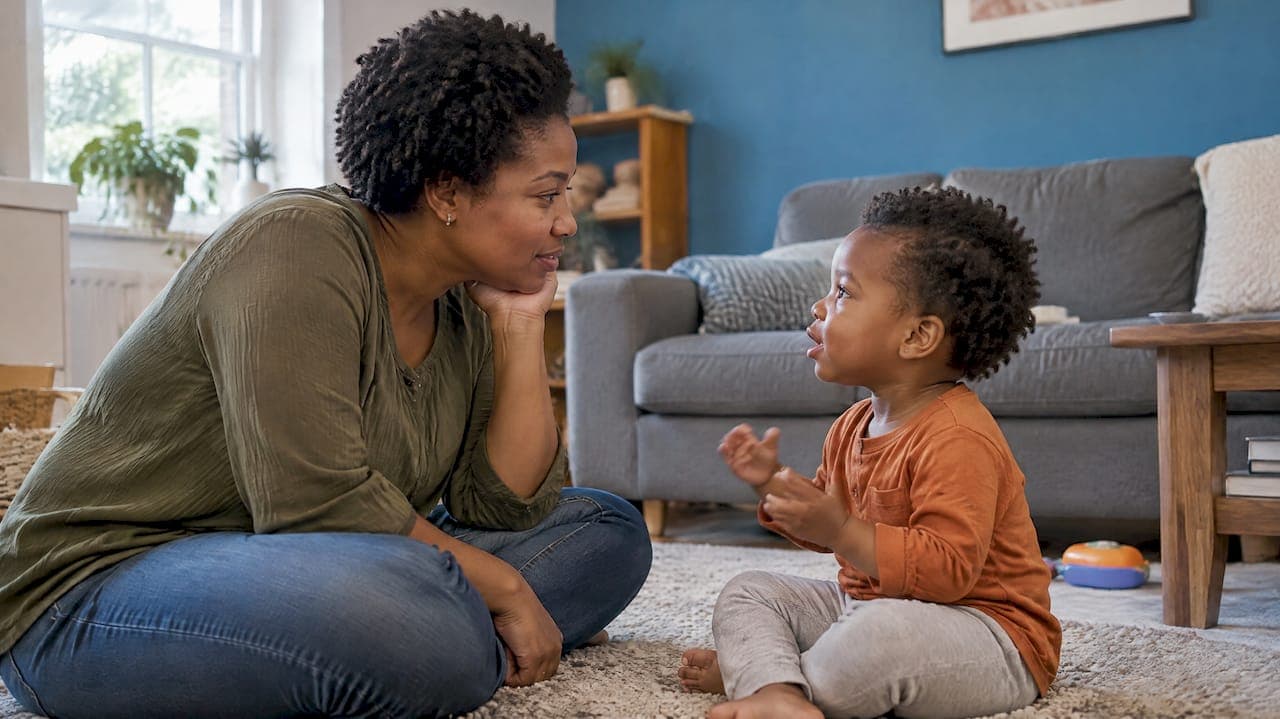
No, raising your child with two languages does not cause a speech delay. The American Academy of Pediatrics' parent site states plainly that speech or language problems are not caused by learning multiple languages. But a bilingual child can still have a true delay, just as any child can, and the same warning signs apply. This guide walks through what to expect, what is normal, and when it is time to call a speech-language pathologist.
TL;DR
- Bilingualism does not cause speech or language delay, and you do not need to drop a language to "make things easier."
- Bilingual children follow the same milestones as other children: a first word around 12 months and two-word phrases by about 24 months.
- Count words in both languages together. Fewer than 50 total words at 24 months, or no word combinations, is a reason to seek an evaluation rather than wait.
- Mixing languages in one sentence and a quiet stretch after a new language starts are both typical.
- Keep speaking the language you are most comfortable with, and ask for an evaluation that takes both languages into account.
Table of Contents
- Why the "bilingual delay" myth lasts
- What typical bilingual development looks like
- Milestones to watch, by age
- When a delay is real: signs that call for an evaluation
- How a bilingual child should be evaluated
- Should you stop speaking one language?
- What therapy looks like for a bilingual child
- Our perspective
- Getting help for your child at Thriving Joy
- Frequently asked questions
- Sources
Why the "bilingual delay" myth lasts
Most parents have heard it from a relative, a neighbor, or even a well-meaning professional: "Two languages will confuse him. That's why he isn't talking yet." It sounds logical. Two sets of words seem like more work, so surely it takes longer.
Researchers have looked at this belief closely. A 2023 paper by Peña and colleagues, Exploring Assumptions of the Bilingual Delay, describes how widespread the belief is, including among health care providers. The practical harm is real: when a delay is blamed on bilingualism, a child can wait months or years for help that would have made a difference.
The myth also pushes families to make a hard choice. Some stop speaking their home language to their toddler, which can cost the child a connection to grandparents and culture without solving anything. If your child is truly behind, the cause lies somewhere else, and finding it matters far more than choosing a language.
What typical bilingual development looks like
Children learning two languages hit the same landmarks as children learning one. According to the AAP's parent guidance, most say a first word around 12 months and use two-word phrases by 24 months. Their total number of words should be about the same as a same-age child learning one language.
That last point is the one parents most often miss. A bilingual toddler's vocabulary is split across two languages, so each language on its own may look smaller. You have to look at the whole picture.
Count words in both languages
Say your daughter uses "agua" for water and "milk" for milk. Both count. If she says "perro" and "dog" for the same animal, that counts as two words in total vocabulary terms, because she has learned two labels. Keep a simple running list on your phone, in whatever language she uses, and add to it for a couple of weeks. We go deeper on this method in our post on counting words in both languages.

Typical behaviors that are not red flags
Some things that worry parents are part of the normal path:
- Mixing languages in one sentence. This is a normal part of multilingual development and not a sign of confusion, as JAMA Pediatrics explains in its guidance for parents.
- A quiet period. When a child starts hearing a new language, for example at daycare, some children go through a silent period that can last several months, according to Reading Rockets. They are listening and absorbing, not stuck.
- One language stronger than the other. Dominance often shifts with where the child spends time and who talks with them.
Milestones to watch, by age
Use these as windows into your child's development, not a pass-fail test. Count both languages together.
- By about 12 months: first words, plus babbling, pointing, waving, and responding to their name.
- By about 18 months: a growing set of words, understanding simple directions in either language, and trying to imitate sounds. Our 18 month milestone guide includes a simple three-word check.
- By 24 months: roughly 50 or more words in total across languages and the start of two-word combinations like "more juice" or "mama up."
- After age 2: speech that other people can understand more and more of, even if strangers still miss some words.
If your older child talked earlier, resist comparing. As HealthyChildren notes, a sibling may simply have been advanced for their age, so measure against expected milestones instead.
When a delay is real: signs that call for an evaluation
A true language delay can happen in any child, in one language or two. The American Family Physician review (2023) lists these concerning signs:
- Fewer than 50 words at 24 months or older
- Speech that is still incomprehensible after age two
- Loss of speech or language skills the child previously had
A two-year-old who uses fewer than 50 words or does not combine words is considered a late talker, and the same review advises against simply watching and waiting in those cases. Referral criteria are the same for monolingual and bilingual children. There is no "extra time" for a second language.
A few other situations also deserve a call: your toddler rarely tries to communicate by gesture or sound, does not seem to understand simple requests in either language, or seems to pull back from interaction. Some of these overlap with other developmental questions, which we cover in 50 words by 24 months: autism vs. language delay. For a broader checklist, see our guide to early signs of speech delays.
Hearing and mouth structure are part of the picture too. The AFP review recommends that children with speech or language concerns be referred for both speech-language pathology and audiology evaluations. Some families also want to understand how the tongue and mouth are working, and a pediatric dental perspective on tongue health red flags can help you know what to mention to your child's care team.
How a bilingual child should be evaluated
A good evaluation does not measure a bilingual child against a monolingual yardstick. It should consider every language the child speaks or understands, and which language is preferred at home, per the AFP guidance.
In practice, that looks like this:
- A detailed history. Which languages are spoken, by whom, how often, and since when.
- Observation of play and interaction. How your child communicates with you, in the language they use with you.
- Both languages assessed where possible. Looking at total communication, not only English.
- An interpreter when needed. If parents speak limited English, a trained interpreter is essential to capture the complete picture of the child's language system, as Contemporary Pediatrics points out. A relative translating on the spot is not the same.
- Hearing screening. Hearing problems can look like language delay.
If you want to know what the visit itself feels like, we describe it step by step in what happens during a speech-language evaluation.
Where to start in Florida
For children under three, the AFP review notes that early intervention programs allow parents to self-refer for evaluation of speech and language concerns. You do not necessarily need a pediatrician's referral to start the process. Your pediatrician is still a good partner, and can check hearing and overall development. Many families in Pasco and Hillsborough Counties begin with both: a call to the early intervention program and a visit to the pediatrician.
Should you stop speaking one language?
No. Parents and caregivers should use the language or languages they are most comfortable with, per the AAP. Children with speech or language disorders can learn additional languages too.
There is a practical reason this advice works. Children build language through the amount and richness of what they hear. A research review in PMC reports that the amount of speech children hear at 16 or 18 months predicts vocabulary growth and processing speed at older ages. A parent speaking naturally and warmly in their strongest language gives more rich input than one struggling through a second language to "be safe."
Make the conversation count
JAMA Pediatrics authors Drs. Othman and Thompson explain that children learn languages better through direct, in-person conversation in their household languages than through passive exposure to television or radio. A few easy habits:
- Narrate daily routines like bath, meals and walks in whichever language feels natural.
- Read picture books together and talk about the pictures, pausing so your child can respond.
- Give each caregiver a comfortable language, or mix freely. Both approaches work.
- Wait three to five seconds after asking a question. Toddlers need time to answer.
- Expand what your child says: if they say "car," you say "yes, a big red car."
What therapy looks like for a bilingual child
Speech-language therapy works. Systematic reviews, as summarized in the same PMC review, find it effective for many disorders, alone or alongside other developmental services. For toddlers, therapy is usually play-based and coached through parents, because you are the person your child talks with most.
For a bilingual family, a good therapist will build on the languages in your home instead of asking you to switch to English only. You will leave sessions with simple strategies you can use in whichever language you speak, during snack time, bath time, and the car ride.
How often to attend is a common question. We suggest a 6 to 8 week checkpoint to review progress and adjust the schedule, and our guide on when to start speech therapy covers the 18 to 24 month window in more detail.
Our perspective
We meet many families who were told to wait, or who were told to pick one language. Usually they are tired, a little guilty, and quietly sure something is off. Our view is simple: your instinct deserves a real answer, and a bilingual home is never the problem to fix.
We look for root causes instead of reaching for quick fixes. For a late talker, that means asking about hearing, oral-motor skills, feeding history, social interaction, and how much back-and-forth conversation happens in a day. Sometimes feeding and speech are connected, since the same muscles and the same sensory systems are involved, which is one reason we offer both under one roof.
We also believe the parent is the most important member of the team. Our sessions are family-centered, and we can meet your child in our office, at home, or at daycare or preschool, wherever your child is most relaxed and where new skills will actually be used. We want you to leave feeling more confident, not more worried.
— Thriving Joy
Getting help for your child at Thriving Joy
If you are in Pasco or Hillsborough County and have a toddler or preschooler whose speech has you wondering, our speech therapy services start with listening to your family's story and your languages. We accept private pay, major health insurance plans and scholarships, so ask us about your options. Not sure whether it is time? Read about early intervention speech help, then reach out and we will talk it through with you.
Frequently asked questions
What age should a bilingual child start talking clearly?
Most bilingual children say first words around 12 months and combine two words by about 24 months, the same as other children. Clarity develops gradually, and strangers understand more of a child's speech with each passing year. If speech is still incomprehensible after age two, ask for an evaluation.
Is a 2-year-old considered a late talker?
A two-year-old with fewer than 50 words, or who does not combine words, is considered a late talker. For bilingual children, count words from both languages together. The AFP review advises seeking an evaluation rather than waiting, because early identification is beneficial.
How long does it take bilingual babies to talk?
Most say their first words by about age one, just like children learning one language. If a child begins a new language, such as when starting daycare, a quiet period lasting several months can be normal. Mixing words from both languages is also typical.
At what age is speech considered delayed?
Concern begins at 24 months if a child has fewer than 50 words or no word combinations, or at any age if a child loses skills they once had. Speech that remains hard to understand after age two also warrants a referral. The same criteria apply to bilingual children.
Sources
- Young Children Learning Multiple Languages: Parent FAQs, HealthyChildren.org
- How to Raise Concerns about a Child's Speech and Language Development, HealthyChildren.org
- Speech and Language Delay in Children, American Family Physician (2023)
- What Parents Should Know About Children With Multiple Languages, JAMA Pediatrics (2024)
- Learning Two Languages, Reading Rockets
- Language development in bilingual children: A primer for pediatricians, Contemporary Pediatrics
- How young children learn language and speech: Implications, PMC