
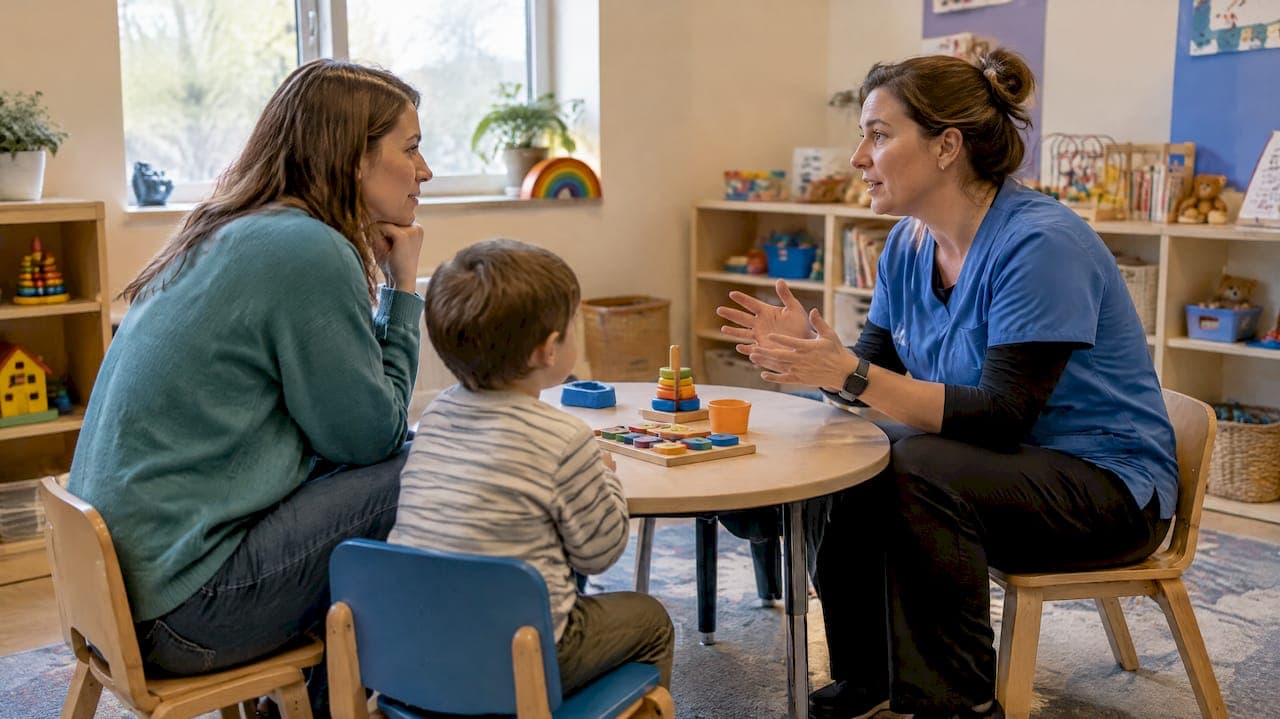
Most families begin with weekly sessions, and children with more complex motor-speech needs often benefit from 2 to 3 sessions a week or short intensive blocks. There is no single right answer: the best schedule depends on your child's diagnosis, age, and how they respond over time. The first real step is an evaluation that sets measurable goals, so frequency has something concrete to aim at.
TL;DR:
- Children with more complex motor-speech needs often benefit from two to three sessions per week or short intensive blocks, depending on their diagnosis and progress.
- For milder delays, weekly 30 to 45-minute sessions paired with consistent home practice are typically sufficient, while more severe cases like apraxia may need intensive scheduling.
- The evidence shows that treatment effectiveness depends more on total hours, session intensity, and home practice than on a fixed number of clinic visits.
- Diagnosis and severity influence the optimal frequency, with some conditions responding better to higher intensity or shorter, more frequent sessions.
- A flexible, measurable plan that includes regular evaluation and incorporates home practice yields better results than rigid, one-size-fits-all scheduling.
Table of Contents
- Typical speech therapy frequency and session length by age
- How diagnosis and severity change the frequency your child needs
- What the research actually says about dose and intensity
- Building a measurable plan to find your child's right frequency
- How home practice changes how often you need clinic visits
- Why we treat frequency as a question, not a default
- Getting started with speech therapy built around your child
- FAQ
- Sources
Typical speech therapy frequency and session length by age
Session length and frequency usually move together. Younger children, with shorter attention spans, often do best with shorter, more frequent sessions, while school-age kids can sustain longer blocks of focused work.
Here is how that typically breaks down in practice:
- Weekly sessions (30 to 45 minutes) suit many children with mild to moderate delays who also practice consistently at home.
- Twice-weekly sessions often fit kids working on multiple goals or showing slower-than-expected progress on a weekly plan.
- Three times a week is common for more involved motor-speech needs, where frequent repetition speeds up learning.
- Intensive blocks (several sessions a week for a few weeks, sometimes called a "bootcamp" model) are used for short-term pushes toward a specific goal, often for childhood apraxia of speech.
A toddler might attend twice-weekly play-based sessions lasting about 30 minutes. A preschooler with a phonological disorder might have weekly 45-minute sessions paired with home practice. A school-age child with apraxia might start with an intensive block, then taper to weekly maintenance visits as part of therapy. Clinicians weigh various factors before landing on a plan.
How diagnosis and severity change the frequency your child needs
Not every speech or language challenge calls for the same intensity. The diagnosis, and how pronounced it is, shapes what a reasonable schedule looks like.
- Childhood apraxia of speech (CAS) often responds well to more frequent or intensive delivery. A randomized trial found that when total treatment hours were held constant, intensive scheduling produced greater immediate generalization than spreading the same hours over a longer period, with no meaningful difference between in-person and telepractice delivery.
- Speech-sound and phonological disorders often respond to higher intensity too, though the research base is thinner and more variable across studies than for CAS.
- Developmental language disorder (DLD) shows mixed results. A systematic review of children ages 3 to 18 found no single best frequency: some children did best with frequent short sessions two to three times a week, others with one weekly session built around roughly 20 minutes of focused practice.
- Watch for signs your child may need more frequent sessions: progress stalling, errors that do not carry over into everyday talking, or goals that keep multiplying without resolution.
What the research actually says about dose and intensity
Parents often ask whether more sessions automatically mean faster progress. The honest answer is more nuanced than that.

No systematic review has found one universal prescription for frequency. A 2023 systematic review and meta-analysis spanning 38 studies and 108 treatment effects found that longer sessions delivered over longer periods tended to track with better outcomes, but the sheer number of sessions was not a consistent predictor on its own. The same review reported a modest average effect size (d = 0.27 right after treatment, dropping to d = 0.18 at follow-up), a reminder that gains from any single dosage choice tend to be real but modest, and that publication bias may inflate some reported results.
A few patterns show up across the evidence:
- Holding total treatment hours steady, intensive schedules can speed up generalization, though that early edge does not always hold up months later.
- The number of practice trials within a session (the dose) can matter as much as how many sessions you book.
- Clinicians weigh dose, how sessions are spaced, and cumulative hours together rather than treating session count as the only lever, since some interventions show diminishing returns past a certain point.
Building a measurable plan to find your child's right frequency
Instead of picking a frequency and hoping, the more reliable path treats frequency as one piece of a plan you can measure and adjust.
- Start with a baseline evaluation. A thorough assessment identifies specific, measurable short-term goals, not just a general sense that "speech needs work." This typically includes a communication evaluation and goal-setting conversation at the first visit, along with details on what the evaluation involves.
- Choose a schedule that fits the whole picture. Diagnosis, attention span, how much home practice your family can realistically sustain, and your clinician's recommendation all factor in.
- Set a checkpoint, often around 6 to 8 weeks out, with objective criteria for whether frequency should increase, decrease, or stay the same.
- Ask your SLP direct questions: How many practice trials happen per session? Would teletherapy work for part of the plan? What would tell us this frequency is not enough?
Pro Tip: Bring a short list of specific behaviors you have noticed at home to your evaluation. It gives your clinician real data to build measurable goals around from day one.
How home practice changes how often you need clinic visits
Clinic time and home practice work together, not separately. Brief, focused practice between sessions often determines how much clinic frequency a child actually needs.
- Micro-practice sessions of 2 to 10 minutes daily, built around a single target sound or phrase, reinforce what happens in the therapy room far more than occasional long practice sessions.
- SLPs commonly track carryover with practice logs, short video clips, or simple home activities, adjusting the plan based on what actually happens between visits.
- Consistent home practice can sometimes offset the need for a third weekly session for milder goals, but for CAS, clinic intensity usually still matters because motor-speech learning benefits from a clinician's hands-on cueing and feedback.
- Our activities for building speech skills at home and toddler speech activities give families a starting point for that daily practice.
Why we treat frequency as a question, not a default
There is no one-size-fits-all schedule; frequency recommendations should grow out of a family-centered evaluation that looks at the child's specific goals, not a generic protocol.
Insurance limits and school-based services often shape what is realistic, so parent coaching, teletherapy, and short intensive blocks can help fill gaps when weekly clinic time is not enough on its own. Our advice to every parent: track what you see at home, and insist on an honest reassessment rather than staying on autopilot.
— Thriving Joy
Getting started with speech therapy built around your child
We build every speech therapy plan around your child's actual goals, starting with a real evaluation rather than a standard script. Our family-centered approach looks at the root causes behind a communication delay, whether that means more frequent sessions during a focused stretch or a steady weekly rhythm paired with home coaching.
At your first visit, expect a full communication evaluation, a conversation about what progress should look like, and measurable goals we revisit together on a regular schedule. We also offer flexible therapy locations, including home, daycare, or preschool, when that fits your family's routine better than an office visit. If you are weighing how often your child should be seen, reach out through our speech therapy page to schedule an evaluation and check your insurance coverage before you commit to a plan.
This article is general information, not a substitute for advice from a qualified doctor. Consult a qualified healthcare professional about your own circumstances before acting on anything here.

FAQ
How often should speech therapy be?
Most children start with one weekly session, with two to three sessions a week common for more complex motor-speech needs like childhood apraxia of speech. The right frequency comes from an evaluation and measurable goals, not a fixed rule, and a systematic review of dosage in developmental language disorder found no single frequency worked best for every child.
What is the 3:1 rule in speech therapy?
There is no established clinical standard called the "3:1 rule" in the research we reviewed, and definitions of it vary informally among practitioners. Rather than relying on an unverified ratio, ask your SLP how they are structuring dose and frequency for your child's specific goals.
Can a speech-language therapist diagnose autism?
A speech-language pathologist can identify communication and language patterns that may prompt a referral for a full autism evaluation, but a formal autism diagnosis typically requires a multidisciplinary team that includes a developmental pediatrician or psychologist. An SLP's evaluation often becomes part of that larger diagnostic picture rather than standing alone.
Which frequencies are most important for speech therapy progress?
The evidence points to individualized dose and distribution mattering more than any fixed number of sessions. A 2023 meta-analysis across neurodevelopmental disorders found longer sessions over longer periods tracked with better outcomes, while total session count alone was not a reliable predictor.
Is teletherapy as effective as in-person speech sessions?
Research on childhood apraxia of speech found no meaningful difference between telepractice and in-person delivery when total treatment hours were matched, according to a randomized trial comparing distributed and intensive schedules. A broader overview of teletherapy evidence outlines outcomes across more conditions for parents weighing the option.
Sources
- The Influence of Quantitative Intervention Dosage on Oral Language Outcomes for Children With Developmental Language Disorder: A Systematic Review and Narrative Synthesis
- Randomized trial comparing distributed and intensive schedules for childhood apraxia of speech (2023)
- Dosage, intensity, and frequency: systematic review/meta-analysis (2023)
- Cleveland Clinic — What to expect in pediatric speech therapy