
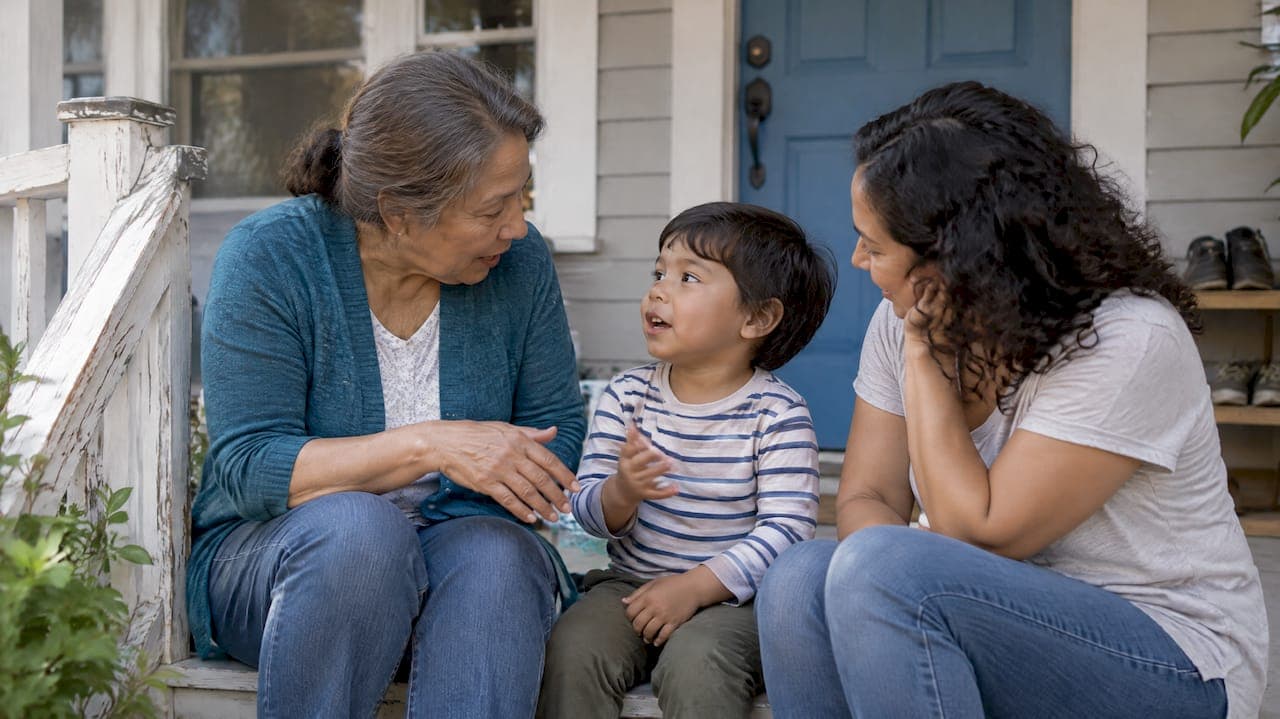
Bilingualism does not cause language delay. If your child is learning two languages, the clearest way to check their progress is to look at their total or conceptual vocabulary, meaning everything they understand and say across both languages combined, rather than judging each language on its own against monolingual charts. From there, simple routines, steady observation, and a quick conversation with your pediatrician if something feels off will serve you well.
TL;DR:
- Track distinct words across both languages, or count each concept once when your child knows its name in either language; single language scores can understate progress.
- Predictable routines, such as one caregiver using one language, support learning; responsive conversation, shared reading, and play offer more value than passive screen time.
- Seek advice if your child loses words or skills, makes little combined progress in both languages, or rarely communicates through speech, gestures, or eye contact.
- Record what your child says and understands in each language for a couple of weeks, then ask your pediatrician about assessment by a bilingual specialist.
Table of Contents
- How Bilingual Development Unfolds: Simultaneous vs. Sequential Paths
- Milestone Snapshots by Age and How to Read Them
- Documented Advantages of Bilingualism for Cognition and Social Growth
- Daily Routines That Strengthen Both Languages
- Red Flags and When to Seek a Bilingual-Aware Evaluation
- How Family-Centered Therapy Supports Bilingual Kids
- How Culture and Language Diversity Shape Bilingual Development
- Why Family and Community Support Matter for Bilingualism
- Myths About Bilingual Language Development, Debunked
- Balancing Two Languages Without Overloading Your Child
- Social and Emotional Benefits of Growing Up Bilingual
- An Encouraging, Science-Grounded Take for Worried Parents
- How Our Speech Therapy and Parent Coaching Support Bilingual Families
- FAQ
- Sources
How Bilingual Development Unfolds: Simultaneous vs. Sequential Paths
Children come to two languages in one of two ways. Simultaneous bilinguals are exposed to both languages from birth or within the first few months of life, often because each parent speaks a different language at home. Sequential bilinguals learn one language first, usually at home, and then add a second one later, commonly when they start daycare or preschool. Both paths are typical, and neither one puts a child at a disadvantage.
Within either path, the building blocks look familiar: babbling gives way to first words, then two-word combinations, then longer phrases. What differs is the pace in each individual language, since a child's exposure to each one rarely splits evenly. A child might lean more heavily on Spanish at home and pick up English vocabulary at a faster clip once preschool starts, and that lopsided pattern is expected rather than a warning sign.
This is where total and conceptual vocabulary become useful tools. Total vocabulary adds up every distinct word a child uses across both languages, while conceptual vocabulary counts a concept once even if the child only has a word for it in one language (saying "perro" but not yet "dog" still counts as knowing the concept). Research on total and conceptual vocabulary shows this combined measure tracks much closer to monolingual growth curves than scores from either single language alone, and it helps identify children who may actually be at risk for a language delay.
A few practical distinctions worth keeping in mind:
- Simultaneous bilinguals often blend sounds and words from both languages early on, which reflects one developing language system rather than confusion.
- Sequential bilinguals may go through a quiet period in the new language before speaking it, which is a normal adjustment phase.
- Vocabulary size in each separate language can look smaller than a monolingual peer's, even when total vocabulary is right on track.
Milestone Snapshots by Age and How to Read Them
Bilingual children generally follow the same developmental arc as monolingual children, just distributed across two languages. The CDC's milestone guidance gives useful age markers, and applying them across both languages combined, rather than language by language, gives a more accurate picture.
- 0 to 12 months: babbling with a range of sounds, turning toward their name, and sharing attention with a caregiver by looking where you point.
- 12 to 24 months: first words emerge in one or both languages, word combinations begin, and understanding (receptive language) grows faster than speech.
- 2 to 3 years: multiword phrases appear, back-and-forth conversational turns become more frequent, and early grammar rules start showing up, sometimes mixed between languages.
- 3 to 5 years: sentences grow longer and more grammatically complete, and storytelling and sequencing of events develop.
Progress in each individual language will likely look uneven, and that variability is part of typical bilingual development, not a reason for alarm on its own.
Documented Advantages of Bilingualism for Cognition and Social Growth
Raising a bilingual child comes with real, well-documented upsides that go beyond simply speaking two languages. A broad review of bilingualism research found that children are neurologically prepared to absorb more than one language from birth, and many long-held fears about bilingual delay simply are not supported by the evidence.
Children learning two languages are not inherently at greater risk for language disorders than their monolingual peers, according to research on bilingual language development, which means the gains tend to outweigh the adjustment period many families worry about.
Beyond the core language skills, parents often see benefits such as:
- Stronger cognitive flexibility, since switching between two language systems exercises attention and mental control.
- A deeper connection to cultural identity and extended family, especially when a heritage language is involved.
- Social advantages that come from communicating comfortably with a wider circle of people.
Some researchers have also suggested bilingualism may offer protective effects against cognitive decline later in life, though this remains an area of ongoing study rather than a settled conclusion.
Daily Routines That Strengthen Both Languages
Supporting two languages at home does not require a strict schedule or special materials. What matters most is the quality and quantity of interaction your child gets in each language, and research on early bilingual exposure points to live, responsive conversation as the strongest driver of vocabulary growth, more so than passive screen time.
A few structures that tend to work well for families:
- One person, one language: each caregiver consistently speaks a specific language, which gives the child a predictable pattern to follow.
- Language-designated times or places: certain hours of the day, rooms, or activities are linked to one language, such as reading in the heritage language before bed.
- Play-based exposure: toys, games, and pretend play naturally invite back-and-forth exchanges in either language. Our play-based speech therapy activities offer simple ideas you can try the same evening.
Within those routines, a handful of interaction habits make a real difference. Scaffolding, where you build on what your child already said, and expansion, where you add a word or two to their phrase ("more juice" becomes "you want more juice"), both model correct grammar without turning conversation into a lesson. Encouraging genuine back-and-forth turns, rather than one-sided narration, gives your child repeated chances to practice.
When it comes to media, interactive and co-viewed content works far better than solo screen time, and nothing replaces live conversation with another person. Arranging playdates with peers who speak each language also gives your child real reasons to use both.
Pro Tip: Narrate your own actions out loud during daily routines like cooking or folding laundry. It gives your child a steady stream of natural vocabulary with zero extra effort on your part.

Red Flags and When to Seek a Bilingual-Aware Evaluation
Most variability in bilingual development is typical, but a few patterns are worth a closer look. Watch for a loss of words or skills your child once had, very limited progress in both languages combined (not just one), or minimal interest in communicating with others at all, whether through words, gestures, or eye contact.
Standard speech-language tests are often built and normed on monolingual children, which can make a bilingual child look delayed when they are not. Clinical assessment guidance recommends combining several tools, including language samples, parent-report checklists, and dynamic assessment, to get an accurate read on a bilingual child's true abilities rather than relying on a single standardized score.
If you are concerned, a few concrete steps help:
- Jot down specific examples of what your child says and understands in each language over a couple of weeks.
- Bring those notes to your pediatrician and ask about a referral.
- Ask specifically for a speech-language pathologist experienced in bilingual language evaluation, since that background changes how test results get interpreted.
How Family-Centered Therapy Supports Bilingual Kids
When a bilingual child does need extra support, therapy works best when it looks at the whole picture rather than one language in isolation. A family-centered approach typically includes:
- An assessment that considers both languages together, not just the one spoken at the evaluation.
- Parent coaching that turns everyday routines, mealtime, bath time, car rides, into language-building opportunities.
- In-home or in-daycare sessions that use play to target real communication goals in context.
This kind of coaching helps caregivers feel confident carrying strategies into daily life long after a session ends.
How Culture and Language Diversity Shape Bilingual Development
The languages a child grows up hearing are rarely just a communication tool. They carry extended family relationships, cultural traditions, and a sense of belonging that shapes identity well beyond vocabulary size. A child who hears a grandparent's language at home is absorbing more than words, they are learning how that language connects to family stories, holidays, and values.
Linguistic diversity within a household or community also affects how a child's two languages develop. A child surrounded by several bilingual peers, cousins, or neighbors tends to get richer, more varied input than a child whose second language comes from a single source, like one parent or a weekly class. More voices and contexts generally mean more opportunities to hear the same words used in different ways, which supports deeper understanding.
Cultural attitudes toward bilingualism matter too. In communities where speaking two languages is common and valued, children often feel more comfortable using both languages openly. In settings where one language carries more social status than the other, children may shift toward that language even at home, sometimes letting the other one fade without steady reinforcement. Being aware of this dynamic helps families make intentional choices about which language gets emphasis at which stage, rather than letting outside pressure decide for them.
Why Family and Community Support Matter for Bilingualism
A child's bilingual development rarely rests on one caregiver's effort alone. The people around a child, parents, grandparents, older siblings, daycare providers, and family friends, all contribute input, and that combined exposure adds up to the total language environment a child experiences each day.
Consistency across caregivers helps enormously. When everyone in a child's life understands which language goes with which person or setting, the child develops a reliable mental map for switching between them. This is part of why structures like one-person-one-language tend to work well in multi-caregiver households. For co-parents who live apart or have different approaches to language use, having a shared plan matters just as much as having a shared parenting plan for anything else; resources like a coparenting communication plan can help both parents stay aligned on routines, including which language to use when and how to support consistency across two households.
Community involvement extends this support outward. Bilingual playgroups, heritage language schools, religious or cultural community centers, and even extended family visits give children a reason to use both languages with people outside the immediate household. The wider the circle of people a child practices with, the more natural and durable both languages tend to become.
Myths About Bilingual Language Development, Debunked
A few persistent myths cause unnecessary worry for parents raising bilingual children, and most of them do not hold up against the evidence.
Myth: Bilingualism confuses children and delays their speech. This is one of the most common fears, yet reviews of the bilingualism research find no support for the idea that learning two languages causes delay. Children are capable of acquiring multiple language systems from the start.
Myth: Mixing words from two languages in one sentence means a child is struggling. This behavior, known as code-switching, is actually a sophisticated skill. Studies on code-switching in young bilinguals show it reflects a strategic choice to maximize expression, often pulling whichever word comes to mind fastest or fits the context best, rather than a sign of confusion.
Myth: A child should master one language before starting a second. There is no evidence requiring sequential mastery, and many simultaneous bilinguals learn both languages side by side without issue from infancy.
Myth: If a child has a language disorder, bilingual exposure made it worse. Research comparing bilingual children with and without developmental language disorder finds that bilingualism does not increase the population-level risk for these disorders; children who have them would have them regardless of how many languages they hear.

Balancing Two Languages Without Overloading Your Child
Parents often worry about giving "too much" of one language or not enough of the other, but the goal is steady, meaningful exposure rather than a perfectly even split. Experimental research on dual-language input suggests that predictable, consistent patterns, like a parent always speaking the same language or a specific activity always happening in the same language, support word learning better than abrupt, unpredictable switching mid-conversation.
A few ways to keep exposure balanced without turning it into a chore:
- Stick to a consistent pattern (by person, place, or activity) so your child knows what to expect in each context.
- Let interest lead some sessions. If your child is excited about dinosaurs, follow that topic in whichever language fits the moment, rather than forcing equal time on an unrelated subject.
- Watch for signs of fatigue, like resisting a language altogether, and ease up rather than pushing harder.
There is no need to track minutes spent in each language like a strict budget. Consistency in pattern matters more than exact parity in time, and a flexible, low-pressure approach keeps both languages feeling natural rather than like an assignment.
Social and Emotional Benefits of Growing Up Bilingual
Language is also how children build relationships, express feelings, and understand the people around them, so bilingualism touches more than vocabulary tests. Children who can communicate comfortably in two languages often have a wider circle of people they can connect with, from grandparents who speak only the heritage language to classmates who speak the majority language.
This flexibility can support self-esteem and a stronger sense of identity, particularly for children whose family history spans more than one culture. Being able to participate fully in both sides of that heritage, rather than feeling like an outsider in one, often strengthens a child's confidence in who they are.
Bilingual children also tend to develop strong perspective-taking skills early, since switching languages requires paying attention to who they are talking to and adjusting accordingly. That awareness of another person's needs can carry over into general social skills, like reading social cues or taking turns in a conversation, which shows up in everyday friendships and family interactions.
An Encouraging, Science-Grounded Take for Worried Parents
If you are losing sleep over whether two languages are "too much," take a breath. The evidence points clearly in one direction: bilingualism is an asset, not a setback. Keep an eye on total vocabulary, lean on the routines that work for your family, and reach out for an evaluation if something genuinely concerns you.
— Thriving Joy
How Our Speech Therapy and Parent Coaching Support Bilingual Families
If you want extra guidance along the way, our speech therapy sessions look at a child's full language picture across both languages, not just one in isolation, and our parent coaching sessions turn everyday routines into language-building moments you can keep using long after we meet. An initial consult typically starts with understanding family language goals and current routines before mapping out next steps.
FAQ
What is bilingualism?
Bilingualism means regularly using two languages, whether a child learns both from birth (simultaneous) or picks up a second language after the first is established (sequential). Both paths lead to typical language development, and a bilingual child's overall knowledge is best measured by adding up vocabulary across both languages.
What are the signs of speech delay in a 2-year-old child?
Signs worth discussing with a pediatrician include very few or no words by age 2, difficulty combining two words together, or limited interest in communicating through gestures or sounds. For bilingual children, it is the combined progress across both languages, not performance in just one, that should guide this assessment, per guidance on bilingual assessment.
What are the 7 stages of language development in children?
Definitions vary across sources, but a common version includes: cooing, babbling, one-word utterances, two-word combinations, telegraphic speech, multiword sentences, and complex grammar with storytelling ability. Bilingual children move through these same general stages, often at different paces in each language.
What are some benefits of being bilingual?
Documented benefits include stronger cognitive flexibility and attention control, broader social connections across cultural and family lines, and a deeper sense of cultural identity, according to research on bilingualism in early childhood. Some studies also point to possible protective effects against cognitive decline later in life, though that research is still developing.