
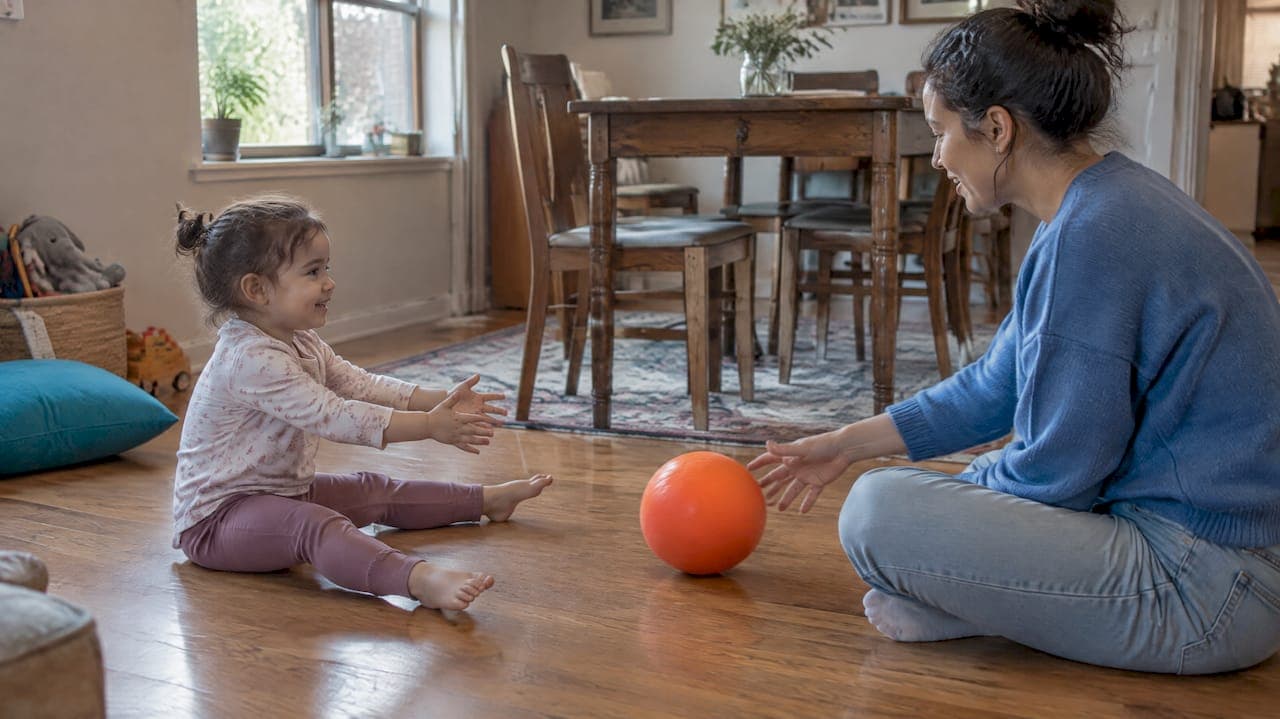
Play-based speech therapy is a goal-directed, evidence-informed way to build communication skills using toys, books, and everyday routines, and it works best when a clinician sets clear targets rather than letting a session drift into unstructured free play. For many toddlers and preschoolers with speech or language delays, this approach supports real gains, especially when parents learn a few techniques to use between sessions. If you notice a persistent gap between your child's communication and typical milestones, an evaluation is the right next step.
TL;DR:
- Play-based therapy must have clear, measurable goals and intentionally structured activities that repeatedly target specific communication skills.
- Parent coaching enhances practice frequency and skill transfer, with small trials showing vocabulary gains and no delay in speech from AAC use.
- Activities should be tailored to age and development, using common household items, with consistency during routine daily moments rather than lengthy sessions.
- Progress tracking should be simple, individualized, and focused on concrete targets, rather than relying solely on unstructured play or vague goals.
- Early evaluation is advisable for persistent delays, and programs should be transparent about goals, progress measurement, and how caregivers participate.
Table of Contents
- What Play-Based Speech Therapy Actually Looks Like
- Benefits Parents Can Expect from Play-Based Approaches
- Play Activities and Games by Age and Communication Goal
- How to Practice Play-Based Strategies at Home
- What the Research Shows and Where the Evidence Is Still Thin
- When to Seek an Evaluation and What to Ask an SLP
- How We Put Family-Centered Play-Based Therapy into Practice
- Getting Started with Evaluation and Parent Coaching
- FAQ
- Sources
What Play-Based Speech Therapy Actually Looks Like
Play-based therapy is often confused with simply letting a child play while an adult watches. The real version looks different: a speech-language pathologist picks a specific, measurable target first, such as combining two words or taking turns in a back-and-forth exchange, and then builds a game around it that creates repeated chances to practice that exact skill.
A clinician working on two-word combinations might set up a bubble game where the child has to request "more bubbles" or "pop bubbles" dozens of times in fifteen minutes, far more repetition than daily life would offer on its own. This intentional structure, sometimes called a naturalistic developmental behavioral intervention, blends child-led play with adult-guided teaching moments. Parent-implemented versions of the same idea, where caregivers learn to use these techniques during regular play, are a core part of many therapy plans.
Here is a quick way to tell goal-directed play from open-ended play:
- A clear, individual target is written down before the session starts.
- The adult arranges materials and games specifically to elicit that target repeatedly.
- Progress on the target gets tracked across sessions, not just generally observed.
- The child's interests shape the activity, but the activity still serves the goal.
A scoping review of play-based interventions for autistic children found the field is broad and uneven, which is exactly why asking about the target behind the play matters so much.
Benefits Parents Can Expect from Play-Based Approaches
Play gives children a reason to communicate. A toddler reaching for a favorite toy has built-in motivation to use a word, point, or gesture, and that natural context tends to help new skills stick and transfer beyond the therapy room.
Parent coaching multiplies this effect. When caregivers learn to use focused stimulation, which means concentrating rich language input around a specific target, children get far more practice opportunities across the day than a single weekly session could provide. A small randomized trial of a parent-implemented program called Parents Plus found promising vocabulary and sentence-structure gains in preschoolers with developmental language disorders after parents were trained in this technique.
What play-based therapy can realistically offer:
- Frequent, low-pressure practice built into activities your child already enjoys.
- Skills that generalize to home, daycare, and other everyday settings.
- A collaborative structure where you see and reinforce progress directly.
The research behind this trial involved a small number of parent-child pairs, a reminder that the evidence base is still growing and results vary across studies, which is why measurable, individualized goals matter more than the label "play-based" alone.
Play Activities and Games by Age and Communication Goal
You do not need a therapy degree or a cabinet of specialty toys to practice these ideas tonight. Most of what works uses items already in your home, paired with consistent, responsive attention.
For infants: building the foundation
- Vocal turn-taking. Make a sound, pause, and wait for your baby to respond before making another sound, treating coos and babbles like a real conversation.
- Joint attention games. Point at something interesting and watch to see if your baby looks too, then name what you both see.
- Routine narration. Describe diaper changes, feedings, and bath time out loud in short, simple phrases so your baby hears language tied to familiar actions.
For toddlers: expanding words and ideas
- Imitation play with objects. Stack blocks or roll cars back and forth, modeling one or two-word phrases like "block up" or "car go" as you play.
- Focused stimulation with household items. Pick a target word, such as "open," and use it repeatedly while opening containers, doors, and boxes during normal play.
- Simple pretend play. Feed a stuffed animal or push a toy stroller together, narrating actions to model short sentences your toddler can start to copy.
For preschoolers: sentences and sound practice
- Role play scenarios. Set up a pretend grocery store or doctor visit to practice requesting, describing, and answering questions in longer sentences.
- Story retell with picture books. After reading, ask your child to tell the story back using the pictures as prompts, which builds sequencing and sentence length.
- Playful articulation practice. Hide small toys whose names contain a target sound, like "sun" or "sock," and turn finding them into a guessing game.
Pro Tip: Keep a small basket of bubbles, a favorite board book, and a few open-ended toys like blocks or play food within reach so you can turn any ten free minutes into focused practice.
For more structured ideas, our toddler speech activities guide breaks down additional games by goal.
How to Practice Play-Based Strategies at Home
Consistency matters more than duration. Short, frequent windows during routines you already have, like mealtime, bath time, or the ten minutes before bed, tend to work better than trying to schedule a long separate practice session.
A few techniques carry most of the weight:
- Focused stimulation: repeat your chosen target word or phrase often during play, without demanding your child say it back.
- Modeling and expansion: when your child says "ball," respond with "yes, big red ball" to extend the idea naturally.
- Pause and wait: after asking a question or offering a choice, count to five in your head before jumping in, giving your child room to respond.
- Contingent responses: respond immediately and specifically to whatever your child communicates, even if it is just a gesture or sound.
If your child uses an augmentative or alternative communication (AAC) system, these same techniques apply: model on the device, pause for a response, and expand what your child produces, whether spoken or selected.
Tracking does not need to be complicated. A simple notebook or phone note with three columns, the date, what target you practiced, and roughly how many attempts your child made, gives you and your child's therapist something concrete to review.
Pro Tip: Pick one target phrase per week rather than several at once; children typically need many repetitions before a new word or structure becomes reliable.
Our guide on translating clinic techniques into living room practice walks through how to build these habits step by step.
What the Research Shows and Where the Evidence Is Still Thin
A broad synthesis of early childhood intervention research found that naturalistic developmental behavioral interventions show small-to-moderate positive effects on language, play skills, and social communication in young children, though the size of the effect and the quality of supporting studies vary by outcome measured. That variation matters: a program that helps with joint attention may not show the same strength of evidence for expressive vocabulary.
Parent-implemented focused stimulation has smaller trials behind it, but they point the same direction. The findings worth knowing:
- Naturalistic play-based interventions show real but inconsistent effects across different language and social outcomes.
- Parent-coached focused stimulation has shown vocabulary gains in small trials, though sample sizes remain limited.
- AAC use does not reliably delay spoken language development.
A trial of parent-implemented AAC found that 45 of 109 children who completed the intervention produced spoken target vocabulary words by the end, without an increase in speech-sound errors, which challenges the old worry that introducing AAC might hold back speech.
The practical takeaway: look for programs built around measurable, individualized goals with a clear way to track progress, rather than judging an approach purely by whether it looks playful.

When to Seek an Evaluation and What to Ask an SLP
Developmental milestones are screening cues, not diagnostic rules, but persistent gaps are worth a conversation with a provider. CDC milestones describe skills most children show by a given age, such as combining two words by age 2 and managing two back-and-forth conversational exchanges by age 3.
Before or during an evaluation, ask:
- What specific, measurable goals will we work toward first?
- How will progress be tracked and shared with us between sessions?
- What role will we play in sessions and at home?
- Will AAC be considered, and how would that decision get made?
- What does a realistic timeline for progress look like?
Be cautious of any program that cannot describe a goal, cannot show how progress is measured, or that consists only of unstructured play without a stated target. Our overview of what happens during an evaluation and our list of early warning signs can help you prepare questions ahead of time.
How We Put Family-Centered Play-Based Therapy into Practice
We build every speech therapy plan around a child's specific goals and the family's daily routines, not a generic script. We look at the whole picture rather than treating communication delays in isolation.
Parent coaching is woven into our sessions from the start: we show caregivers how to carry a clinic technique into home routines. When a feeding concern sits alongside a speech delay, therapists coordinate care to provide families with coherent plans.
— Thriving Joy
Getting Started with Evaluation and Parent Coaching
If your child shows signs of a speech or language delay, or you want a clearer sense of where they stand, a full evaluation is the place to start. Plans are built around specific communication goals rather than a one-size-fits-all program.
Parent coaching is included in how we structure care, because the techniques that work in a session only pay off when they continue during the rest of the week. Many families also find our parent coaching classes a useful way to learn focused stimulation and other strategies in more depth.
To set up an evaluation or learn more about what sessions look like, visit our speech therapy page or explore the full range of services at Thrivingjoy.
This article is general information, not a substitute for advice from a qualified doctor. Consult a qualified healthcare professional about your own circumstances before acting on anything here.
FAQ
What is the best age to start play-based speech therapy?
There is no single best age. Play-based approaches can begin in infancy with joint attention and turn-taking games and continue through the preschool years, with the specific goals and activities adjusted to the child's developmental stage rather than tied to one fixed age.
What are the downsides of play-based speech therapy?
The main limitation is inconsistency: a scoping review of play-based interventions found the approaches vary widely in philosophy and structure, so results depend heavily on whether a clinician sets clear, measurable goals. Without that intentionality, play-based sessions can become unfocused and harder to track for progress.
What are the stages typically involved in play-based therapy?
Programs vary, but most progress through assessment and goal-setting, structured play designed around those goals, parent coaching to extend practice at home, and ongoing progress monitoring to adjust targets. The exact structure depends on the child's needs and the specific intervention model a provider uses.
How is play-based speech therapy different from other structured behavioral approaches?
Play-based speech therapy follows the child's interests and uses natural play as the teaching context, while more structured behavioral approaches often rely on adult-directed, repeated drills with less emphasis on child-led activity. Many providers blend elements of both, since naturalistic approaches that mix structure with play, often called naturalistic developmental behavioral interventions, have shown positive effects on language and social communication in young children.
Can augmentative communication (AAC) be used alongside play-based therapy?
Yes. A study of parent-implemented AAC found that introducing AAC led to more spoken target vocabulary without increasing speech-sound errors, so it can support rather than compete with spoken language goals during play-based sessions.
Sources
- Play-based interventions to support social and communication development in autistic children aged 2–8 years: A scoping review
- Parents Plus: A parent-implemented intervention for preschool children with developmental language disorders
- CDC developmental milestones (3 years)