
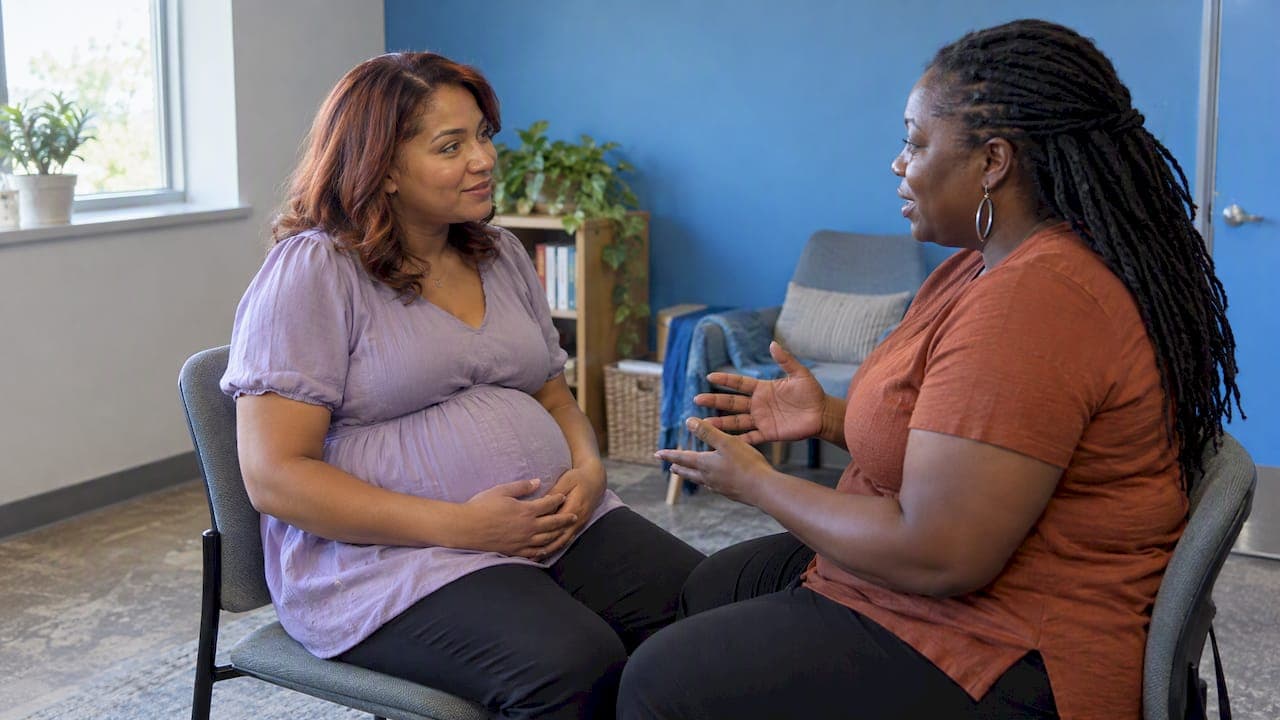
Prenatal breastfeeding education is learning, during pregnancy, how breastfeeding works and what to do when it feels hard. A good class or consultation covers the basics of milk supply, latch, positioning and hunger cues. It also helps you build a plan for the first weeks and line up a lactation professional before you need one. Most families do best when they start in the third trimester, and when they keep the support going after the baby is born.
If you are searching for how to prepare for breastfeeding, this guide walks through what to learn, when to start, what the evidence says, and how to turn it into a simple plan.
TL;DR
- Prenatal education typically covers breastfeeding benefits, latching and positioning, and how to handle common problems.
- Aim to learn during the third trimester, and choose a lactation consultant before your baby arrives.
- Research links breastfeeding support to higher rates of any and exclusive breastfeeding up to 6 months, and support works best across pregnancy, birth and postpartum.
- Most health plans must cover breastfeeding counseling and a breast pump, so check your benefits early.
- A written infant-feeding plan and a named person to call make the first two weeks far less stressful.
Table of Contents
- What prenatal breastfeeding education actually covers
- When to start preparing for breastfeeding
- How to prepare: a step-by-step plan
- Does prenatal education work?
- Perspective: why we treat prenatal education as the first visit, not the only visit
- Paying for breastfeeding education and support
- In person or online?
- Questions to ask any lactation provider
- A few things to remember when the baby arrives
- Get support from Thriving Joy
- FAQ
- Sources
What prenatal breastfeeding education actually covers
Many parents expect a class to be a lecture on why breastfeeding is healthy. That is part of it, but the most useful portion is practical. The U.S. Preventive Services Task Force describes education and support that covers breastfeeding benefits, hands-on skills such as latching, and management of common complications. The Academy of Breastfeeding Medicine adds that prenatal conversations should include benefits, physiology, positioning and the risks of unnecessary supplementation.
In plain terms, a solid prenatal session helps you understand:
- How milk comes in. What to expect in the first days, why newborns feed so often, and how frequent feeding builds supply.
- Latch and positioning. What a deep latch looks and feels like, and how to try different holds. Our guides on newborn breastfeeding positions and latch techniques you can practice at home are a good place to start.
- Feeding cues. Learning your baby's early hunger signs, before crying starts, makes feedings calmer.
- Common bumps. Sore nipples, engorgement, slow weight gain, and when each one is a reason to call a professional.
- Your hospital or birth center. What support they offer, and what you want to ask for.
- Pumping and returning to work. Even if it feels far away, a little knowledge now helps. Our post on budgeting time for pumping at work shows what that can look like.
The same ABM protocol recommends that counseling be patient-centered and culturally sensitive, ideally in your preferred language, with structured materials. If a class feels like it was not made for your family, look for one that is.
When to start preparing for breastfeeding
There is no wrong time, but there is a helpful window. One UK hospital workshop recommends attending from 32 weeks while welcoming people at any point in pregnancy. That lines up with the late second to early third trimester, when you are far enough along to be curious and not yet exhausted.
The American College of Obstetricians and Gynecologists suggests that the last month of pregnancy is the time to research and order a breast pump, choose a lactation counselor and stock the freezer with meals. In the same piece, a physician describes breastfeeding as natural yet the hardest thing she ever did, and says preparation can make the learning curve easier. That honest framing is one we hear from parents often: it is natural, and it is also a skill that both of you are learning.
A simple timeline:
| When | What to do |
|---|---|
| Early to mid pregnancy | Ask your provider about breastfeeding, review your health and medications, check your insurance benefits |
| Late second to early third trimester | Take a class or book a prenatal lactation consultation |
| Final month | Choose your lactation consultant, get your pump, write your feeding plan, tell your support people how to help |
| First days after birth | Feed often, watch cues, call your consultant at the first sign of pain or worry |
How to prepare: a step-by-step plan
The federal Office on Women's Health advises expectant parents to identify a lactation consultant, discuss their health with their doctor, and learn their baby's hunger cues before birth. Here is how that translates into action.
1. Talk to your prenatal provider
Share your health history and any medications. Ask whether your delivery site has staff and a setup that supports breastfeeding, including skin-to-skin contact and help with the first feed. Ask your doctor to recommend a lactation consultant, as Women's Health suggests.
2. Take a class or have a one-on-one session
Group classes are a friendly way to hear other parents' questions. A private prenatal consultation lets you focus on your own situation, such as a previous breastfeeding struggle, breast surgery, a multiple pregnancy, or a medical condition. One prenatal curriculum designed for clinicians and educators is built to be taught one-on-one across all three trimesters, which reflects how much this topic benefits from repetition rather than one big download.
If you want to know what a private visit involves, read our guides to prenatal lactation consultation and how to choose breastfeeding support with confidence.
3. Write a flexible infant-feeding plan
Keep it to one page. Include your goals, who your support people are, what you want to happen in the first hour after birth, and who you will call if feeding hurts or you are unsure your baby is getting enough. Keep the wording open: "I hope to" works better than "I will." Babies and bodies do not always follow the script, and a plan is there to guide you, not to grade you.
4. Gather your people
Women's Health also suggests talking with friends who have breastfed, joining a support group, and discussing with family how they can help. Be specific with relatives: meals, laundry, holding the baby after a feed, or simply protecting your rest.
5. Get your supplies sorted
You do not need a lot. Comfortable clothing, nursing pillows if you like them, and a pump arranged through your insurance are usually enough. Wait on gadgets until you know what you need.

Does prenatal education work?
The honest answer is that it helps, most when it is part of ongoing support. Here is what the strongest recent reviews found.
The U.S. Preventive Services Task Force found that breastfeeding support interventions are associated with higher rates of any and exclusive breastfeeding up to and at 6 months. An updated evidence review in JAMA reached the same conclusion about both any and exclusive breastfeeding through 6 months. The same review did not find an effect on whether breastfeeding was started, or a statistically significant difference at 12 months. In other words, support makes the biggest difference in the early months, which is exactly when parents need it most.
The Task Force also notes that education and support have greater effects when provided across several periods, prenatal, around birth and postpartum, rather than once. The Academy of Breastfeeding Medicine similarly calls for prenatal work to be part of a comprehensive, longitudinal support program, and says that promoting and normalizing breastfeeding during pregnancy can improve initiation and duration. The CDC's guide adds that some strategies have proven effective as components of multifaceted interventions, not as stand-alone fixes.

What this means for your family: a prenatal class is a strong start, and the real payoff comes from having someone to call in week one, week three and month three.
Perspective: why we treat prenatal education as the first visit, not the only visit
At Thriving Joy, we see prenatal education as the beginning of a relationship with your family. We are a pediatric therapy practice, and feeding is at the heart of what we do, from the first latch to the first spoonful of solids and beyond. That gives us a view that many one-time classes cannot offer: we know what the weeks after birth look like, and we want you to walk into them feeling ready.
Our approach is holistic and family-centered. Instead of handing every parent the same checklist, we look at your health, your goals, your baby's needs and your home life, and we work out what is likely to matter most for you. When challenges come up, we look for the root cause rather than reaching for a quick fix.
Our founder brings a strong pediatric healthcare background together with her own experience as a parent, and that shapes how we teach: practical, kind and honest about how much there is to learn. Our prenatal lactation education lets you ask the questions that you might feel silly asking elsewhere, practice before the baby is in your arms, and meet the person you will call when things feel uncertain.
The research points the same way. Support delivered before, during and after birth is more powerful than a single session, and that is why we encourage families to connect with us during pregnancy and stay in touch as feeding evolves.
Thriving Joy
Paying for breastfeeding education and support
Cost worries stop many families from booking help. According to HealthCare.gov, health plans must provide breastfeeding support, counseling and equipment for the duration of breastfeeding, and services may be provided before and after birth. This applies to Marketplace plans and other plans except grandfathered ones, and your plan must also cover a breast pump, though rules about the type and timing vary by plan.
Before you book, call your insurance company and ask:
- Which lactation providers are in network?
- Is prenatal counseling covered, and how many visits?
- Which pump is covered, and when can I order it?
If you are comparing plans or are between coverage periods, looking at maternity coverage options can help you understand what to look for. Thriving Joy accepts private pay, major health insurance plans and scholarships, so ask our team about the option that fits your situation.
For families in Hillsborough County who qualify for WIC, the local health department says that breastfeeding classes are free to WIC clients. The same program lists peer counselors, board-certified lactation consultants and an electric pump loan program for qualified mothers.
In person or online?
Both can work. The Task Force found that effective interventions can be delivered in person or remotely, including by video, telephone or text. Online is convenient when you are tired, on bed rest, or far from a clinic. In person is helpful when you want hands-on help with positioning, using a doll or model before the baby arrives. Many parents choose a mix: a video class in pregnancy, then a visit in the first days when someone can watch a real feed.
Questions to ask any lactation provider
- What credentials do you hold, and what is your experience with babies who have feeding difficulties?
- Do you offer prenatal visits as well as postpartum visits?
- Can you see us at home or in your office?
- What happens if my baby has trouble feeding later, such as with bottles, reflux or starting solids?
- How do you work with my pediatrician and my birth team?
That last pair of questions is where a feeding-focused practice can help. Breastfeeding is the first chapter in a child's feeding story, and having a team who can follow your child from breast to solids to the family table gives you continuity. Our lactation counseling includes prenatal education and postpartum breastfeeding support, and families who later need help with picky eating or feeding challenges already know us. You can also read our overview of lactation counseling services for mothers and our explanation of on-demand breastfeeding.
A few things to remember when the baby arrives
Prenatal learning is about confidence, so here are three reminders to carry with you.
- Pain is a signal, not a rule. Some tenderness early on can happen, but ongoing pain deserves a call to a lactation professional rather than gritting your teeth.
- Your baby's pediatrician is part of the team. Weight checks and diaper counts matter, and questions about weight gain belong with your child's doctor.
- Asking early is a strength. Parents who reach out in the first days often solve small problems before they become big ones.
Get support from Thriving Joy
If you live in Pasco or Hillsborough County and want to feel prepared before your baby arrives, our team can help. Start with prenatal lactation counseling, where we talk through your goals, teach you the practical skills and plan your first weeks together. We also offer parent coaching and workshops such as Starting Solids 101 for the stage that comes next.
FAQ
When is the best time to take a prenatal breastfeeding class?
The third trimester is a popular choice, and one hospital workshop suggests attending from 32 weeks. You are welcome to start sooner, especially if you have had breastfeeding difficulty before or have a health condition that you want to discuss. Try to finish your class before the last month, when energy tends to dip.
What should I do before the baby arrives to prepare for breastfeeding?
Talk with your doctor about your health and medications, find a lactation consultant, and learn your baby's hunger cues. Then write a short feeding plan, arrange your pump through insurance, and tell your family how they can help. These steps match the guidance from the Office on Women's Health.
Does insurance cover prenatal lactation counseling?
HealthCare.gov states that most plans must cover breastfeeding support, counseling and equipment, and that these services may be provided before and after birth. Grandfathered plans are an exception, and network rules and visit limits vary, so call your insurer before booking.
Is one class enough?
A single class gives you a helpful foundation. The evidence suggests support works better when it is spread across pregnancy, birth and the postpartum period. Plan on at least one follow-up with a lactation professional after your baby is born.
Can my partner come too?
Yes, and we encourage it. Partners who understand cues, positioning and what normal newborn feeding looks like are better able to help at 3 a.m. Bring grandparents or other helpers as well if they will be part of your support team.
Sources
- Recommendation: Breastfeeding: Primary Care Behavioral Counseling Interventions, U.S. Preventive Services Task Force
- Academy of Breastfeeding Medicine Clinical Protocol #19
- Interventions to Support Breastfeeding: Updated Evidence, JAMA
- The CDC Guide to Strategies to Support Breastfeeding Mothers and Babies
- How to Prepare for Breastfeeding in the Month Before Birth, ACOG
- Preparing to breastfeed, Office on Women's Health
- Preparing to breastfeed, University Hospital Southampton NHS
- Mother's Guide to Breastfeeding: Prenatal Curriculum
- Breastfeeding benefits, HealthCare.gov
- Breastfeeding Program, Florida Department of Health in Hillsborough County
- US Maternity Coverage Options