
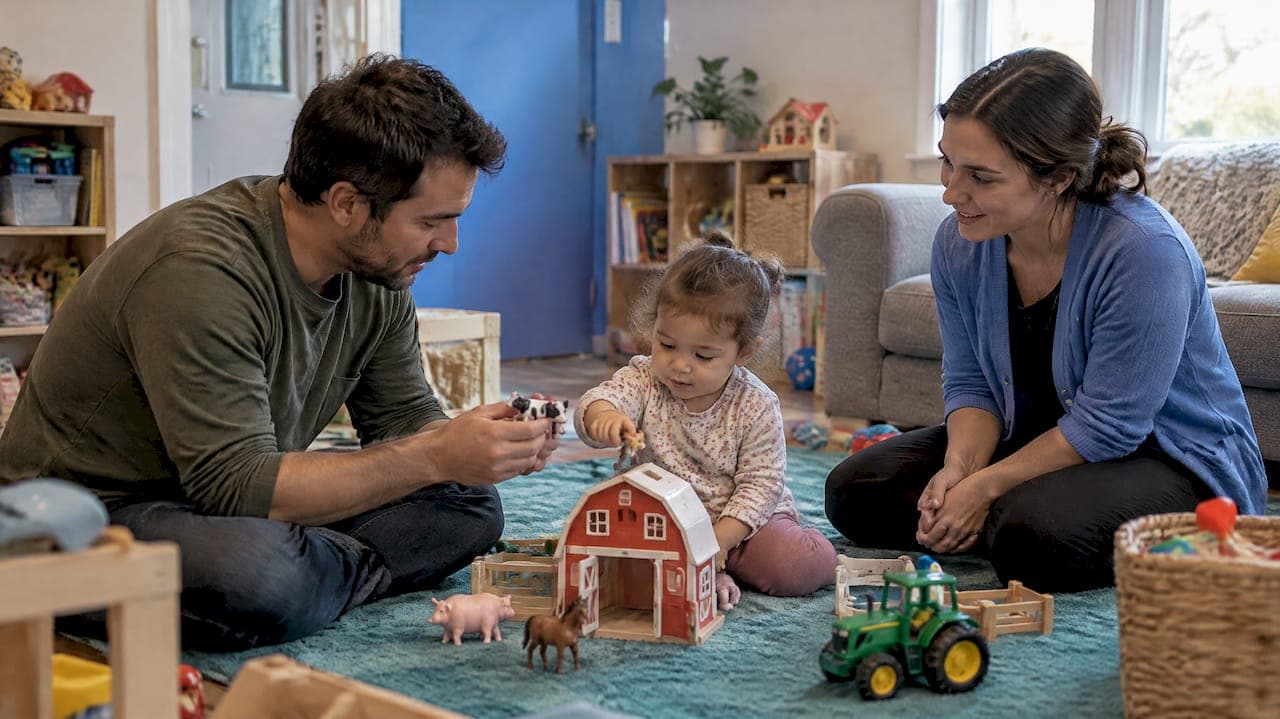
Parent coaching in speech therapy is a way of working in which the speech-language pathologist (SLP) teaches you, step by step, to support your child's communication during everyday life, instead of working with your child while you watch from the sidelines. You stay in the room, you practice, you get feedback, and you leave each visit with a small plan for the week. If your child has a speech or language delay, it can be one of the most practical ways to turn a few hours of therapy into many moments of daily practice.
Below, we explain how coaching works, what happens in a session, which strategies parents use, what research says, and how to tell whether it fits your family.
TL;DR
- Parent coaching means the SLP partners with you to build your skills and confidence so you can support your child's communication during routines like play, meals, and bath time.
- A typical visit includes setting goals, observing, trying a strategy together, getting feedback, and agreeing on what to practice before the next session.
- Common strategies include pausing and waiting, following your child's lead, commenting instead of quizzing, and expanding your child's words.
- Research on caregiver-implemented interventions is encouraging, especially for expressive language, and direct therapy can be added when a child needs hands-on support.
- At Thriving Joy, we offer speech therapy and parent coaching for families in Pasco and Hillsborough Counties.
Table of Contents
- What parent coaching in speech therapy means
- What happens in a coaching session
- Strategies parents learn
- What research says about parent coaching
- Is parent coaching right for your child?
- A note on the parent's side of coaching
- Our perspective
- Getting started with Thriving Joy
- Frequently asked questions
- Sources
What parent coaching in speech therapy means
The American Speech-Language-Hearing Association (ASHA) describes caregiver coaching as partnering with families to build their skills and confidence in supporting a child's communication within everyday routines. In that model, the caregiver is an active participant in assessment and intervention and the child's primary interaction partner, not a passive observer.
That is a real shift from the older picture many of us carry in our heads. In the traditional model, the therapist works directly with the child at a table while the parent sits and watches. The Hanen Centre's 2022 guide on language delay contrasts that model with parent-implemented intervention, where the SLP coaches parents to use language-building strategies during enjoyable activities at home.
The reasoning is simple. Your child spends far more time with you than with any therapist. When you know exactly what to do in the moments that already fill your day, those moments become practice.

How it differs from child-only therapy
In child-only sessions, the therapist leads and the child responds. In coaching, the therapist's main "client" in the moment is the adult-child interaction. You might still see the therapist play with your child to demonstrate a technique, but the goal is that you can do it too, in your own kitchen, car, or backyard.
This is not either/or. The ASHA guidance notes that direct intervention may supplement coaching for complex needs or when hands-on support is needed. A collaborative practice paper from 2020 also emphasizes that no single delivery model fits everyone: depending on the family's needs and preferences, the SLP may deliver intervention directly, or parents may become the agents of change. Good speech therapy adjusts to your child and your household.
What happens in a coaching session
If you have never experienced coaching, it helps to know what a visit can look like. ASHA describes a sequence that most families will recognize:
- Choosing goals together. You and the SLP pick meaningful targets and the routines where they fit best. You contribute ideas and help guide the decisions.
- Observation. The SLP watches how you and your child usually interact, so advice is built on what really happens in your home.
- Demonstration or explanation. When needed, the SLP shows or explains a strategy.
- Your turn to practice. You try the strategy with your child while the SLP is right there.
- Specific feedback and reflection. The SLP points out what worked, and you talk through what felt natural and what felt awkward.
- Adapting the plan. Strategies are adjusted as your child changes.
- An agreement for the week. You decide together what you will try between visits.
A 2024 scoping review of how therapists and parents work together for children with speech sound disorders describes a coaching model built on joint planning, observation, action, reflection, and feedback. It also lists methods such as written and verbal information, scripts, and role play. If you have ever rehearsed what to say in a hard conversation, role play in coaching will feel familiar, and it is a gentle way to try a new technique before using it with your child.
A sample visit
Imagine a mother, we will call her Dana, whose 26-month-old says about ten words and mostly points and fusses. Snack time is the hardest part of her day. In a coaching visit, the SLP watches snack time, notices that Dana asks lots of questions ("What do you want? Say cracker!"), and suggests something different: hold the crackers, wait, and comment on what her son is doing. Dana tries it while the SLP watches, then they talk about how the pause felt. The plan for the week is one routine, one strategy, five minutes at snack time. This is an illustration, not a real client story, but it shows the size of the steps: small, specific, and doable.

Strategies parents learn
ASHA lists strategies that caregivers commonly practice in coaching. None of them require special equipment, and most can be woven into what you already do.
- Wait and pause. Give your child extra time to take a turn. Silence can feel long to adults, and it is often exactly what a child needs to try a sound or word.
- Imitate your child. Copy their sounds, actions, and words so they see that communication gets a response.
- Use gestures. Pair simple gestures with words to give meaning more than one way in.
- Comment rather than question. Narrate what is happening ("You're pushing the truck!") instead of testing ("What's that?").
- Follow your child's lead. Join what already interests them.
- Offer choices. "Banana or apple?" invites a response and shows the words in action.
- Create communication opportunities. Set up situations where your child has a reason to ask, such as a favorite toy in a clear container.
- Expand. When your child says "truck," you say "big truck" or "truck go fast."
For more ideas you can try the same evening, our post on play-based speech therapy activities walks through nine of them. If your child is older and working on conversation and social language, see our at-home routines for pragmatic language.
Everyday routines are the classroom
ASHA notes that caregivers support communication during familiar routines such as play, meals, dressing, bath time, and going outside. The Hanen Centre makes a similar point in Parents as "Speech Therapists": parent-implemented intervention extends practice across the child's day and uses play, meals, bath time, and bedtime, instead of relying only on clinic exercises.
Routines work well because they repeat. A review of caregiver-implemented communication interventions explains that embedding support in frequent routines is intended to give children repeated, motivating chances to communicate, and that it can be adapted to a family's cultural, social, and developmental strengths. Your family's routines are not an obstacle to therapy. They are the material.
What research says about parent coaching
The same 2022 review found that meta-analyses generally show caregiver-implemented interventions have a positive effect on early social communication and language, particularly expressive language. It also reported that outcomes did not differ between trained parents and clinicians, which is good news for parents who wonder whether they can really make a difference.
A few details are worth knowing so you can set realistic expectations:
- The review covered children with language impairment from birth through 48 months, with seven studies for ages 12 to 23 months, 21 for ages 24 to 35 months, and 21 for ages 36 to 48 months.
- For children under 12 months, the review did not find strong caregiver-language evidence, and it noted that results vary across studies. For babies, a pediatrician and early feeding or lactation support are often the right first conversations.
- Combined approaches may benefit autistic children, so a team plan that blends coaching and direct therapy can make sense.
The Hanen Centre adds a practical note: in the studies it cites, parent-implemented programs averaged about 26 intervention hours over many weeks, and some children still went on to ongoing speech therapy. In other words, coaching is a real program with real time and effort, and it works best as part of a plan that can grow with your child. Stoner, Meadan, and Angell's 2013 ASHA article is a good example of the approach in action: it describes a project that coached parents to use naturalistic and visual teaching strategies with young children with developmental disabilities, in their own homes.
Is parent coaching right for your child?
Coaching tends to fit well when:
- Your toddler has a late start with words, or is using fewer words than you expected.
- You want to feel more capable and less like you are guessing at home.
- Your child is more comfortable and relaxed with you than with a new adult at a table.
- You would like strategies that carry over into mealtimes, play, and bedtime.
It can also sit alongside direct therapy when your child needs hands-on work on specific sounds or language skills. If you are wondering about timing, our guide on when to start speech therapy at 18 to 24 months explains what to look for and why you do not need to wait for a diagnosis to ask questions. A pediatrician can also help you decide on next steps and make referrals when appropriate.
What families can expect
ASHA says families can expect individualized coaching with meaningful targets and routines, feedback, reflection, and regular adaptation. The 2020 collaboration paper describes the process as aligning parent and therapist understandings, values, expectations, roles, resources, and activities through conversation and co-design. In plain words: you will be asked what matters to you, what your days look like, and what feels realistic, and the plan is built around your answers.
Progress is usually something you notice in small ways first: your child waits and looks at you, copies a sound, uses a new gesture, or tries a word to ask for something. Your therapist will help you name those wins and set the next small step.
A note on the parent's side of coaching
Many parents worry that coaching means they are being asked to "fix" things, or that they did something wrong. It does not. A good coaching relationship is judgment-free, and it exists because you are the most important communication partner your child has. Therapists bring the training. You bring knowledge of your child that no one else has: which songs make them laugh, which foods they love, what their "almost words" mean.
If you have felt stress around your child's speech, you are not alone, and that stress often eases once you have a clear plan and someone to check it with. Our posts on what parent coaching services involve and on supporting families at every step go deeper on that partnership.
Our perspective
At Thriving Joy, we believe a child's communication grows in the places where your family already lives: the kitchen table, the car seat, the floor with a pile of blocks. That is why parent coaching is at the heart of how we approach speech therapy.
We look for root causes, not quick fixes. Before we suggest a strategy, we want to understand your child, your routines, and what a stressful day looks like for you. Our founder brings a strong pediatric healthcare background together with her own experience as a parent, and we try to bring both to every family we work with.
We also know that every family is different. Some children do well with coaching alone, and some need direct, hands-on sessions as well. We can meet you at our office, or in your home, daycare, or preschool, so the strategies we practice fit the real places your child communicates.
Our goal is a parent who leaves each session feeling more confident, and a child who is gaining skills every day, not just during therapy hour.
Thriving Joy
Getting started with Thriving Joy
If you live in Pasco or Hillsborough County and your child is showing signs of a speech or language delay, our speech therapy services are designed to give you both: expert guidance for your child and coaching that helps you carry the work into daily life. We accept private pay, major health insurance plans, and scholarships, and we can see children at our office, at home, or at daycare or preschool.
If you would like to learn alongside other parents, our parent coaching and classes include one-on-one coaching and Talking Toddlers workshops. Reach out through our site to ask which option fits your child's age and needs.
Frequently asked questions
What is parent coaching in speech therapy?
It is a collaborative approach in which the speech-language pathologist teaches and supports you to use communication strategies with your child during daily routines. You observe, practice, reflect, and plan with the therapist, then use what you learned at home between visits.
Does parent coaching replace speech therapy?
Not necessarily. Coaching is a form of speech therapy, and it can be combined with direct sessions. ASHA notes that direct intervention may supplement coaching for complex needs, and some children in the studies the Hanen Centre cites continued with ongoing therapy afterward.
Do I need special skills or a lot of free time?
No. Strategies like pausing, commenting, offering choices, and expanding your child's words fit into routines you already have. Most plans start with one routine and one strategy for a few minutes a day, then build from there.
Can parent coaching help a baby under 12 months?
Research on caregiver language coaching is stronger for toddlers and preschoolers than for babies under 12 months. For infants, talk with your pediatrician, and if feeding or breastfeeding is the concern, our lactation counseling can support you.
How do I know if my child needs a speech evaluation?
If you are worried about how your child is communicating, trust that instinct and ask. You can start with your pediatrician or contact a speech-language pathologist directly, and our article on when to start speech therapy gives age-based guidance.
Sources
- ASHA: Family-Centered Care and Coaching in Early Intervention
- The Hanen Centre: When a Child Has a Language Delay
- The Hanen Centre: Parents as "Speech Therapists"
- Caregiver-Implemented Communication Interventions (scoping review, 2022)
- How speech and language therapists and parents work together (scoping review, 2024)
- Collaboration between parents and SLTs (2020)
- Stoner, Meadan, and Angell: A Model for Coaching Parents to Implement Teaching Strategies (2013)