
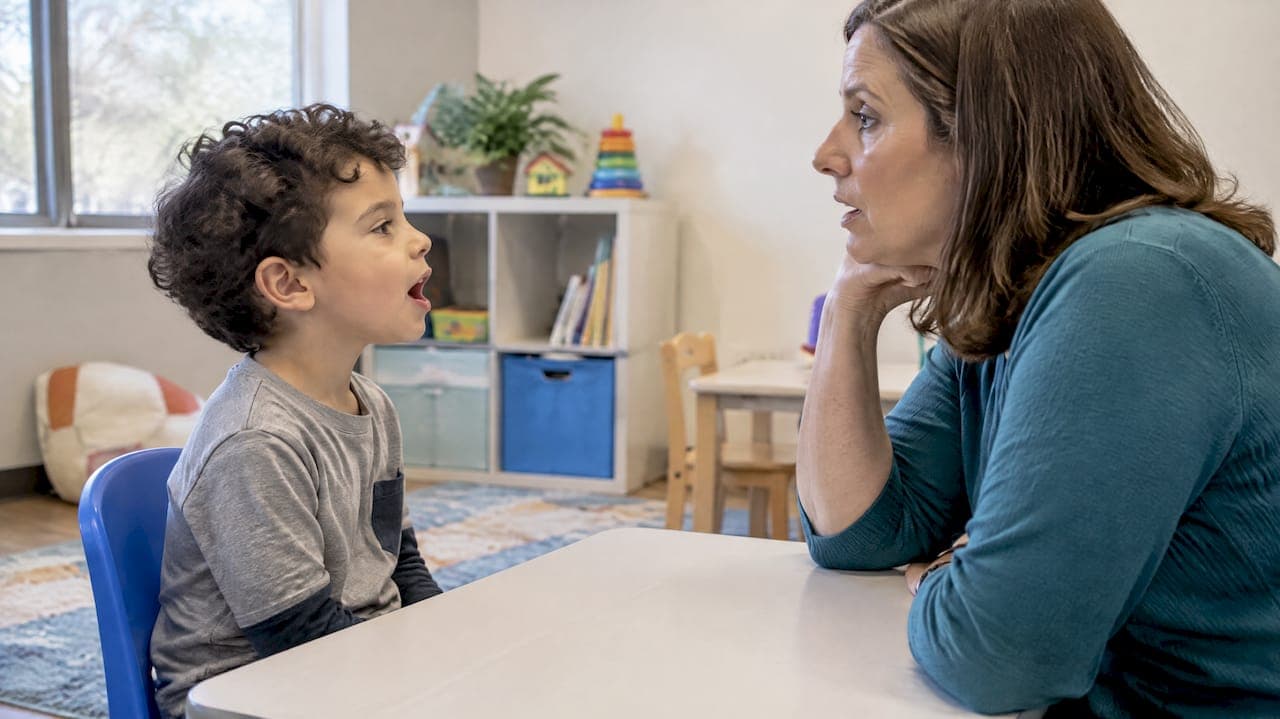
A lisp in a child is often a normal part of speech development, and many kids grow out of it. Start with gentle, playful practice at home. If the lisp lingers past the expected ages, makes your child hard to understand, or shows up alongside other delays, get a hearing check and a speech-language pathologist (SLP) evaluation. Speech therapy works well when it is needed.
TL;DR:
- Seek an evaluation if only family understands your child, speech worsens suddenly, skills disappear, structural concerns appear, or frustration affects communication.
- An SLP checks hearing, language, sound production, and stimulability, then distinguishes tongue placement habits from broader sound patterns to guide treatment.
- Therapy may use tongue placement practice or integrated sound work; one trial averaged 11.5 months for broader speech sound disorders, not lisp alone.
- At home, model correct sounds without correction; use brief playful practice several times daily, and seek evaluation if progress stalls after a few weeks.
Table of Contents
- What a lisp is and the types parents hear
- When a lisp is developmentally typical
- When to seek an evaluation: red flags and first checks
- What a speech-language pathologist evaluation involves
- How speech therapy treats lisps: approaches and evidence
- Practical at-home strategies you can try right away
- What timeline and prognosis to expect
- Our family-centered approach to speech support
- How we can help and how to get started
- FAQ
- Sources
What a lisp is and the types parents hear
A lisp is an articulation error that distorts the "s" and "z" sounds, which speech professionals call sibilants. The distortion happens when the tongue sits in the wrong place or air flows the wrong way. MedlinePlus notes that some sounds, like "s" and "z," may be consistently distorted in a speech disorder.
Naming the type helps you describe it to a pediatrician or SLP:
- Frontal (interdental) lisp: the tongue pushes too far forward, so "sun" sounds like "thun."
- Lateral lisp: air escapes over the sides of the tongue, giving "s" a wet or slushy sound.
- Palatal lisp: the tongue touches too far back on the roof of the mouth, so "s" sounds muffled or closer to "sh."
Listen for which one sounds most like your child, and jot down a few example words.
When a lisp is developmentally typical
Many errors on "s" and "z" are common in preschoolers, and a good number fade by early school age. Some persist without help, though, so age is only part of the picture. ASHA's early identification guidance lists the ages at which different sounds are expected to emerge. Our own post on when phonological processes should fade is a useful companion.
What matters most is how the lisp affects your child:
- Clarity: Can people outside your family understand most of what your child says?
- Social impact: Does your child get teased, avoid talking, or seem frustrated?
- Severity: Is every "s" distorted, or only some?
Children vary widely. Clinicians weigh severity and everyday impact, not just a birthday. If clarity or confidence is suffering, earlier help is reasonable even when the error is age-expected.
When to seek an evaluation: red flags and first checks
Stop waiting and get a professional look if you notice any of these:
- The lisp continues past the ages when it is usually expected to resolve.
- Only family members can understand your child's speech.
- Speech suddenly gets worse or skills are lost.
- Other developmental concerns appear, such as limited words or trouble following directions.
- You see structural issues in the mouth, or your child seems upset about how they sound.
Hearing comes first, because clear speech depends on hearing sounds accurately. ASHA treats checking for hearing loss or persistent ear infections as foundational, and the Merck Manual recommends hearing and language evaluation, plus ENT assessment when indicated. Ask your pediatrician for a hearing screening and an SLP referral. Before the visit, record a short sample of natural speech, note when the lisp began, and list ear infections and speech milestones. Our guide on when to start speech therapy can help you decide how soon to act.
What a speech-language pathologist evaluation involves
An evaluation is friendly and play-based, and it gives you a clear picture of what is going on. Our overview of what happens during a speech-language evaluation walks through it in more detail. Most include these pieces:
- Background and history: your concerns, milestones, ear infections, and family history.
- Speech-sound testing: formal and informal checks of how your child produces "s," "z," and other sounds.
- Stimulability: whether your child can make the correct sound with a model or cue.
- Language screening: a look at understanding and expressive language.
- Follow-up referrals: hearing or medical checks when they are indicated.
SLPs also work out whether the pattern is motor-based, meaning a tongue-placement habit, or phonological, meaning a pattern of simplified sounds. That distinction shapes which therapy method fits best. Afterward you should receive clear goals, a recommended session frequency, home practice ideas, and a way to measure progress.
How speech therapy treats lisps: approaches and evidence
Therapists generally draw on two families of approaches. Motor-based therapy teaches placement directly through shaping and repeated practice. One ASHA case study of a young child with a lateral lisp reported large reductions in lateralization at the word level and better attitudes toward communication after 8 months of tailored motor-based therapy. Integrated phonological approaches emphasize stimulability and carrying new sounds into everyday speech.
- Direct placement and shaping: guiding the tongue to the right spot, then practicing in words.
- Integrated approaches: blending sound practice with the child's broader speech patterns.
- Auditory training as an add-on: a small study found that brief computerized auditory training combined with speech therapy offered greater potential for phonological gains than therapy alone in that sample.
A randomized controlled trial of an integrated treatment found that treated children improved their percent correct consonants and reduced phonological processes more than wait-list controls.
Many programs plan weekly sessions with home practice. How long it takes depends on severity.
Practical at-home strategies you can try right away
Home practice works best when it feels like play. Try these:
- Mirror play: sit side by side and let your child watch where your tongue goes for "s."
- Straw and bubble games: sipping through a straw or blowing bubbles encourages controlled airflow and tongue position.
- Sound-rich books: pick stories heavy on "s" and "z," like snakes, sunshine, and zoo animals.
- Short, frequent bursts: a few minutes several times a day beats one long drill.
- Everyday words: weave target sounds into favorite words, snacks, and routines.
Pro Tip: Model the sound correctly instead of correcting your child, and praise every try so practice stays fun.
For more ideas, see our post on helping your child say sounds correctly and this guide to language-building moves. If you see no progress after a few weeks, or any red flag from earlier, move from home-only strategies to a professional evaluation. A parent's checklist for recognizing speech delays can help you spot other signs.
What timeline and prognosis to expect
Many children improve with structured therapy. In the integrated-treatment trial described above, the average treatment duration was around 11.5 months. How long therapy takes varies with the child and the treatment approach. Therapy for a lisp alone may move faster than that figure, which came from children with broader speech sound disorders.
Starting earlier often helps new sounds carry over into everyday talk sooner, especially when delays are significant. The encouraging part is that most children make real, functional gains with good therapy and steady home practice. Timing varies from child to child, so measure progress by clearer speech and more confidence, not just by weeks on a calendar.

Our family-centered approach to speech support
We provide early-intervention speech therapy built around individualized goals for each child, and we coach parents so practice at home actually works. Our approach is holistic and family-centered because we look for the root cause rather than a quick fix. Where we can, we meet families at our office, at home, or at daycare. If your child's speech is on your mind, we welcome you to contact us for an evaluation.
— Thriving Joy
How we can help and how to get started
If you want expert eyes on your child's speech, here is what we offer:
- Early-intervention speech therapy for children
- One-on-one parent coaching to support practice at home
- Flexible session locations, including office, home, and daycare
Getting started is simple: schedule an evaluation, ask us about insurance and private-pay options, and watch for our intake materials. Visit our speech therapy page to book or learn more.
This article is general information, not a substitute for advice from a qualified doctor. Consult a qualified healthcare professional about your own circumstances before acting on anything here.
FAQ
What are the symptoms of a speech impediment?
Common signs include sounds that are consistently distorted or swapped, speech that is hard for others to understand, and visible frustration when talking. MedlinePlus describes a speech disorder as difficulty creating or forming the sounds needed to communicate.
How can I correct a dentalized lisp?
A dentalized lisp means the tongue presses too far forward on "s" or "z." An SLP can teach tongue placement through modeling and practice, and you can support this at home with mirror play and short, playful practice. A professional evaluation helps confirm the type.
What are the signs of delayed speech in young children?
Look for few or no words when peers are talking, trouble understanding or following directions, and speech that family cannot understand. ASHA's early identification guidance lists age-linked signs to watch for.
My child understands everything but does not talk. What could be causing this?
Understanding is a good sign, and children develop on different timelines. Because hearing affects speech, ask your pediatrician for a hearing screening and an SLP evaluation if talking does not develop. The Merck Manual recommends evaluating hearing and language when communication appears delayed.
Sources
- Effect of hearing training on hearing and speech skills in children with speech sound disorders
- Communication Disorders in Children - Pediatrics - Merck Manual Professional Edition