
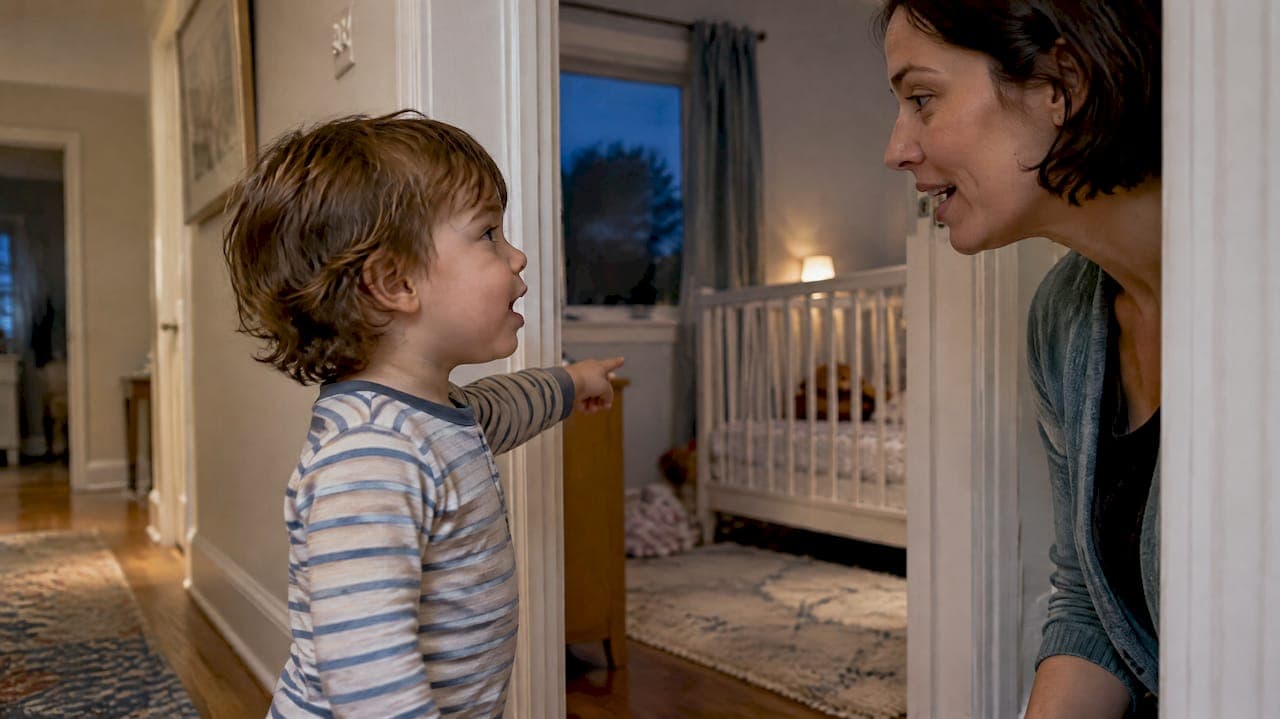
Echolalia, repeating words or phrases a child has heard, is a normal part of how many toddlers learn language, and it often fades on its own by around age 3. If repetition continues past that age, or if you notice other developmental concerns alongside it, that is the moment to bring it up with your pediatrician. Watching your child's overall progress and knowing key milestones can help you decide whether to raise concerns with your pediatrician.
TL;DR:
- Developmental screening is recommended at 9, 18, and 30 months, while autism screening is recommended at 18 and 24 months; repetition alone is not diagnostic.
- Seek advice if your child loses skills, uses few gestures, shares little attention, or does not respond to their name after hearing has been checked.
- Respond to the intended message, then model a slightly fuller phrase; simple choices, routine narration, and pauses can invite more flexible language without suppressing repetition.
- A clinician assesses spontaneous speech, play, interaction, and home observations; follow up may include pediatric care, speech therapy, or early intervention.
Table of Contents
- What echolalia looks like: immediate and delayed repetition
- Is echolalia normal in toddlers, and when does it usually fade?
- Echolalia and autism: what parents need to understand
- Practical strategies you can use to support communication
- When to contact a pediatrician or speech-language pathologist
- Typical phase or communication difference: how to tell them apart
- What echolalia is actually doing for your toddler
- How echolalia connects to other speech and language patterns
- Your role in turning repetition into real communication
- Echolalia at mealtimes: what repetition can signal during feeding
- Our family-centered take on echolalia
- How we can help with speech therapy and parent coaching
- FAQ
- Sources
What echolalia looks like: immediate and delayed repetition
Echolalia is the automatic, non-voluntary repetition of words or phrases a child has heard someone else say. It is not the same as a toddler consciously copying a word you just taught them; it happens more reflexively, as part of how the brain processes incoming language.
Clinicians generally describe two types:
- Immediate echolalia: your toddler repeats a word or phrase right after hearing it, like echoing "Do you want juice?" back to you instead of answering.
- Delayed echolalia: your child repeats a phrase they heard earlier, often to express a need or make a comment, such as reciting a line from a favorite show when they want attention.
Some toddlers also show what researchers call scripting or gestalt language acquisition, a style of language learning that starts with whole chunks of speech and gradually breaks them into smaller, more flexible pieces. This is considered one legitimate path toward independent sentence building, not a problem to correct.
Is echolalia normal in toddlers, and when does it usually fade?
For most toddlers, echolalia is simply part of figuring out how language works. It tends to improve over the first two years of life, with most children moving toward independent sentence construction by around age 3.
While your child's echolalia settles, a few milestones can help you track overall progress:
- Pointing to show interest or request something by 12 to 18 months.
- Responding consistently to their own name.
- Combining words into short phrases.
- Using language to comment, ask, and greet, not just repeat.
Routine developmental checkups at 9, 18, and 30 months give your pediatrician scheduled opportunities to screen for delays, so bringing your observations to those visits (rather than waiting for a problem to become obvious) can help identify concerns early.
Echolalia and autism: what parents need to understand
Echolalia shows up often in autism, but it also shows up in toddlers with completely typical development, so repetition alone does not point to a diagnosis. What matters more is the full picture: how your child plays, interacts, understands language, and responds to their name.
Developmental screening is recommended for all children at 9, 18, and 30 months, with specific autism screening recommended at 18 and 24 months, according to the CDC. That schedule exists precisely because early signs can be subtle and easy to miss at home.
A few signs are worth raising with your pediatrician sooner rather than later:
- Loss of words or skills your child previously had.
- Limited eye contact or little interest in sharing attention with you.
- Few or no gestures, like waving or pointing.
- Not responding when their name is called, even with hearing confirmed.
Clinicians weigh echolalia alongside these broader signs rather than in isolation, and the speech-language pathology literature acknowledges that interpreting echolalia well takes looking at the whole communication picture, not a single behavior.
Practical strategies you can use to support communication
Rather than trying to stop the repetition outright, the most useful approach treats echolalia as a starting point for communication and builds from there.
- Model and expand. When your child repeats "want juice," respond with "You want juice, please" to add a small, natural extension.
- Narrate routines. Describe what you are doing during bath time, snack time, or getting dressed so your child hears language tied to meaningful, repeated context.
- Offer limited choices. Asking "Milk or water?" instead of open-ended questions gives your toddler a manageable way to respond with real words.
- Pause and wait. Leave space after a question or during a routine so your child has room to fill it with their own words, even imperfect ones.
- Use visuals if needed. Simple picture cards or objects can support toddlers who process spoken language more slowly.
Playful repetition, like echoing lines from a favorite book during a game, can be a comfortable, low-pressure way to build connection. The goal over time is gently encouraging new or expanded phrasing rather than only matching what your child already said.
Pro Tip: Respond to the intent behind the repetition, not just the words. A child echoing "time for bed" while pointing at their crib is communicating, even if the phrasing is borrowed.
This approach lines up with current thinking in speech-language pathology, which has shifted toward viewing echolalia as a stepping stone to functional communication rather than a behavior to eliminate. For more structured ideas you can try between sessions, our speech therapy activities for toddlers offer a good starting point.
When to contact a pediatrician or speech-language pathologist
Most echolalia resolves on its own, so there is rarely a need to panic over a toddler who repeats phrases. That said, a few situations call for a professional conversation:
- Echolalia persists past age 3 without signs of independent sentence use.
- Your child shows regression, losing words or social skills they once had.
- They are not meeting other speech or social milestones for their age.
- Hearing concerns have not been ruled out.
If you reach out, expect a developmental screening first: your pediatrician will ask about milestones, observe your child, and may refer you for a full speech-language evaluation. That evaluation typically includes direct observation, a sample of your child's spontaneous language, and a conversation with you about what you see at home. Depending on the findings, your child's care might involve a pediatrician, a speech-language pathologist, or an early intervention program, with goals centered on building functional, flexible communication rather than erasing echolalia entirely. Our speech-language evaluation guide walks through what a session actually looks like.
It is also worth confirming hearing is not a contributing factor, since untreated ear issues can affect how clearly a child processes spoken language; a partner resource on recognizing ear health concerns outlines signs worth ruling out alongside a speech evaluation.
Typical phase or communication difference: how to tell them apart
For many toddlers, echolalia is simply a phase, a scaffold they use while building the skills to generate original sentences. In these cases, you will usually see steady movement: more spontaneous words, less reliance on repeated phrases, and growing flexibility in how your child uses language across different situations.
For other children, echolalia reflects a different way of processing and producing language rather than a temporary stage. This is especially true for children on a gestalt language development path, where larger chunks of speech are the natural starting material, gradually broken down into smaller, reusable pieces over months or longer. For these children, echolalia is not something to outgrow so much as something to build on.
The practical difference matters for how you respond. A toddler moving through a typical phase often benefits from everyday language modeling and patience. A child using echolalia as a core communication strategy may benefit more from structured support that honors their starting point and intentionally expands it, rather than redirecting them away from the phrases they already use. Neither path means something is wrong; they simply call for different kinds of support, which is why an individualized look at your specific child matters more than a general rule.

What echolalia is actually doing for your toddler
Repetition rarely happens for no reason. Research into echolalia has moved away from viewing it as empty mimicry and toward recognizing real communicative functions behind it.
For some toddlers, echolalia helps with self-regulation, offering a familiar, predictable pattern of sound during moments of stress or overstimulation. For others, it is part of processing: repeating a phrase gives their brain more time to work out its meaning before responding. Delayed echolalia in particular often carries a clear communicative purpose, like using a memorized line from a show to request something or to comment on a situation that reminds them of it.
Understanding the function behind a specific instance of echolalia changes how you respond to it. A child repeating a phrase to self-soothe during a meltdown needs comfort, not a prompt to "use your own words." A child repeating a scripted line to request a snack is already communicating; the next step is helping that request become more flexible over time. Watching for the pattern behind the repetition, rather than treating all echolalia the same way, helps you respond in a way that actually supports your child's goal in that moment.
How echolalia connects to other speech and language patterns
Echolalia does not exist in isolation. It often overlaps with, or gets confused for, other developmental speech patterns that show up around the same age.
Delayed speech, where a toddler has fewer words than expected for their age, can coexist with echolalia, since some children lean on repeated phrases precisely because generating original words is harder for them. In these cases, echolalia can actually function as a bridge toward speech rather than a separate issue, especially when caregivers respond by expanding on what the child repeats.
Stuttering and echolalia are distinct from each other. Stuttering involves disruptions in the flow of speech, like repeated sounds or prolonged syllables, within a child's own spontaneous language. Echolalia involves repeating someone else's words or phrases rather than disruptions in original speech. A toddler can show one, the other, or occasionally both, which is part of why a professional evaluation looks at the full pattern of a child's speech rather than a single behavior in isolation.
Recognizing these distinctions matters because the right response differs. A child who stutters often benefits from a relaxed pace and reduced pressure to speak quickly. A child who echoes benefits more from language modeling and expansion. Confusing the two can lead to strategies that do not match what your child actually needs.

Your role in turning repetition into real communication
Echolalia gives you a starting point, but your response is what shapes whether it grows into more flexible communication. Children learn language largely through interaction, so the way you react to repeated phrases carries real weight.
Acknowledging the attempt matters more than correcting the phrasing. When your toddler repeats something, responding warmly and expanding on it, rather than asking them to "say it right," keeps the exchange positive and keeps your child engaged in communicating with you. Over time, small expansions can add up to more flexible language.
Consistency across caregivers also helps. When everyone in your child's life, parents, grandparents, daycare providers, responds to echolalia in similar, supportive ways, your toddler gets a more predictable pattern to learn from. This does not mean scripting every interaction; it means noticing opportunities to build on what your child already says instead of only correcting or ignoring it.
Your attention to these small moments does more long-term work than any single technique. A child who feels heard when they repeat a phrase is more likely to keep trying to communicate, which is the real goal behind every strategy here.
Echolalia at mealtimes: what repetition can signal during feeding
Mealtimes are full of language, requests for more food, comments about taste or texture, protests about ending a meal, which makes them a natural place for echolalia to show up. A toddler who repeats "all done" after hearing it, without yet using the phrase spontaneously to end their own meal, is still in the process of connecting that phrase to its meaning and function.
This overlap matters because feeding and communication challenges often travel together. A toddler who struggles to communicate hunger, fullness, or texture preferences may also show feeding difficulties, like limited food acceptance or mealtime frustration, that are hard to separate from the language delay itself. Recognizing echolalia during meals, rather than dismissing it as background noise, can give you useful clues about what your child is trying to express about their feeding experience.
Supporting communication at the table does not require separate sessions from everyday meals. Narrating what is happening, offering simple choices between two foods, and responding to repeated phrases the same way you would elsewhere in the day all carry over naturally into mealtime. When feeding and communication concerns show up together, that overlap is worth mentioning to whoever evaluates your child, since addressing both areas together tends to serve a toddler better than treating them as unrelated.
Our family-centered take on echolalia
We look for the reason behind a child's echolalia rather than treating it as a behavior to erase. Our goal is helping toddlers use language functionally, in their own way, not pushing them toward a single "correct" way of speaking. If repetition is on your mind, trust your instincts enough to ask questions and request an individualized look at your specific child.
— Thriving Joy
How we can help with speech therapy and parent coaching
If you are noticing echolalia alongside other concerns, or simply want expert eyes on your toddler's communication, our speech therapy team evaluates language patterns, play, and interaction to understand what is actually happening, then builds a plan around your child's specific strengths.
A typical first step looks like this:
- An initial assessment to observe your child's communication and understand your concerns.
- Collaborative goal setting focused on functional, flexible language use.
- A family coaching plan so strategies carry over naturally into daily routines at home.
For parents who want hands-on guidance implementing strategies between sessions, our parent coaching and classes offer additional support. Reach out to schedule an intake and get a clearer picture of what your toddler needs.
This article is general information, not a substitute for advice from a qualified doctor. Consult a qualified healthcare professional about your own circumstances before acting on anything here.
FAQ
Is it normal for a 2-year-old to have echolalia?
Yes, echolalia is a common part of early language development, and many toddlers repeat words or phrases as they learn how language works. It typically improves over the first two years of life, with continued progress expected as your child approaches age 3.
Can a toddler have echolalia and not be autistic?
Yes, echolalia appears in many toddlers with completely typical development, not only in those with autism. What matters more than the repetition itself is the broader developmental picture, including social interaction, gestures, and response to their name.
Is echolalia a part of autism?
Echolalia is common among autistic children, but it is not exclusive to autism and does not confirm a diagnosis on its own. Clinicians look at echolalia together with other signs, and routine autism screening at 18 and 24 months helps catch broader patterns early.
Do kids grow out of echolalia?
Many children show less echolalia over time as they build independent language skills, often transitioning toward spontaneous sentence construction by around age 3. If echolalia continues well past that point or appears alongside other developmental concerns, a conversation with your pediatrician is a reasonable next step.