

Yes, most babies with torticollis can keep breastfeeding, and starting a few things right away makes a real difference. Try feeding holds that let your baby face you comfortably from their preferred side, build in supervised tummy time to encourage head turning, and consult an IBCLC and pediatric physical therapist early. Combined feeding support and prompt therapy help most babies stay at the breast while their neck muscles improve.
TL;DR:
- Early positioning adjustments, such as feeding holds that align your baby's face with the breast and side-lying feeds, can improve latch and reduce discomfort.
- Supporting your baby's neck with gentle stretching, tummy time, and toys on the restricted side promotes natural head turning and accelerates muscle development.
- Using skin-to-skin contact and breast compressions during feeds helps maintain milk transfer when neck restriction causes weaker suckling.
- A coordinated approach involving lactation and physical therapy providers working together yields quicker, more effective torticollis resolution.
- Seek professional evaluation promptly if your baby shows signs like poor weight gain, neck lumps, limited range of motion, or head flattening, for targeted treatment.
Table of Contents
- How Torticollis Changes Feeding Mechanics at the Breast
- Positioning and Holds That Help
- Keeping Milk Transfer Strong While You Work on Positioning
- Home Exercises, Tummy Time, and When Therapy Should Start
- When to Call In Professional Help
- A Clinical Take on Coordinating Feeding and Movement Care
- Getting Support for Torticollis and Breastfeeding in One Visit
- Sources
- FAQ
How Torticollis Changes Feeding Mechanics at the Breast
Torticollis happens when the sternocleidomastoid muscle, the long muscle running from behind the ear to the collarbone, is tight or shortened on one side. That tightness pulls your baby's head into a tilt toward the tight side and a turn away from it, which is why so many babies seem to have a strong side and a "difficult" side at the breast. Some babies also develop mild jaw or facial asymmetry alongside the neck tightness, and a case series in the Journal of Human Lactation found that mandibular asymmetry can directly interfere with how well a baby latches and transfers milk.
At the breast, this shows up in specific, watchable ways:
- A strong preference for one breast, with fighting, arching, or shallow latching on the other
- Shorter feeds on the restricted side, sometimes with clicking or slipping off the nipple
- Nipple pain or damage that shows up only (or mostly) on one side
- Fussiness, pulling away, or falling asleep quickly instead of feeding actively
- Fewer wet diapers than expected or slower-than-typical weight gain
A scoping review of manual interventions for infants with suboptimal breastfeeding found moderate evidence that treating the underlying musculoskeletal restriction, not just the latch itself, improves nursing outcomes. That's a useful reframe: the feeding problem and the neck problem are often the same problem wearing two hats.
Positioning and Holds That Help
The guiding principle is simple: let your baby feed facing the direction their neck naturally wants to go, rather than forcing them to turn against the tightness every time they eat. Pediatric guidance from KidsHealth recommends adapting your hold so your baby's face and body line up with the breast without a fight, which protects both your comfort and your milk supply.
Here's a sequence worth trying at your next few feeds:
- Start with the football hold on the tighter side. Tuck your baby under your arm like a football, facing you, with their head level with your breast. This hold naturally avoids the turn your baby resists.
- Turn your modified cradle hold to match their preference. Instead of the classic cradle, rotate your baby's whole body so their face points the same direction it wants to on that side, using your forearm for support.
- Try side-lying feeds for the tough side. Lying down with your baby facing you removes gravity's pull on their neck and often results in a calmer, deeper latch.
- Use a small rolled blanket or nursing pillow to support your baby's shoulders and hips in line with their head. Misalignment at the shoulders often shows up as latch trouble at the mouth.
- Check the latch itself. If it looks shallow or asymmetrical, unlatch gently and try again rather than pushing through pain.
- Switch sides slowly and on purpose. Offer the harder side first when your baby is calmest, usually right at the start of a feed, and save the easier side for when they're tired.
Pro Tip: Support your baby's jaw lightly with one finger during latch on the restricted side. A gentle downward cue at the chin can help correct the asymmetrical mouth opening that tight neck muscles cause, giving you a deeper, less painful latch.
Keeping Milk Transfer Strong While You Work on Positioning
Positioning fixes the mechanics, but you still need to protect your milk supply while your baby's neck improves. Skin-to-skin contact before feeds calms babies and often improves latch quality on the harder side. Breast compressions during a feed keep milk flowing when your baby's suck is weaker or less coordinated on the restricted side, and shorter, more frequent feeds (cluster feeding) can make up for a baby who tires quickly in a tricky position.
Some families use temporary supports while working through torticollis:
- A nipple shield, used short-term and under an IBCLC's guidance, to protect a damaged nipple while the latch improves
- Paced bottle feeding with expressed milk if a specific feed is too painful or unproductive to continue at the breast
- Hand expression or pumping after feeds to make sure the breast is fully drained on the side your baby favors less
Watch for the signs that transfer is working: audible swallowing, a rhythmic suck-swallow-breathe pattern, a softer breast after feeds, and steady diaper output. A scoping review noted that adverse events from manual and positioning interventions were rare and improvements in nursing were commonly reported, which is reassuring if you're nervous about trying new holds. If transfer looks weak at a given feed, don't wait it out. Switch positions, add compressions, or offer expressed milk that same session rather than hoping the next feed goes better on its own.
Home Exercises, Tummy Time, and When Therapy Should Start
Positioning and gentle stretching are the frontline treatment for infant torticollis, and timing matters more than almost anything else here.
- Supervised tummy time, 10 to 15 minutes total, spread across several sessions a day rather than one long stretch, builds neck strength while your baby is awake and watched.
- Position toys and sounds toward the restricted side during play so your baby is motivated to turn that way on their own.
- Learn passive range-of-motion stretches from a pediatric physical therapist rather than guessing. These gentle neck stretches are safe when taught correctly but can be uncomfortable or counterproductive when done wrong.
Physical therapy tends to work fastest when it starts early. Resolution is quickest when therapy begins before one month of age, and outcomes are generally best when treatment starts before four months, according to guidance from Nationwide Children's Hospital. That's a real argument for asking about a referral now rather than waiting to see if things resolve on their own.
Heat and cold are not primary treatments for infant torticollis, and clinical guidance from Children's Minnesota advises against applying either without professional direction. A printable tummy time schedule can help you stay consistent and give you something concrete to bring to appointments.
Pro Tip: Film 15 seconds of a feed and 15 seconds of tummy time on your phone each week. Therapists can spot subtle range-of-motion changes on video that are easy to miss in the moment, and the clips help track progress across visits.

When to Call In Professional Help
Some signs mean it's time to move past home strategies and get evaluated. Call your pediatrician promptly if you notice:
- Poor weight gain or fewer wet diapers than your baby's age would predict
- Signs of dehydration, like a sunken soft spot or dry mouth
- Complete inability to feed on one side, even with adjusted holds
- Very limited neck range of motion, or a hard lump felt in the neck muscle
- A flattening or asymmetry developing on the back of the head (plagiocephaly)
Your pediatrician can confirm the diagnosis and start the referral chain. An IBCLC assesses the latch itself and troubleshoots positioning in real time, while a pediatric physical or occupational therapist evaluates range of motion and builds a stretching plan. Bring a feeding log, a short video of a typical feed, and a video showing your baby's head turning to each side. That handful of details often saves an entire appointment of back and forth.
A Clinical Take on Coordinating Feeding and Movement Care
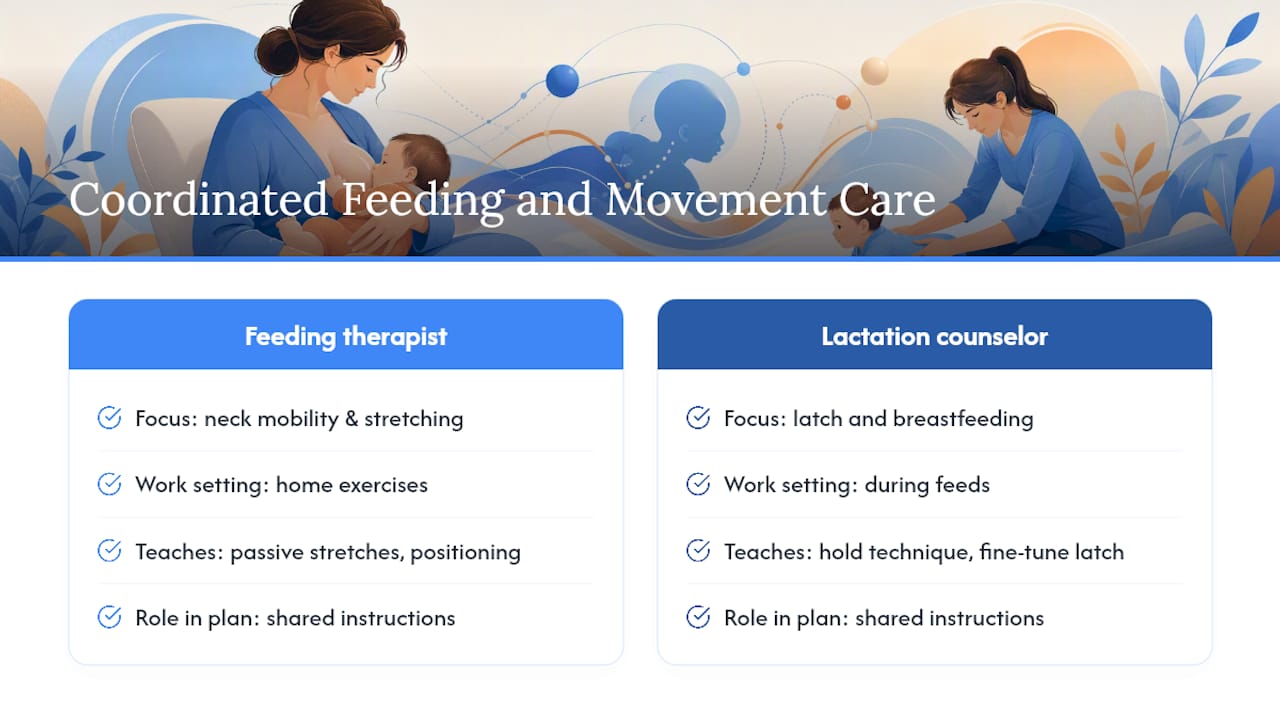
A connected approach treating feeding and movement as parts of one story, not separate referrals, can benefit infants with torticollis. When a baby comes in with torticollis and breastfeeding trouble, our evaluation looks at both the latch and the neck at the same time, because fixing one without the other usually means the problem comes back.
In practice, that looks like a feeding therapist and lactation counselor working from the same plan: one teaches the passive stretches and positioning at home, the other fine-tunes the hold and latch at the breast during actual feeds. Parents get one coordinated set of instructions instead of two conflicting ones....
— Jamie
Getting Support for Torticollis and Breastfeeding in One Visit
Chasing down a pediatrician, a separate lactation consultant, and a separate physical therapist is exhausting when you're already sleep-deprived and worried about weight gain. Some clinics bring feeding therapy and lactation counseling together, allowing assessment of neck restriction and feeding support in the same visit.

A first visit typically includes a feeding assessment, a look at range of motion, and a plan you leave with the same day, whether that means adjusted holds to try that night or a referral into a longer therapy program. Services include:
- Lactation counseling for latch, positioning, and milk supply support
- Feeding therapy evaluations for babies with structural or skill-based feeding challenges
- Coordinated care planning between feeding and movement specialists
If your baby has been diagnosed with torticollis and feeds are getting harder instead of easier, book a feeding therapy evaluation and bring your feeding log and any video you've taken. It's the fastest way to get a plan built around what your baby actually needs.
This article is general information, not a substitute for advice from a qualified doctor. Consult a qualified healthcare professional about your own circumstances before acting on anything here.
Sources
- Manual interventions for musculoskeletal factors in infants with suboptimal breastfeeding (scoping review) — PMC
- Positioning and exercises for torticollis — Nationwide Children's
- Torticollis — KidsHealth (Nemours)
- Torticollis — Cleveland Clinic
FAQ
How Do You Release Torticollis in a Baby?
Release comes from consistent, gentle passive range-of-motion stretches taught by a pediatric physical therapist, paired with positioning changes during feeding, play, and tummy time; it's rarely a single quick fix.
What Is the Three-Month Breastfeeding Crisis, and What Are Its Symptoms?
Some parents notice a rough patch around three months tied to growth spurts and increased distraction at the breast, with symptoms like shorter feeds, fussiness, and more frequent nursing. This is separate from torticollis-related feeding trouble, though the two can overlap and make feeds feel harder at once.
What Are the Signs of Torticollis in Babies?
Common signs include a head tilted to one side with the chin turned to the opposite side, a strong preference for turning one direction, a firm lump in the neck muscle, and, over time, a flattened spot on one side of the head.
Is Heat or Cold Better for Torticollis?
Neither heat nor cold is a recommended primary treatment for infant torticollis, and Children's Minnesota advises against using either without direct guidance from your baby's provider.