

Reverse cycling breastfeeding means your baby feeds lightly during the day and makes up for it with frequent, longer feeds at night. It is one of the most common patterns pediatric feeding specialists hear about from exhausted parents, and it usually resolves on its own within weeks to months.
Try these three things tonight:
- Offer one long, distraction-free feed in the late afternoon or early evening, before the overtired witching hour hits.
- Try a dream feed (a gentle feed while baby is still mostly asleep) an hour or two before your own bedtime.
- Keep nighttime feeds calm, dim, and quiet so baby doesn't get more alert or social than they need to be.
UNICEF's breastfeeding guidance and clinical feeding specialists at Thrivingjoy both note this pattern often emerges around four to six months, frequently tied to a return to work or a growth spurt. It's common, it's not a sign you're failing, and it's almost always temporary.
Key Takeaways
Reverse cycling breastfeeding resolves fastest when daytime feeds become longer and more focused, not when nighttime feeds get cut abruptly.
| Point | Details |
|---|---|
| It's a normal adaptation | Babies often shift feeding toward night after a return to work or separation, not because of low supply. |
| Fix days before nights | Prioritizing calm, focused daytime feeds every 3 to 4 hours shifts the pattern more reliably than limiting night feeds. |
| Timeline is usually weeks | Growth-spurt versions often resolve in under a week; separation-driven patterns can take a few months. |
| Know the red flags | Poor weight gain, fewer wet diapers, fever, or feeding pain mean it's time to call a pediatrician or IBCLC. |
| Get hands-on help | Thrivingjoy's lactation counseling builds an individualized daytime feeding and pumping plan based on a full assessment. |
Table of Contents
- What Does Reverse Cycling Breastfeeding Look Like?
- Why Do Babies Reverse Cycle?
- How Can You Fix Reverse Cycling at Night?
- How Do You Plan Pumping Around a Return to Work?
- Will Reverse Cycling Affect My Baby's Sleep Long Term?
- When Should You Call the Pediatrician or a Lactation Consultant?
- How Can Exhausted Parents Cope With the Nighttime Load?
- How Thrivingjoy Approaches Reverse Cycling in the Clinic
- Get Hands-On Support for Reverse Cycling and Pumping Plans
- Where Can You Learn More About Reverse Cycling?
- Sources
What Does Reverse Cycling Breastfeeding Look Like?
Reverse cycling shows up as a noticeable shift, not a subtle one. A baby who used to nurse well every three hours during the day starts taking short, snacky feeds of five or ten minutes, then wakes two or three times overnight for long, hungry sessions.
Watch for this pattern:
- Daytime feeds that feel rushed, distracted, or half-hearted, sometimes just a few minutes at the breast.
- One noticeably long "marathon" feed in the evening, often right when you walk in the door from work.
- Cluster feeding overnight, with baby waking every one to two hours wanting to nurse.
- More daytime napping than usual, as if baby is saving energy for nighttime.
This differs from the newborn day/night confusion many babies show in the first few weeks, which resolves as circadian rhythms mature. Reverse cycling is a later, more deliberate behavioral shift, and per Medela's clinical guidance, it tends to appear once a baby has already settled into a fairly predictable feeding rhythm.
Why Do Babies Reverse Cycle?
Most causes trace back to something changing in your baby's day, not something wrong with your milk. Here's what typically drives it:
- Return to work or separation. Babies often "save up" their appetite for the parent they nurse from, feeding lightly with a caregiver and heavily once reunited, according to KellyMom's research.
- Distractibility. Older babies get curious about their surroundings, and a busy daycare room competes hard with a bottle or breast.
- Growth spurts. A temporary jump in calorie needs can trigger a few rough nights that resolve within a week.
- Comfort nursing. Nighttime nursing offers closeness and reassurance that a bottle or busy daytime schedule doesn't replicate.
- Sleepier daytime babies. Some babies simply doze through daytime hunger cues instead of waking to feed.
- Snack feeding. Frequent, brief daytime feeds fill baby up just enough to blunt appetite without providing a full, efficient feed.
- Feed to sleep habits. If nursing is baby's only path to sleep, every night waking becomes a feeding request.
Medical causes are less common but worth ruling out, including reflux, tongue tie, or illness that makes daytime feeding uncomfortable. Reverse cycling is specific to breastfed babies. Bottle-fed babies who take a bottle from any caregiver don't show the same "save it for mom" pattern, though distraction and bottle refusal at daycare can create a similar-looking daytime slump.
Pro Tip: Keep a two-day log of feed times and rough lengths before you assume the cause. A pattern that starts abruptly around a daycare transition points toward separation anxiety; one that builds gradually over a week often points toward a growth spurt.

How Can You Fix Reverse Cycling at Night?
Shifting the pattern back toward daytime feeding works best as a gradual process, not an overnight fix. Try these steps in order:
- Prioritize a focused daytime feed every 3 to 4 hours. Find a quiet spot, dim the lights if possible, and remove toys or screens during the feed.
- Trim the late-afternoon nap slightly. A short catnap instead of a long one often means baby arrives at the evening feed hungrier and more willing to nurse fully.
- Add a dream feed. Nursing or offering a bottle while baby is drowsy, right before your own bedtime, can reduce one overnight wake-up.
- Break the feed-to-sleep association gradually. Start putting baby down slightly more awake, so nursing becomes one part of the bedtime routine rather than the only route to sleep.
- Use paced bottle feeding if a caregiver is bottle-feeding during the day. This means holding the bottle horizontally and pausing every 20 to 30 seconds so baby controls the pace, mimicking breastfeeding and preventing overfeeding or feed-refusal from oversized, fast flow.
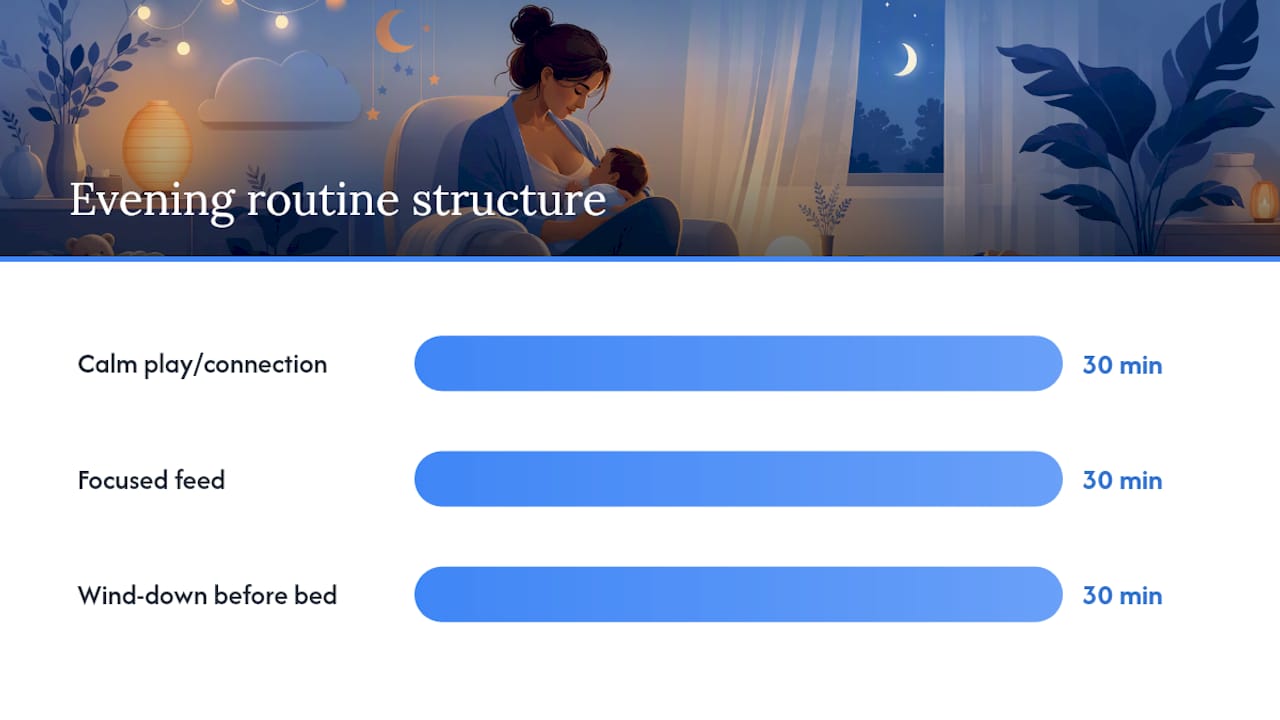
The 30-30-30 rule is a simple way to think about restructuring the evening: roughly 30 minutes of calm play or connection after pickup, followed by a 30-minute focused feed, followed by a 30-minute wind-down before bed. It's a loose framework, not a strict clock, but it gives distracted evenings some shape.
For daytime feed efficiency, switch positions if baby seems bored or slouchy (an upright or side-lying hold sometimes re-engages a sleepy or distracted nurser), dim the room, and turn off the TV. Watch for active swallowing rather than just sucking, which signals a deeper, more productive latch.
If daytime feeds stay short despite these changes for more than a week or two, Thrivingjoy's lactation counseling team can assess latch, positioning, and oral function, and build a pumping or paced-bottle plan suited to your baby's actual feeding style.
Pro Tip: If your baby fights daytime feeds but nurses beautifully at 2 a.m., don't take it personally. Half-asleep babies often latch better because they're too drowsy to get distracted.
How Do You Plan Pumping Around a Return to Work?
Building a pumping routine before your first day back gives your body time to adjust and gives you a realistic sense of your supply. A workable starting schedule looks like this:
- Pump once mid-morning, roughly three hours after baby's last feed.
- Pump again after lunch, spacing sessions about every three hours as a baseline, per Cleveland Clinic's guidance.
- Add a mid-afternoon session if your workday runs long or your commute delays the evening feed.
Storage matters as much as timing. Label every bottle or bag with the date, refrigerate milk you'll use within four days, and pack an insulated cooler with ice packs for the commute home. UNICEF's return-to-work guidance also points out that many workplaces are required to provide break time and a private space (not a bathroom) for pumping.
- Bring a photo or a piece of baby's clothing to help trigger letdown when you're pumping without baby nearby.
- Hand-express for a minute before pumping if letdown is slow, it often speeds things up.
Pro Tip: A double electric pump with a properly sized flange cuts session time significantly compared to single pumping, an important detail during a short lunch break.
Will Reverse Cycling Affect My Baby's Sleep Long Term?
Most reverse cycling resolves within a few weeks to a couple of months once daytime feeding improves, according to Healthline's reporting on the pattern. Growth-spurt-driven versions tend to be the shortest, sometimes clearing up in under a week.
What's actually happening with sleep:
- Baby sleeps more during the day, which lowers daytime hunger cues and shifts calorie intake toward the night.
- Night waking increases, not because something's wrong, but because that's when baby is genuinely hungry.
- Gradual daytime improvements protect your milk supply better than abruptly cutting night feeds, which can cause engorgement or a dip in production.
Give any change at least a week before judging whether it's working. Babies adjust on their own timeline, and rushing the process tends to backfire.
When Should You Call the Pediatrician or a Lactation Consultant?
Most reverse cycling is a normal phase, but a few signs mean it's time to get an evaluation rather than wait it out.
Poor or stalling weight gain, fewer than six wet diapers a day, lethargy, persistent vomiting, fever, or visible pain during feeding are all signs that warrant a same-week evaluation, not a wait-and-see approach.
Call your pediatrician first for fever, vomiting, or weight concerns. Call an IBCLC or lactation consultant first for latch pain, suspected tongue tie, or supply worries. Either way, bring a weight trend, a rough diaper count from the last 24 hours, and notes on daytime versus nighttime feeding to make the visit more productive, per AAP's guidance on breastfeeding problems.
How Can Exhausted Parents Cope With the Nighttime Load?
Reverse cycling doesn't just cost baby's sleep, it costs yours. A few adjustments make the stretch more sustainable:
- Alternate night duties with a partner when possible, even splitting by time block rather than by night.
- Keep night feeds low-light and low-stimulation to help everyone fall back asleep faster.
- Ask for help with chores or meals so your energy goes toward feeding and rest, not laundry.
- Protect one predictable nap or quiet block for yourself, even 20 minutes counts.
If exhaustion tips into something heavier, persistent sadness, anxiety, or feeling unable to cope, talk to your doctor. That's a medical conversation, not a parenting failure.
Pro Tip: Sleep in the clothes you'd want to feed in. Skipping the fumbling at 2 a.m. adds up to real extra rest over a week.
How Thrivingjoy Approaches Reverse Cycling in the Clinic
When a family comes to us describing reverse cycling, we start with a full feeding assessment, not a generic script. That means looking at latch, oral motor function, and the daytime environment before recommending a plan.

Sometimes the fix is behavioral. Sometimes there's a latch or sensory piece underneath that a hands-on evaluation catches. Either way, the plan gets built around your baby, not a checklist.
Get Hands-On Support for Reverse Cycling and Pumping Plans
If daytime feeds still feel like a struggle after trying these steps, an in-person feeding assessment often finds what a nighttime log alone can't. Thrivingjoy's lactation counseling combines hands-on latch and positioning support with personalized pumping and paced-bottle plans built around your baby's actual feeding style, not a one-size schedule pulled from a chart.

Our team works with parents on everything from prenatal breastfeeding education through the return-to-work transition, including coaching on daytime feeding efficiency and realistic pumping schedules for your specific workday. If your baby also struggles with bottle acceptance from a caregiver, our feeding therapy services can evaluate oral motor patterns that make bottles harder to take. Ready to get a clearer picture of what's driving your baby's nighttime feeds? Book a lactation counseling session and bring your feeding log, we'll build a plan from there.
Where Can You Learn More About Reverse Cycling?
- KellyMom: plain-language explanation of reverse cycling and its link to returning to work.
- Medela: clinical breakdown of causes and fixes.
- Healthline: timeline expectations and troubleshooting.
- Cleveland Clinic: pumping schedules and milk storage guidance.
- La Leche League: feeding frequency norms and troubleshooting FAQs.
For concerns specific to your baby, a pediatrician or IBCLC remains your best resource.
This article is general information, not a substitute for advice from a qualified doctor. Consult a qualified healthcare professional about your own circumstances before acting on anything here.
Sources
- Kellymom
- What Is Reverse Cycling and Why Does It Happen? | Medela
- Reverse Cycling: Breaking the Pattern — Healthline
- Pumping schedule and pumping at work | Cleveland Clinic
- Breastfeeding when you return to work | UNICEF Parenting