
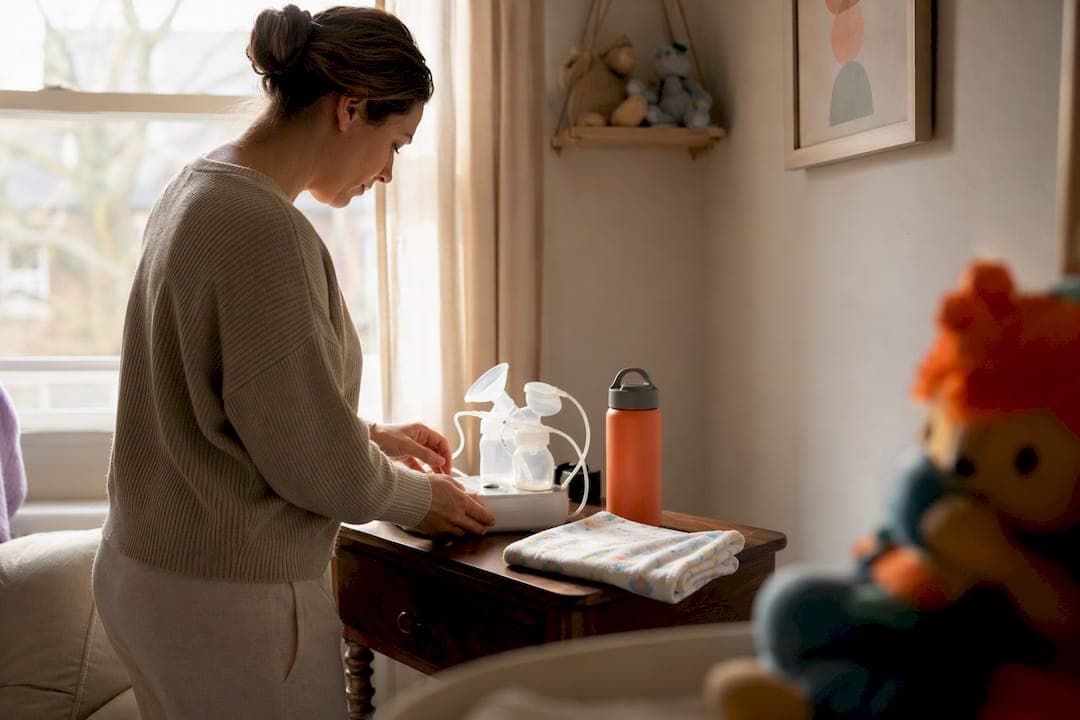
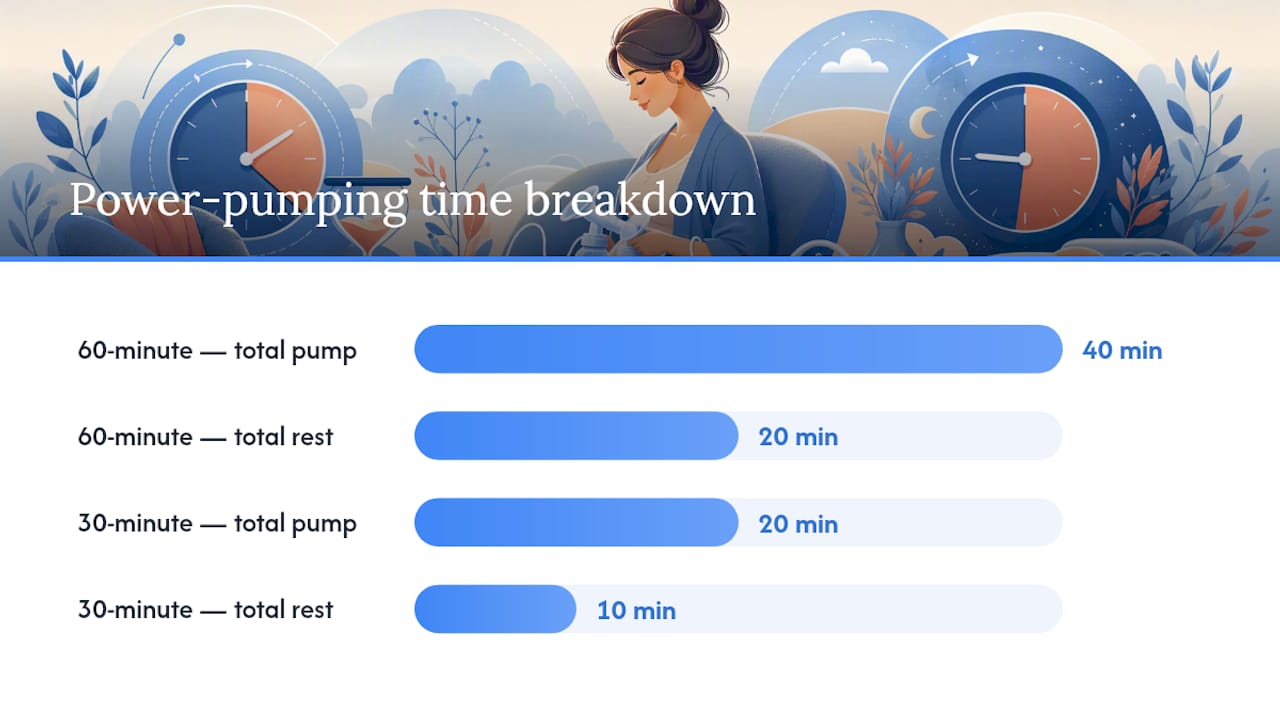
Pump 20 minutes, rest 10, pump 10, rest 10, pump 10. That's the standard 60-minute power pumping schedule, and it's the version most lactation resources recommend starting with. If an hour feels impossible right now, a 30-minute compressed version (pump 10, rest 5, pump 5, rest 5, pump 5) still sends a demand signal, just a gentler one.
Try one session daily for 3 to 7 days, swapping it in for a regular pump session rather than adding it on top of your routine. Then check your numbers.
- Standard protocol: 20 min pump → 10 min rest → 10 min pump → 10 min rest → 10 min pump (40 total active minutes)
- Compressed protocol: 10 min pump → 5 min rest → 5 min pump → 5 min rest → 5 min pump
- Frequency: once daily, 3 to 7 days, then reassess
A 2023 randomized pilot trial found that consistent daily power pumping nearly doubled median per-session volume, from 27 mL to 50 mL, over one week. Stop and call a lactation clinician if you notice fever, painful lumps, or engorgement that doesn't ease between sessions.
Key Takeaways
Power pumping increases milk supply by replacing one regular pump session with short, repeated bursts that signal your body to remove milk more frequently, typically over 3 to 7 days.
| Point | Details |
|---|---|
| Start with the standard cycle | Pump 20 minutes, rest 10, pump 10, rest 10, pump 10, once daily. |
| Use the 30-minute option if needed | A compressed 10/5/5/5/5 cycle still works, just with slower gains. |
| Give it a full week before judging | Days 1 to 3 show little change; days 4 to 7 often bring small, real increases. |
| Swap sessions, don't stack them | Replace one existing pump session rather than adding an extra one to your day. |
| Watch for pain and red flags | Fever, hard red patches, or lasting soreness mean it's time to call a professional. |
| Get personalized troubleshooting | Thriving Joy's lactation counseling offers observed pump sessions and individualized plans when a standard schedule isn't enough. |
This article is general information, not a substitute for advice from a qualified doctor. Consult a qualified healthcare professional about your own circumstances before acting on anything here.
Table of Contents
- What Is Power Pumping and Why Does It Boost Supply?
- The Standard 60-Minute Power Pumping Schedule, Step by Step
- Shorter Options When an Hour Isn't Realistic
- How Long Until You See Results?
- Fitting a Power Pump Into Your Existing Routine
- Troubleshooting: Fit, Pain, and When Something's Wrong
- When to Get Professional Help With Power Pumping
- A Note From Our Team on What Actually Helps
- Getting Personalized Support for Your Pumping Plan
- Sources
What Is Power Pumping and Why Does It Boost Supply?
Power pumping is a pumping pattern that mimics cluster feeding, the stretch of frequent, closely spaced feeds many babies do naturally in the evening or during growth spurts. Instead of one long, steady pumping session, you break the hour into short pumping bursts separated by brief rests, which signals your body to remove milk more often in a short window.
Your milk supply responds to two hormones working together. Prolactin rises with frequent breast stimulation and tells your body to make more milk. Oxytocin triggers the actual release, the "let-down" that moves milk out. Frequent, effective emptying, not the clock, is what drives the response. Healthychildren notes that pump technique and flange fit matter just as much as frequency, because milk that isn't actually removed doesn't send any signal at all.
A few notes before you start:
- Hold off on power pumping in the very first days postpartum without guidance from a lactation professional, since supply patterns are still settling.
- Consistency across several days matters more than any single marathon session.
- If you're already emptying effectively at every feed, power pumping adds less than it would for someone with longer gaps between sessions.
The Standard 60-Minute Power Pumping Schedule, Step by Step
Here's the classic protocol that most lactation consultants teach, broken into a sequence you can follow without overthinking it mid-session.
- Pump for 20 minutes. Use your normal comfortable suction level, not the highest setting. Higher isn't better here; it just increases the odds of soreness.
- Rest for 10 minutes. Set the pump down completely. This isn't wasted time. It's part of the pattern that tells your body to expect another round soon.
- Pump for 10 minutes.
- Rest for 10 minutes.
- Pump for 10 minutes to finish. That's 40 active minutes across a full hour.
A hands-free pumping bra makes the rest periods actually restful, since you can eat, scroll your phone, or close your eyes without holding anything. Sit somewhere you'd actually choose to relax, not just wherever the pump happens to be plugged in. Let-down responds to calm more than it responds to effort.
Pro Tip: Keep a photo of your baby, or a worn piece of their clothing, next to your pumping spot. Oxytocin release is genuinely easier to trigger with a sensory cue than with willpower alone.
Before you start, run through a short checklist: confirm your flange size still fits (breast tissue changes over the postpartum months), fill a glass of water, and pick one relaxation trigger, whether that's a specific playlist or a few slow breaths.

For storage, label every bottle or bag with the date and time pumped. Fresh milk holds safely in the refrigerator for up to four days and in a standard freezer for six to twelve months. Since power pumping sessions often produce smaller individual amounts across each burst, it's fine to combine same-day pumps into one container as long as they're all cooled to the same temperature first.
Shorter Options When an Hour Isn't Realistic
A full hour isn't always possible, especially with a newborn who needs you every ninety minutes or a work schedule with fixed break windows. A shortened 30-minute cycle still works, just less powerfully:
- 30-minute version: pump 10 minutes, rest 5, pump 5, rest 5, pump 5
- 25 to 50 minute variants: adjust the ratio while keeping short bursts and short rests, roughly two-thirds pumping to one-third resting
Expect the compressed version to produce smaller and slower gains than the full 60-minute protocol. That's the trade-off, and it's a reasonable one. A consistent 30-minute session done daily beats an hour-long session you only manage twice a week. The demand signal from repetition adds up even when each individual session is modest.
If you're using a manual pump, shortened cycles are often more sustainable on your hands and wrists than trying to stretch a hand pump through a full 60 minutes. Battery-operated pumps work well for shortened protocols too, particularly if you're pumping somewhere without easy outlet access, like a car during a lunch break.
Pick one consistent time you can actually protect most days, whether that's the last 30 minutes before your commute or a block right after your baby's longest nap. A power pumping session you do sporadically at different times sends a weaker signal than a shorter one you do reliably.
How Long Until You See Results?
Most practitioner guides describe a fairly predictable arc, and knowing it ahead of time keeps you from quitting on day two when nothing seems to be happening yet.
Days 1 through 3 typically show little visible change, which is normal and not a sign the protocol is failing. Days 4 through 7 often bring small increases, sometimes an extra half ounce to a full ounce per session. By 7 to 14 days of consistent daily sessions, many parents see a clearer shift in their overall baseline output.
The 2023 pilot trial backs this timeline with real numbers: participants' cumulative 7-day pumped volume rose from a median of 213 mL to 305 mL with consistent daily power pumping.
Track progress with a few simple methods:
- Ounces per pumping session, logged daily at the same time of day
- Total daily expressed volume across all sessions, not just the power pumping session
- For babies feeding directly at the breast, output cues like wet diapers and pediatrician weight checks
A meaningful increase generally means a consistent rise over several days, not a single unusually good session. If two full weeks pass with no change at all, that's worth a pump fit check or a conversation with a lactation professional rather than pushing longer.
Fitting a Power Pump Into Your Existing Routine
The most important rule here is simple: replace one regular session with the power pump, don't add an extra one. Stacking an additional session on top of your normal routine tends to backfire, since fatigue and stress can actually work against let-down.
Here's how that looks depending on your feeding situation:
| Feeding Situation | Where the Power Pump Fits | Why |
|---|---|---|
| Exclusive pumping | Replace the mid-morning session | Prolactin tends to run higher earlier in the day |
| Combination feeding | Replace one pump session between nursing sessions | Keeps direct feeds and milk removal balanced |
| Returning to work | Replace your first pump break of the day | Easier to protect a consistent time before the day fills up |
| Overnight/early riser | Keep night pumps as-is, place power pump mid-morning | Preserves prolactin's overnight peak without extra fatigue |
To put this into practice:
- Look at your current pump schedule and pick the session that's easiest to protect, meaning nothing else usually competes for that slot.
- Swap that single session for the full power pumping cycle, whichever length fits your day.
- Keep every other session exactly as it was, including overnight pumps if you have them.
- Reassess after a week before deciding whether to adjust timing or length.
Practitioner guides note that morning sessions often work slightly better because prolactin tends to run highest overnight into early morning. That said, consistency in timing matters more than chasing the theoretically perfect hour. A power pump you can reliably do at 10 a.m. every day beats a 6 a.m. session you skip half the time.
Troubleshooting: Fit, Pain, and When Something's Wrong
Most disappointing power pumping results trace back to one of two things: flange fit or suction settings. If your flange is too small, you'll notice rubbing, pain right at the nipple, or a ring of tissue pulling into the tunnel. Too large, and you'll see reduced output along with areola tissue getting drawn in with the nipple. Neither situation is dangerous, but both limit how much milk actually comes out.
- Reduce suction any time a session feels sharply painful rather than just intense; pain signals poor fit or too-high settings, not effective pumping.
- Recheck your flange size every few months, since breast tissue changes throughout the postpartum period.
- Stop a session early if you notice numbness, blanching, or lasting soreness afterward.
Watch for a short list of red flags that need faster attention than a routine fit check: a hard, hot, or red patch on the breast, a fever above 101°F, a lump that doesn't soften with pumping, or flu-like body aches alongside breast pain. Those can signal a plugged duct progressing toward mastitis, and waiting it out rarely helps.
Pro Tip: Warm compresses before a session and gentle massage during the rest periods often loosen a stubborn plugged duct faster than pumping alone.

Once you've reached the supply increase you were aiming for, ease back to your regular schedule. Healthline notes that continuing aggressive power pumping past that point risks oversupply, which brings its own problems, including engorgement and recurring plugged ducts. More isn't automatically better here.
If a week of consistent sessions brings no change, or if pain and fever show up, that's the point to call an IBCLC or lactation counselor rather than keep adjusting on your own.
When to Get Professional Help With Power Pumping
Reach out for help if a full week of daily sessions brings no measurable change, if pain persists despite adjusting flange size and suction, or if you have any concern about your baby's weight gain. These aren't signs you're doing something wrong. They're signs your situation needs a closer look than a general schedule can provide.
A lactation consultation typically includes an observed pumping session, precise flange sizing, adjustments to your pump's settings, and a plan built around your specific supply pattern rather than a generic timeline. That individualized piece matters, since two parents with identical schedules can have very different underlying issues.
Before your appointment, it helps to bring:
- A few days of session logs, including timing and approximate output
- Your current flange size and pump model
- Notes on any pain, timing of pain, or changes in your baby's feeding behavior
Thriving Joy's lactation counseling covers exactly this kind of hands-on troubleshooting, connecting the mechanics of pumping with the bigger picture of your baby's feeding and growth.
A Note From Our Team on What Actually Helps
A few things worth holding onto: protect your rest periods as seriously as your pump time, expect the first few days to look unremarkable, and treat pain as information rather than something to push through. Your supply story doesn't have to match anyone else's timeline to be a success.
Caring for yourself matters here too. Intensive pumping schedules add real physical and mental load on top of new parenthood, and it's worth reading about coping strategies for postpartum mental health if the stress of tracking ounces starts to feel heavier than it should.
Getting Personalized Support for Your Pumping Plan
A printed schedule can only tell you so much. If your flange fit, pump settings, or milk transfer need a trained eye, that's where Thriving Joy's lactation counseling steps in, with an observed pumping session and a plan built around your actual numbers instead of a generic protocol.

Sessions typically start with a review of your feeding and pumping history, a hands-on flange check, and time watching an actual pumping or nursing session so adjustments can happen in real time. Thriving Joy offers both telehealth and in-person visits at our Lutz, Florida clinic, so you can choose whichever fits your baby's schedule better. Most parents leave with a specific, written plan rather than general advice. If a week of power pumping hasn't moved your numbers, or pain and fit issues keep interrupting your sessions, book a lactation counseling appointment and bring your session logs with you.
Sources
- PubMed: randomized pilot trial on power pumping (2023)
- Storkpump: What is power pumping and does it actually work?
- Healthline: Power pumping overview and cautions
- SolidStarts: Power pumping how-to and shortened options