
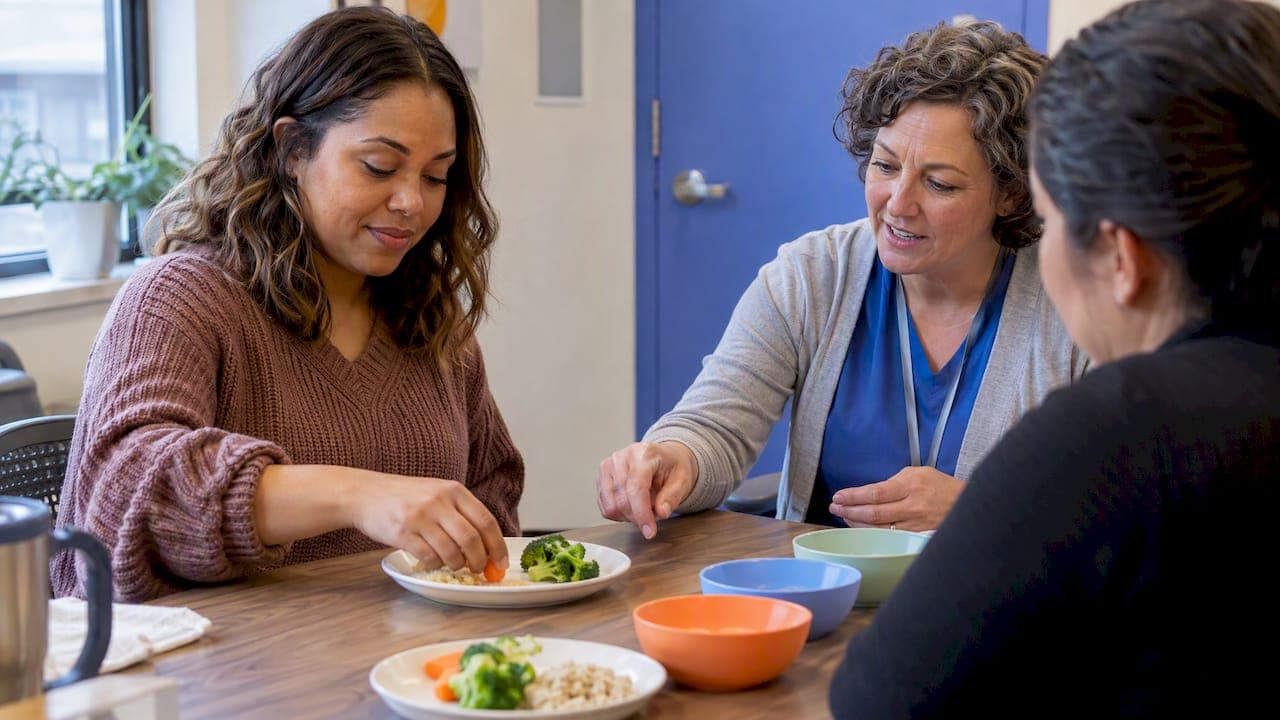
A parent feeding workshop is a guided class where you learn practical, evidence-based ways to handle mealtimes at home: setting routines, offering new foods, and keeping the table calm. It is a good fit if your child is a picky eater, you are starting solids, or you want coaching alongside other parents. It is not a substitute for an individual evaluation when your child shows signs of a true feeding disorder. This guide explains the difference, so you can pick the right next step with confidence.
TL;DR
- A parent feeding workshop teaches you routines, food exposure, and ways to reduce mealtime conflict, so you can support your child at home.
- Workshops suit picky eating, starting solids, and general mealtime stress. Individual feeding therapy suits children with significant symptoms such as poor growth, gagging, or very limited diets.
- Formats vary: some are online classes with a set tuition, others are local group sessions or one-on-one coaching.
- Thriving Joy offers Starting Solids 101, Picky Eating Workshops, Feeding Support Groups, and parent coaching in Pasco and Hillsborough Counties.
- If you are unsure, a short conversation with a feeding specialist can tell you whether a workshop is enough.
Table of Contents
- What a parent feeding workshop is
- What you typically learn
- Who a workshop helps most
- Workshop or feeding therapy? How to decide
- What therapy approaches workshops draw on
- Can a workshop help with breastfeeding, speech, or tube weaning?
- What to expect: formats and costs
- Our perspective
- Workshops and coaching at Thriving Joy
- Getting the most from a workshop
- Where to find clinicians who treat feeding disorders
- FAQ
- Sources
What a parent feeding workshop is
Most parents do not call it a workshop at first. They search because dinner has become a daily standoff, a baby is rejecting purees, or a toddler eats only five foods. A workshop gives you a structured place to learn what is typical, what is worth working on, and what you can try tonight.
The format is built around the parent, not the child. You are the person at the table every day, so the goal is to give you skills, language, and a plan. Children usually are not in the room. That is the main difference from feeding therapy, where a clinician works directly with your child.
Academic medical centers run these too. Stanford Medicine's child psychiatry division, for example, offers parent webinars and classes that teach evidence-based strategies for picky eating, including mealtime routines, food exposure, and reducing conflict. That mix is a good picture of what a solid workshop covers.

What you typically learn
Topics differ from one program to the next, but the strongest workshops return to the same few themes.
Mealtime routines
Children feel safer when meals follow a pattern. Workshops help you set predictable meal and snack times, decide where your child sits, and remove distractions. Stanford's parent class lists establishing a mealtime routine as a core skill.
Gentle, repeated exposure to new foods
Seeing, smelling, touching, and tasting a food on many occasions is how most children grow comfortable with it. You learn how to put a new food next to a safe food, how to serve small portions, and how to keep your tone neutral when it is refused.
Handling conflict at the table
Pleading, bribing, and bargaining often make a picky eater dig in harder. Workshops teach calm scripts and clear roles: you decide what and when food is offered, and your child decides how much to eat from it. Many parents tell us this shift alone lowers the stress in their home.
Knowing when to ask for more help
A good workshop also helps you recognize when picky eating may be something more. Stanford's webinar, for instance, covers when picky eating may warrant concern about ARFID, avoidant restrictive food intake disorder. Knowing the signs is as valuable as any mealtime trick.
Who a workshop helps most
Workshops work best when your child is growing well and the struggle is mostly about behavior, routine, or confidence. Common situations include:
- Starting solids. You want to know when to begin, which textures to offer, and how to handle gagging versus choking.
- Picky eating in toddlers and preschoolers. Your child accepts a short list of foods and refuses the rest.
- Mealtime battles. Meals last too long, end in tears, or rely on screens.
- Parents who want community. Hearing that other families face the same thing is a relief in itself.
- Parents preparing for the next step. A class can give you vocabulary before you meet a therapist.
Age matters when choosing. Some programs target older children. Stanford's Mealtime Made Easier is recommended for caregivers of children ages 5 to 18 with significant picky eating and/or ARFID. For babies and toddlers, look for a program built around early feeding, such as a starting solids class or a toddler-focused picky eating workshop.
Workshop or feeding therapy? How to decide
This is the question we hear most. The honest answer is that they do different jobs, and many families benefit from both.
| Parent feeding workshop | Individual feeding therapy | |
|---|---|---|
| Who attends | Parent or caregiver | Child with parent present |
| Focus | General strategies, routines, confidence | Your child's specific skills, sensory needs, and medical picture |
| Best for | Picky eating, starting solids, mealtime stress | Significant feeding difficulty, limited diet, tube dependence |
| Personalization | Shared with a group | Built around one child |
| Setting | Group class, online or in person | Office, home, daycare, or preschool |
Signs your child may need more than a workshop
Talk with your pediatrician and a feeding specialist if you notice any of the following:
- Poor weight gain or a drop in growth
- Frequent coughing, choking, or gagging at meals
- A very small list of accepted foods that keeps shrinking
- Strong distress, crying, or panic around food
- Needing a feeding tube or struggling to move off one
- A baby who tires quickly, leaks milk, or refuses bottle or breast
For children with significant symptoms, Maine Health Developmental Behavioral Pediatrics describes an ideal multidisciplinary approach that brings together medicine, nutrition, occupational therapy, and speech-language pathology. A workshop can support that team, but it should not replace it.
For a closer look at warning signs in infants, read our guide to your baby's feeding red flags. If symptoms have lasted more than a couple of weeks, our article on why parents need a team for pediatric feeding disorder explains what that team looks like.
What therapy approaches workshops draw on
Parent classes borrow from the same toolbox clinicians use. Professional guidance lists approaches such as sensory desensitization, progressive exposure, and cognitive behavioral therapy, with CBT generally reserved for children who are cognitively able to take part, typically around ages 8 to 10 and up.
In plain terms, that means a workshop can show you how to build comfort with a food step by step, from tolerating it on the table to touching, smelling, and eventually tasting it. It can also help you understand why a child who gags at a texture is not being stubborn. Their body is telling them something, and a calm, patient response is part of the solution.

Can a workshop help with breastfeeding, speech, or tube weaning?
A general parent workshop is usually not the right tool for these topics. Each one benefits from hands-on, individual attention.
- Breastfeeding. Latch, milk supply, and pain are specific to you and your baby. One-on-one lactation counseling, including prenatal education and postpartum support, fits better. Our lactation counseling is built for exactly that.
- Speech and feeding together. The muscles and coordination involved in speaking and eating overlap, so a child with a speech delay may also have feeding challenges. Our speech therapy team looks at both.
- Tube weaning. Moving from tube to oral eating needs a medical team and an individualized plan. A workshop can teach you the language and routines that support the process, but the plan itself should come from your child's clinicians and a feeding therapist.
Our approach is to look for root causes instead of quick fixes. Sometimes that starts with a workshop. Sometimes it starts with an evaluation.
What to expect: formats and costs
Workshops come in several shapes.
- Online series. Stanford's Mealtime Made Easier class runs on Zoom over several Thursdays and charged $175 per participant in 2026, with scholarships available. Check their page for the current schedule.
- Single-session classes. A one-time class on a topic such as starting solids is a lower commitment.
- Support groups. Ongoing groups let you trade ideas and hear how other families handle setbacks.
- One-on-one parent coaching. This is a private session focused on your family's routine, your questions, and your goals.
When comparing programs, ask these questions:
- Who leads it, and what is their training in pediatric feeding?
- What age range is it designed for?
- Is the content based on evidence, not just anecdotes?
- Will I leave with a written plan or specific steps?
- Is there a path to individual help if my child needs it?
- Are scholarships, insurance, or private-pay options available?
Our perspective
We started offering workshops because we kept meeting parents who had been told to wait it out. Many of them were exhausted, second-guessing every bite, and unsure whether their child's eating was typical.
We believe education is a form of care. When you understand why your child refuses a food, you stop reading it as a failure and start seeing it as information. That shift lowers stress for everyone at the table.
Our workshops sit alongside our individual services on purpose. Starting Solids 101 and our Picky Eating Workshops give you tools early. If your child needs more, you are already in a practice that offers feeding therapy, lactation counseling, and speech therapy, so there is no starting over with a new team.
We look for root causes, not quick fixes, and we bring both pediatric healthcare experience and the reality of raising children to every session. We also meet families where they are: in our office, at home, or at daycare or preschool, depending on the service.
Thriving Joy
Workshops and coaching at Thriving Joy
If you live in Pasco or Hillsborough County, we offer parent education built for real family routines: Starting Solids 101, Picky Eating Workshops, Talking Toddlers Workshops, Feeding Support Groups, and One-on-One Parent Coaching. You can see everything on our parent coaching and classes page. We accept private pay, major health insurance plans, and scholarships for therapy services, and you can ask our team how payment works for each class or coaching package.
If you would rather start with your child's own needs, our feeding therapy services in Lutz are a good place to begin.
Getting the most from a workshop
A class only helps if the ideas make it to your kitchen. These habits make a difference.
- Pick one change. Choose a single routine, such as sitting down together at set times, and practice it for two weeks before adding more.
- Write down what your child eats. A simple weekly list shows patterns you cannot see in the moment.
- Keep the tone neutral. Praise effort and curiosity, not bites eaten.
- Involve your child in food. Washing vegetables, stirring, and choosing a fruit at the store all count as exposure.
- Bring your partner or another caregiver. Consistency across adults matters, and everyone benefits from hearing the same plan.
- Follow up. If nothing improves after a few weeks of steady effort, ask for an evaluation. That is not a setback, only a next step.
For more on how coaching can support your family over time, see our overview of parent coaching services and our guide to pediatric feeding therapy.
Where to find clinicians who treat feeding disorders
If your child needs individual evaluation, look for a clinician who routinely treats pediatric feeding disorder, often a speech-language pathologist or occupational therapist working with a pediatrician and dietitian. Professional bodies such as the American Speech-Language-Hearing Association offer training that distinguishes pediatric feeding disorder from ARFID and stresses multidisciplinary collaboration, which tells you what good teamwork looks like. In our area, you can also contact us directly and we will help you work out the right starting point.
FAQ
Is a parent feeding workshop worth it for a picky eater?
For most picky eaters who are growing well, yes. Workshops teach routines, exposure, and calm responses that you can use right away. If your child's diet is very narrow, shrinking, or tied to gagging or distress, ask for an individual feeding evaluation as well.
Do children attend the workshop?
Usually not. Workshops are designed for parents and caregivers, so you can focus and ask questions openly. Your child's direct work happens in feeding therapy, where a clinician works with them in person.
How much does a parent feeding workshop cost?
It depends on the provider and format. Stanford's online Mealtime Made Easier class, for example, listed $175 per participant in 2026 with scholarships. Thriving Joy has no published prices for its classes, so contact our team for current details.
Can a workshop replace feeding therapy?
No. A workshop builds your skills and confidence, while therapy addresses your child's specific needs. Many families use a workshop first and move to therapy if concerns remain, or use both together.
When should I talk to a professional instead of waiting?
Call your pediatrician and a feeding specialist if your child is not gaining weight, coughs or chokes often at meals, has a shrinking list of foods, or becomes very distressed around eating. You do not need to wait for a class to start.
Sources
- Eating Concerns, Stanford Medicine Division of Child and Adolescent Psychiatry
- Feeding and Eating Issues in Autism Spectrum Disorders, Maine Health Developmental Behavioral Pediatrics
- Beyond the Label: Distinguishing PFD and ARFID, American Speech-Language-Hearing Association