

Occasional open-mouth breathing during a cold is completely normal for toddlers. But when your child breathes through their mouth every night, snores, or seems groggy and irritable during the day, that pattern points to something worth checking, whether it's chronic allergies, enlarged adenoids, or another blockage. Call your pediatrician and start tracking what you notice at night and during the day.
TL;DR:
- Most cases of mouth breathing in toddlers result from nasal blockages caused by allergies, enlarged adenoids, or structural issues, which can persist as habits.
- Home tests like the mirror fogging, lip-seal, and water hold can help parents assess whether nasal obstruction or habit causes mouth breathing.
- Mouth breathing at night may lead to poor sleep quality, facial development issues, and dental misalignments if left unaddressed over time.
- Pediatric diagnosis involves simple tests, with potential referrals for nasal endoscopy, sleep studies, or orthodontic evaluation if symptoms are severe.
- Early intervention with medical treatments, surgery, or therapy aimed at retraining tongue posture can prevent long-term facial and dental problems.
Table of Contents
- What Does Open Mouth Breathing Look Like in a Toddler?
- What Causes a Toddler to Breathe Through Their Mouth?
- Why Mouth Breathing Matters for Sleep and Development
- How Do Doctors Diagnose Mouth Breathing in Toddlers?
- What Treatments Actually Help, and What to Expect
- What Can Parents Try at Home While Waiting for an Appointment?
- When Should You Seek Urgent Care for Mouth Breathing?
- How Tongue Posture and Feeding Therapy Fit Into Recovery
- How Thriving Joy Supports Toddlers After a Mouth-Breathing Diagnosis
- Sources
What Does Open Mouth Breathing Look Like in a Toddler?
Some kids only breathe through their mouth when they're stuffed up from a cold. Others do it every single night, and that's the pattern that matters most.
During the day, watch for a mouth that hangs open at rest, frequent drooling past the age you'd expect it, chronically dry or cracked lips, and speech that sounds mushy or swallowing that seems effortful. At night, the signs often show up as snoring, noisy or labored breathing, restless tossing, or actual pauses and gasping sounds while your toddler sleeps.
You can run a few simple checks at home before your appointment:
- Mirror test: hold a small mirror under your child's nose while they sleep; heavy fogging on one side but not the other can suggest a blocked nostril.
- Lip-seal test: watch whether your toddler can comfortably rest with lips closed for a few minutes while distracted, or whether the mouth drifts open every time.
- Water test: ask your toddler to hold a small sip of water in their mouth for a minute or two; kids with significant nasal blockage often struggle to do this without swallowing early.
Jot down what nights this happens, how loud the snoring gets, and any pauses you notice. A short video clip on your phone is often more useful to your pediatrician than a verbal description.
What Causes a Toddler to Breathe Through Their Mouth?
Most cases trace back to something blocking or narrowing the nasal airway, though habit can keep the behavior going long after the original cause clears up.
The most common culprits include:
- Nasal congestion from colds or allergies. A cold resolves in a week or two, but chronic allergic rhinitis can keep nasal passages swollen for months, especially during high-pollen seasons.
- Enlarged adenoids and tonsils. These tissues naturally grow fastest between ages two and six, and oversized adenoids and tonsils are among the most frequently cited causes of mouth breathing in preschoolers.
- Structural issues. A deviated septum or nasal polyps can physically narrow the airway, though these are less common at toddler age than adenoid or tonsil enlargement.
- Tongue posture and low orofacial tone. Some toddlers rest their tongue on the floor of the mouth instead of up against the palate, which makes nasal breathing feel less automatic even without an obvious blockage.
Here's the part parents often miss: once a toddler learns to breathe through the mouth during a stretch of congestion, the habit can outlast the congestion itself. The nose clears up, but the open-mouth posture sticks around because it became the default.
Why Mouth Breathing Matters for Sleep and Development
Breathing through the mouth changes more than comfort. It can quietly reshape how your toddler sleeps, behaves, and grows.
Kids who breathe through their mouth at night often get lower-quality sleep, even without full-blown sleep apnea, and that shows up the next day as irritability, trouble focusing, or unusual daytime sleepiness. A concise review of dentofacial development links persistent, uncorrected mouth breathing to a narrower palate, malocclusion, and a higher risk of open bite, changes tied to how the face and jaw grow when the tongue isn't resting where it should.
The encouraging part is timing. These dental and facial changes develop over months and years, not overnight, and early screening during the toddler and preschool years, before major growth spurts, gives dentists, orthodontists, and pediatricians a real window to intervene before the pattern becomes structural. Diagnostic tests for mouth breathing vary and there's no single strict criterion clinicians use, which is exactly why your own observations at home carry real weight in an evaluation.
None of this means one snory night spells trouble. It means a nightly pattern deserves a look sooner rather than later.
How Do Doctors Diagnose Mouth Breathing in Toddlers?
A pediatric visit for suspected mouth breathing usually starts simple. Your doctor will likely repeat the lip-seal, mirror, and water tests themselves, along with a basic exam of the nose, mouth, and throat.

If something looks off, or your child's symptoms are significant, expect a referral to an ENT (ear, nose, and throat specialist), who may use nasal endoscopy to get a direct look at the adenoids and nasal passages. A sleep study becomes the next step when snoring comes with pauses, gasping, or clear daytime functional problems like extreme fatigue or behavior changes. An orthodontic referral may follow if dental or jaw changes are already visible.
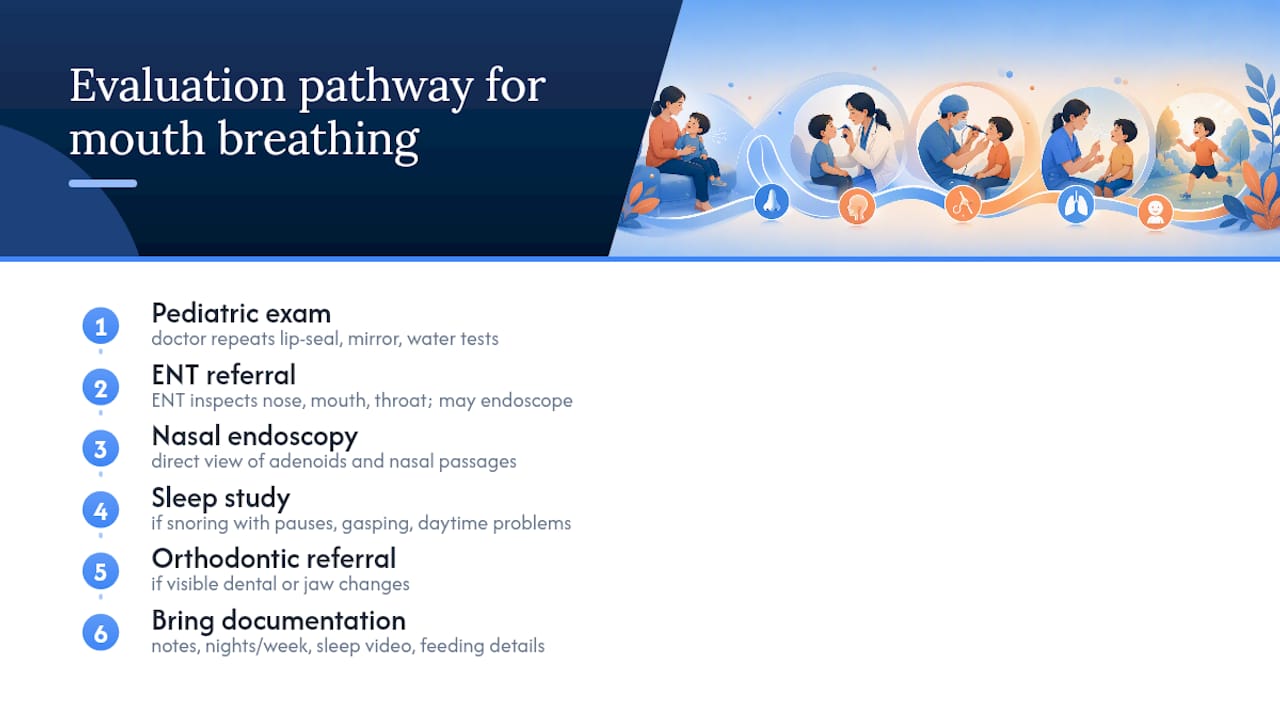
Bring what you've gathered: notes on how many nights a week this happens, any video of your child sleeping, and details on feeding difficulties if you've noticed them. That documentation often shortens the path to an answer.
What Treatments Actually Help, and What to Expect
Treatment follows the cause, and most families start with the least invasive option first.
- Medical management. Saline rinses, intranasal steroid sprays, and antihistamines address allergy-driven or congestion-driven cases, along with antibiotics if a sinus infection is involved.
- Surgical options. Adenoidectomy and tonsillectomy are common when enlarged tissue is the clear cause, with recovery typically running one to two weeks. Septoplasty or turbinate reduction addresses structural blockages, though these are rarer in toddlers.
- Supportive therapy. Myofunctional or oromyofunctional therapy retrains tongue posture and oral muscle patterns, often alongside orthodontic follow-up and feeding or speech therapy.
A coordinated plan across pediatrician, ENT, dental, and therapy providers tends to produce the best outcomes when both structural and functional pieces are in play, which is common. Clearing the airway and retraining the habit often go hand in hand.
What Can Parents Try at Home While Waiting for an Appointment?
You don't have to sit on your hands while you wait for an evaluation. A few safe steps can ease symptoms in the meantime:
- Use a saline nasal spray or rinse formulated for young children to loosen congestion.
- Reduce bedroom allergens by washing bedding weekly in hot water and keeping pets out of the sleep space.
- Run a cool-mist humidifier overnight to keep nasal passages from drying out.
- Keep your toddler well hydrated, which thins mucus and eases nasal breathing.
- Stick to a consistent sleep schedule, and ask your pediatrician about positional adjustments if reflux or congestion worsens lying flat.
Pro Tip: Skip anything marketed as a "mouth tape" or DIY jaw device for toddlers. Clinical guidance is clear that closure devices should only be used once a doctor has confirmed the nasal airway is actually clear; taping a mouth shut over a blocked nose doesn't fix the blockage; it just removes the backup airway your child needs.
When Should You Seek Urgent Care for Mouth Breathing?
Most cases aren't emergencies, but a few signs need same-day attention. Call your pediatrician right away, or seek emergency care, if you see choking or gasping during sleep, actual pauses in breathing, bluish coloring around the lips, severe labored breathing, or an inability to feed or wake normally. Bring any video you've captured; it helps the care team assess severity fast.
How Tongue Posture and Feeding Therapy Fit Into Recovery
Once a pediatrician or ENT clears the airway, whether through allergy treatment, adenoid surgery, or another path, the mouth-breathing habit doesn't always disappear on its own. Tongue posture matters here: a tongue that rests against the palate supports normal breathing and dental arch development, while one that rests low on the floor of the mouth tends to keep the mouth open by default, even after the original blockage is gone.
This is where feeding and speech therapy earns its place, not as a replacement for medical care, but as the rehabilitation step after it. At Thriving Joy, we see this gap often: parents whose child had adenoids removed or allergies treated, yet the open-mouth habit lingered because no one retrained the muscle pattern underneath it. Therapy works best in coordination with your child's medical team, picking up exactly where the airway treatment leaves off.
— Jamie
How Thriving Joy Supports Toddlers After a Mouth-Breathing Diagnosis
Once your pediatrician or ENT has ruled out or treated the medical cause, Thriving Joy is where the habit itself gets addressed, not through guesswork, but through hands-on therapy that retrains tongue posture, oral muscle tone, and feeding patterns your toddler may have built up over months of mouth breathing.

Our team offers feeding therapy for kids whose eating or swallowing has been affected, plus speech therapy for toddlers that includes orofacial assessment when tongue posture is part of the picture. If your child has also shown feeding changes alongside the mouth breathing, our guide on feeding red flags can help you sort out what's worth mentioning at intake. For families in the Tampa area also managing dental prevention alongside airway care, this pediatric oral hygiene guide is a useful companion resource.
Come to your first session with your pediatrician's or ENT's notes, plus anything you've already tracked at home. If you're ready to build a plan around your child's specific needs, schedule a feeding therapy consultation with our team.
This article is general information, not a substitute for advice from a qualified doctor. Consult a qualified healthcare professional about your own circumstances before acting on anything here.
Sources
- Mouth Breathing in Kids: When to Worry and What You Can Do | Connecticut Children's
- The impact of mouth breathing on dentofacial development: A concise review - PMC
- Mouth Breathing: Symptoms, Complications & Treatment | Cleveland Clinic