

Nipple confusion is rarely the right diagnosis. Most babies who struggle to switch between breast and bottle are showing a flow preference, not confusion, and the fix starts with timing and technique. Hold off on routine bottles until breastfeeding feels steady, use paced bottle-feeding with a slow-flow nipple whenever supplements are needed, and call a lactation professional if latch trouble, pain, or weight gain concerns last more than a few days.
TL;DR:
- Most feeding difficulties attributed to nipple confusion are actually flow preferences, which can often be corrected through pacing, timing, and technique adjustments.
- Introducing routine bottles or pacifiers before three to four weeks can increase flow preference issues, but delaying or using paced bottle methods may prevent this.
- Signs indicating a need for professional help include poor weight gain, fewer than six wet diapers a day after five days, persistent nipple pain, or oral issues like tongue-tie.
- Reversing flow preference involves offering the breast first, increasing skin-to-skin contact, and gradually replacing bottles with breastfeeding or supplemental nursing; patience is essential.
- Evidence shows that bottle use might signal existing feeding problems rather than cause them, making early intervention with proper technique more effective than avoidance.
Table of Contents
- Is Nipple Confusion Real, or Is It Flow Preference?
- Signs Your Newborn Is Struggling With the Switch
- How to Prevent Flow Preference Before It Starts
- Reversing a Bottle Preference Without Losing Your Supply
- When to Call In Professional Help
- How Thriving Joy Approaches Feeding and Lactation Support
- What Actually Matters Here (and What Doesn't)
- Sources
- FAQ
Is Nipple Confusion Real, or Is It Flow Preference?
Sucking at the breast and sucking from a bottle are two different jobs for a baby's mouth. At the breast, your baby has to work to trigger let-down, coordinate a deep latch, and manage a variable flow that often starts slow and speeds up. A bottle, by contrast, can deliver milk fast and steady with far less effort. Given a choice between the two, some babies start holding out for the easier option. That's a preference for flow and effort, not a mix-up about which nipple is which.
This distinction matters because it changes what you do next. A 2015 review in the Journal of Perinatology looked at the evidence behind "nipple confusion" and found the overall support thin. The review did find emerging evidence linking bottle use to feeding difficulties, but almost nothing tying pacifiers to the same problem. The researchers also flagged something worth sitting with: bottle use might be a marker of other underlying feeding issues rather than the direct cause of them.
Here's why the terminology shift matters in practice:
- "Confusion" suggests a wiring problem you can't fix, which can leave parents feeling stuck.
- "Flow preference" points to something adjustable: pace, nipple type, and timing.
- Clinical guidance from Cleveland Clinic frames it the same way, recommending paced feeding and delaying bottles when possible rather than treating it as a lost cause.
Signs Your Newborn Is Struggling With the Switch
Some fussiness at the breast is normal newborn behavior. But a cluster of specific signs, especially together, means it's worth adjusting your approach now.
Watch for these patterns:
- Arching, crying, or pulling off the breast repeatedly during feeds
- Very short nursing sessions followed by falling asleep quickly
- A strong preference for the bottle even when offered the breast first
- Choking, gulping, or coughing at the breast, which can signal an overwhelming let-down rather than true flow rejection
- Clamping down or shallow latching that leaves nipples sore
Some of this overlaps with completely normal newborn behavior. Cluster feeding in the evenings, drowsy nursing in the first couple of weeks, and short naps at the breast during a growth spurt can look alarming but resolve on their own within days.
Pro Tip: Keep a simple feeding log for 48 hours, noting which side or method your baby fed from, how long, and how they reacted. Patterns are much easier to spot on paper than from memory at 3 a.m.
Certain signs shouldn't wait for a pattern to emerge. Contact your pediatric provider promptly if you notice poor weight gain, fewer than six wet diapers a day after day five, severe or worsening nipple pain, or signs suggestive of tongue-tie, such as clicking sounds or a shallow latch that won't deepen no matter how you reposition your baby.
How to Prevent Flow Preference Before It Starts
Prevention is far easier than reversal, and most of it comes down to sequencing.
- Wait before introducing routine bottles or pacifiers. Many clinicians suggest holding off for three to four weeks while breastfeeding gets established, a timeline echoed by La Leche League's guidance on early feeding. Medical exceptions exist, including significant weight loss, jaundice requiring supplementation, or a baby unable to transfer milk effectively, so a lactation consultant or pediatrician should guide any earlier introduction.
- Use paced bottle-feeding from the first bottle onward. Hold the bottle horizontally rather than tipped up, choose the slowest flow nipple your baby tolerates, and pause every 20 to 30 seconds to let your baby catch up and decide whether they're still hungry.
- Choose non-bottle supplementation when possible in the earliest days. Cup feeding, syringe feeding, or a supplemental nursing system at the breast can meet nutritional needs without introducing a faster, easier flow. Hospitals frequently reach for these tools in the first days when supplementation can't wait.
- Sort out pacifier guidance separately from bottle guidance. Pacifiers carry a documented role in reducing SIDS risk, and the 2015 review found little evidence they cause feeding problems on their own. Most guidance suggests introducing one once breastfeeding is going well, balancing that safety benefit against early breastfeeding establishment.
A paced bottle-feeding planner can help you keep the technique consistent, especially if a partner, grandparent, or babysitter is handling feeds too.
Reversing a Bottle Preference Without Losing Your Supply
If flow preference has already set in, you can turn it around with a deliberate, gradual plan. Rushing it usually backfires.
- Lead every feed with the breast when you can. Offer the breast first while your baby is calm and a little hungry, not frantic. Hand-expressing a little milk before latching gets let-down started so your baby doesn't have to work as hard for that first flow.
- Increase skin-to-skin time and feeding frequency. More frequent, low-pressure contact at the breast builds both comfort and supply.
- Swap one bottle-feed at a time. Replace a single bottle session with breastfeeding or an SNS, and give it three to five days before changing another. Both your supply and your baby's expectations need that time to reset.
- Have someone else give any remaining bottles. When a partner or another caregiver handles supplemental bottles, your baby has less opportunity to associate you specifically with the easier option.
- Keep supplements paced and slow-flow throughout. If your baby still needs supplementation during this transition, a trial with a nipple shield can sometimes bridge the gap, though it should come with a pumping plan to protect supply and a plan to wean off the shield once latch improves.
Pro Tip: If you're not seeing any improvement after one to two weeks of consistent effort, that's not a sign you're doing it wrong. It's a sign it's time for hands-on support.
When to Call In Professional Help
Some situations call for an evaluation rather than more time and patience at home. Reach out to your pediatrician or a certified lactation consultant if you notice any of the following:
- Weight loss beyond the expected newborn dip, or slow regain past two weeks
- Fewer wet or dirty diapers than expected for your baby's age
- Nipple pain that doesn't ease once latch is adjusted
- No improvement in breast acceptance after a week of consistent paced feeding and breast-first attempts
A thorough evaluation usually includes a hands-on latch assessment, a look at oral anatomy for tongue-tie or lip-tie, direct observation of a feed to check actual milk transfer, and a review of your supply. From there, a lactation consultant might suggest positioning changes, a temporary SNS, a targeted pumping schedule, or a referral for feeding therapy if oral-motor issues are part of the picture.
Bring what you've tracked. A record of daily weight if you have one, a log of feeds and diaper counts, and a list of what you've already tried will save time and help the consultant zero in on what's actually happening.
How Thriving Joy Approaches Feeding and Lactation Support
Thriving Joy Pediatric Therapy offers lactation counseling alongside feeding therapy and speech therapy, built around finding the root cause of a feeding struggle rather than a one-size-fits-all fix. A first visit typically involves watching a full feed, checking oral anatomy and latch mechanics, and reviewing your baby's weight and feeding history to build a plan specific to your situation.
Families often reach out when home strategies have stalled: a baby who still refuses the breast after weeks of effort, a suspected tongue-tie that needs a closer look, or a tube-weaning process that needs structured support. Because sessions can happen in various locations, the plan can adapt to wherever feeding actually happens, which matters more than it sounds when you're troubleshooting real-life feeds instead of a clinic-only snapshot.
What Actually Matters Here (and What Doesn't)
The evidence on nipple confusion is thinner than most parenting advice suggests, and that's worth taking some comfort in. The 2015 Journal of Perinatology review didn't find strong proof that a bottle permanently rewires how a baby feeds. It found a correlation worth watching, not a verdict worth panicking over.
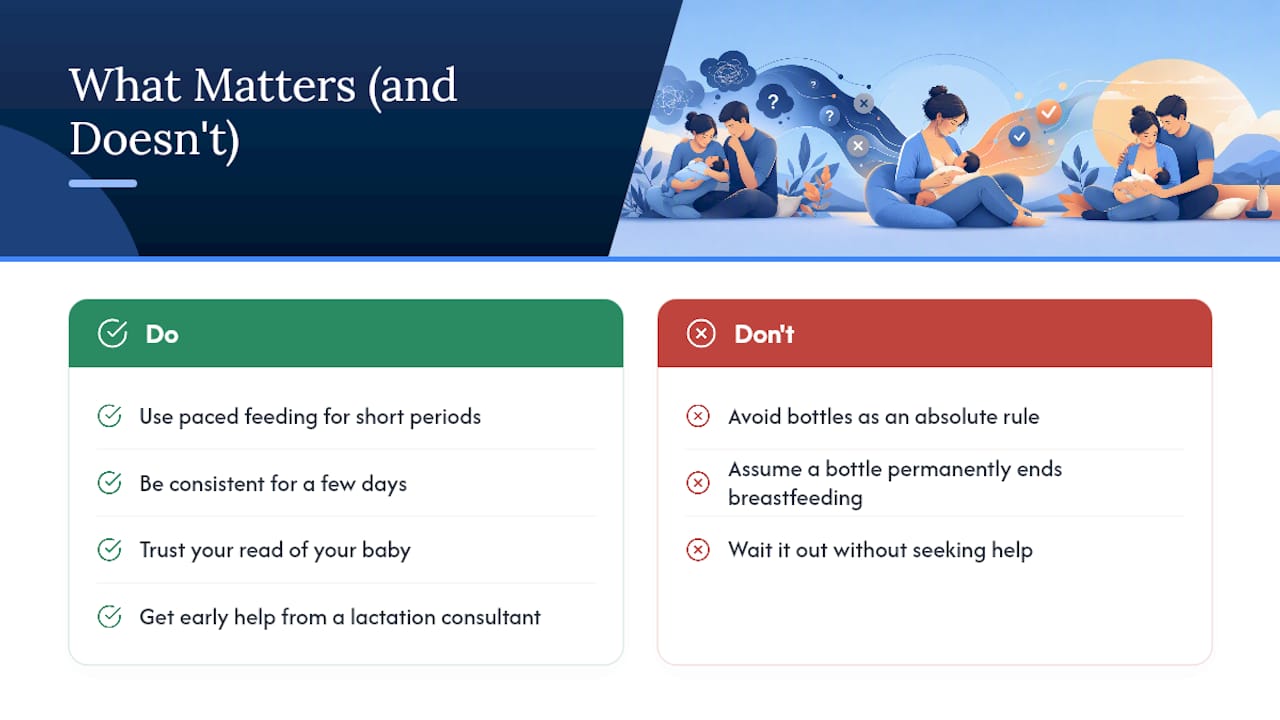
Where conventional advice falls short is in its all-or-nothing framing: avoid bottles entirely, or accept that breastfeeding is over. Neither extreme reflects how most families actually solve this. The real lever is technique and timing, done consistently, for a few days at a time, before you swap something else.
Trust your read of your own baby over any timeline that says confusion should resolve by a certain week. Some babies settle back into breastfeeding in days once paced feeding starts. Others need a lactation consultant to catch a tongue-tie or a shallow latch that home efforts can't fix alone. Getting help early costs you far less time and stress than waiting it out on your own would.
— Thriving Joy
This article is general information, not a substitute for advice from a qualified doctor. Consult a qualified healthcare professional about your own circumstances before acting on anything here.
Sources
- Clarifying nipple confusion
- What Is Nipple Confusion? Myths and Help
- “Nipple Confusion”: why does my baby seem to prefer a bottle or dummy?
FAQ
How Do You Fix Nipple Confusion in a Newborn?
Start by offering the breast first at every feed, increase skin-to-skin contact, and switch any needed supplements to paced bottle feeding with a slow-flow nipple. Replace one bottle-feed at a time and give it several days before changing another, and reach out to a lactation consultant if there's no improvement within one to two weeks.
What Is the Three-Month Breastfeeding Crisis?
Many parents notice a dip around the three-month mark where a baby seems fussier at the breast, feeds more often, or briefly seems to prefer a bottle. It usually reflects a growth spurt and a developing distractibility rather than true flow preference, and it typically resolves within a week or two of consistent nursing.
When Do Babies Stop Having Nipple Confusion?
Most flow preference issues improve within one to three weeks of consistent paced bottle feeding and breast-first attempts, since young infants adapt quickly to feeding patterns. If a baby is still struggling well past that window, it's a sign to get a hands-on evaluation rather than wait it out.
Can You Overfeed a Breastfed Baby?
Overfeeding is uncommon at the breast because your baby controls the pace and stops when full, but it's more possible with a fast-flow bottle nipple that delivers milk faster than a baby can signal fullness. Paced bottle feeding helps prevent this by letting your baby set the pace even during supplemental feeds.