
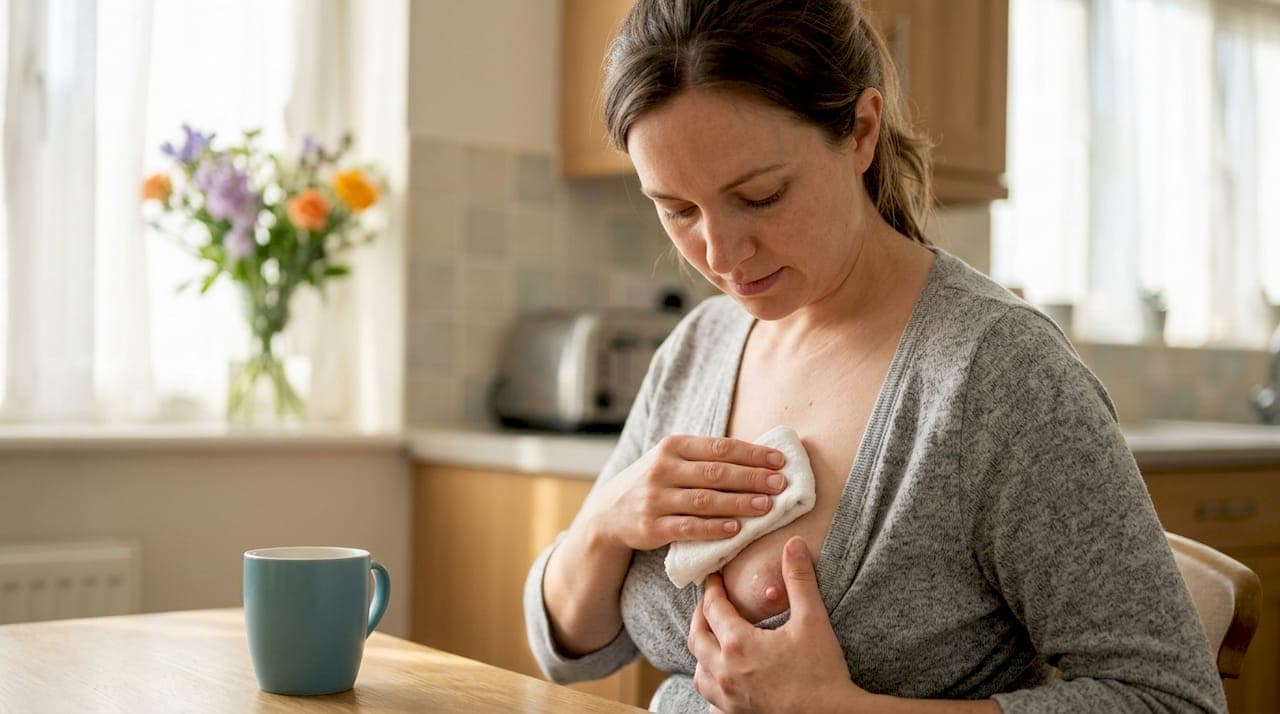
A nipple bleb, also called a milk bleb or milk blister, is a small white, yellow, or clear spot on the nipple caused by ductal inflammation and skin growing over a milk duct opening. You can almost always keep breastfeeding through it. The one thing not to do is poke, pick, or unroof it yourself.
Right now, focus on three things:
- Apply a warm, moist compress to the nipple for a few minutes before feeding.
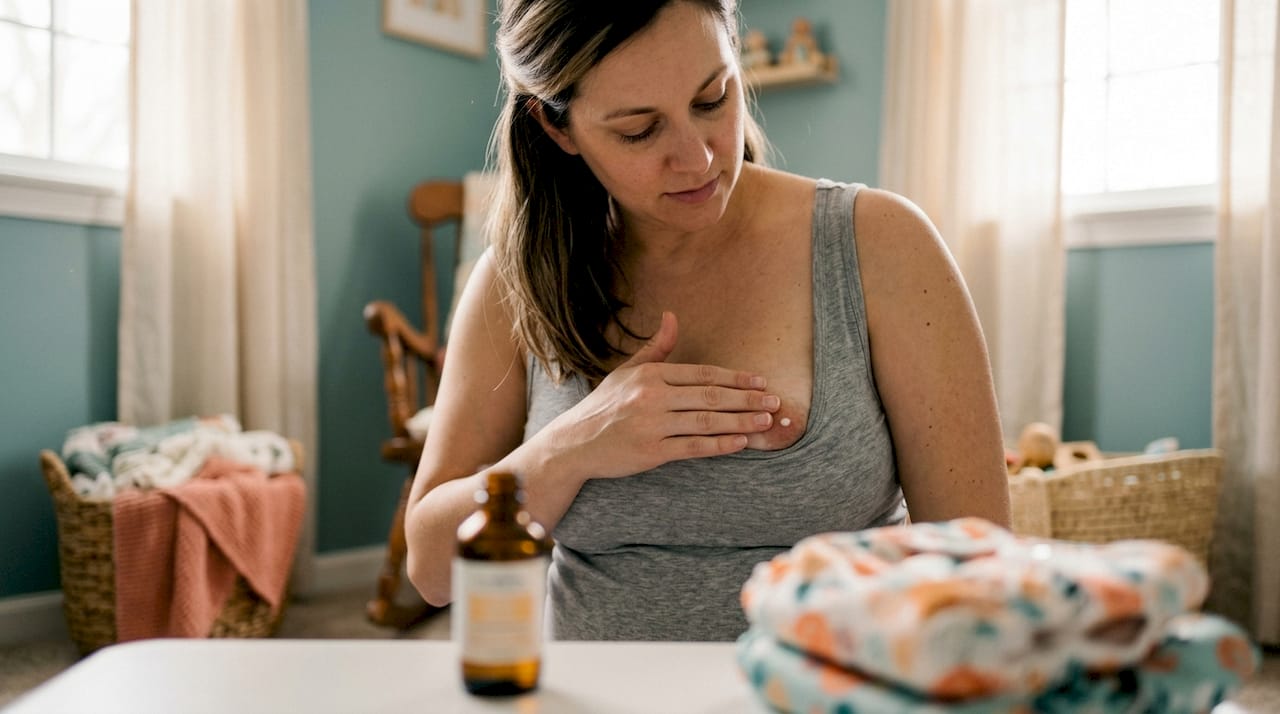
- Soften the spot with a dab of food-safe oil, like olive or coconut oil.
- Nurse or hand express to encourage the duct to drain naturally.
A Cleveland Clinic overview of milk blebs notes these spots can cause sharp, shooting pain during or after a feed, and clinicians consistently warn against unroofing them at home. If pain is severe or the spot lingers beyond several days, loop in a lactation consultant.
Key Takeaways
A nipple bleb usually heals with warm compresses, food-safe oil, and continued breastfeeding, and it almost never requires puncturing or unroofing.
| Point | Details |
|---|---|
| Never unroof a bleb | Popping or picking at the spot raises infection risk and often delays healing. |
| Soften before feeding | Warm compresses plus olive or coconut oil help the duct drain during normal nursing. |
| Rule out thrush first | Nipple thrush is uncommon; most pain traces back to latch mechanics or ductal inflammation. |
| Know your red flags | Fever, spreading redness, or a spot lasting past seven to ten days needs clinical review. |
| Get a latch check for recurrence | Thriving Joy's lactation counseling addresses the mechanical root cause behind repeat blebs. |
Table of Contents
- What Causes a Nipple Bleb During Breastfeeding?
- How Do You Tell a Bleb Apart From Thrush or a Plugged Duct?
- What Home Care Actually Helps a Milk Blister Heal?
- When Should You See a Lactation Consultant or Doctor?
- How Do You Prevent Nipple Blebs From Coming Back?
- How Thriving Joy Supports Mothers Through Recurring Blebs
- Why the "Just Pop It" Advice Needs to Die
- Get Hands-On Help for Nipple Pain That Won't Quit
- Frequently Asked Questions
- Sources
What Causes a Nipple Bleb During Breastfeeding?
Your nipple has multiple tiny pores, each connected to a milk duct. When skin cells grow over one of those pore openings, milk backs up behind it and the duct becomes inflamed. That trapped pressure is what you feel as a burning or stinging sensation right at the surface, and it's the reason the spot looks shiny or slightly raised.
Not every white spot is the same thing, though, and knowing the difference matters for how you treat it.
- Milk blister (true bleb): small, well-defined, often clear or pale yellow, tends to sit right over a single duct opening.
- Hyperkeratosis: larger, callous-like patch with a diffuse, less distinct border, more sensitive to scraping or abrasive treatment.
- Epidermal inclusion cyst (milium): a small, firm bump under the skin rather than a surface spot, usually less painful during feeds.
Mechanical trauma from a shallow latch, repetitive friction, or a pump flange that's too tight is a common trigger. So is oversupply or hyperlactation, since faster milk flow can put extra pressure on a duct that's already narrowed by inflammation, according to Medical News Today's breakdown of nipple white spots.
How Do You Tell a Bleb Apart From Thrush or a Plugged Duct?
The pain pattern is your best clue. A bleb typically causes a sharp, localized, shooting pain right as your baby latches, sometimes with a deeper ache that radiates back into the breast between feeds. That's different from the diffuse, burning nipple pain some mothers report with thrush, or the firm, tender lump further back in the breast tissue that signals a plugged duct.
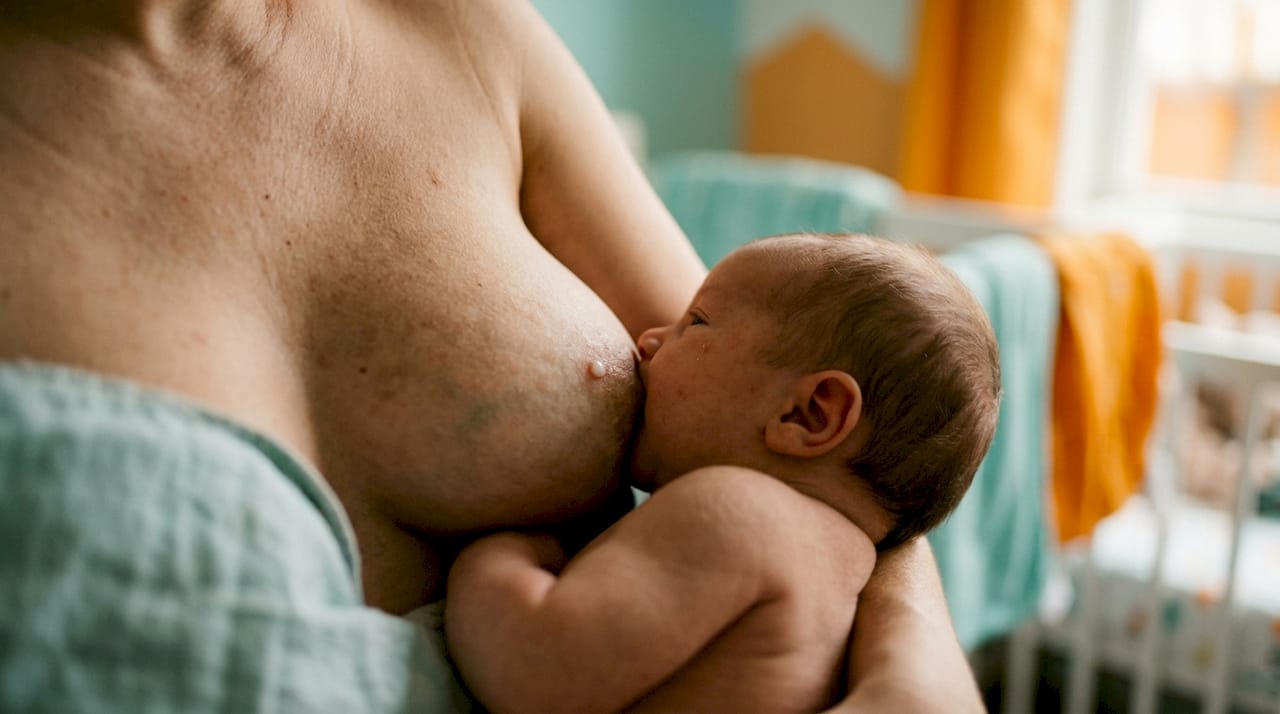
Appearance helps too. A true bleb stays small and doesn't spread, and it often changes shape slightly after a feed as milk moves behind it. Hyperkeratosis, by contrast, looks more like a thickened patch that doesn't shrink or shift.
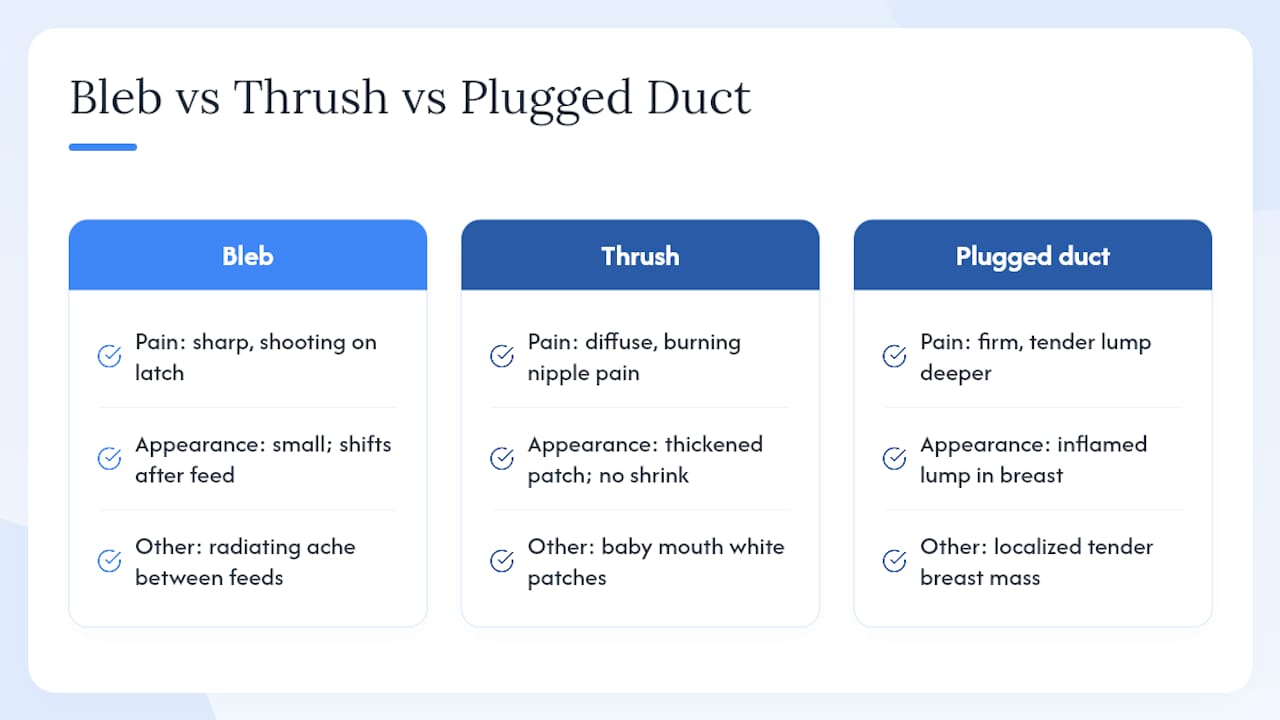
Here's where a lot of unnecessary treatment happens: thrush on the nipple is actually uncommon, and it shouldn't be assumed just because nipples hurt. The Physician Guide to Breastfeeding points out that most persistent nipple pain traces back to mechanical or inflammatory causes, not fungal infection. Real thrush usually comes with additional signs, like white patches in your baby's mouth or a burning pain that persists even when your baby isn't latched.
Pro Tip: If you've been treating "thrush" for more than a week with no improvement, it's worth asking whether the actual issue is a latch problem or a bleb rather than a fungal infection.
What Home Care Actually Helps a Milk Blister Heal?
Gentle, consistent care resolves most blebs without any clinical treatment at all. Here's a sequence that works with your body instead of against it.
- Wash your hands before touching the area, and keep a clean towel nearby.
- Apply warm, moist heat for three to five minutes before feeding. A warm washcloth or a few minutes in a warm shower both work.
- Soften the spot with a small amount of food-safe oil, like olive or coconut oil, massaged gently over the bleb.
- Encourage a deep latch so your baby's suckling helps move milk past the blocked opening naturally. If a direct feed is too painful, hand express or pump first to relieve pressure.
- Express gently after feeding if the spot still feels full, to support ongoing drainage.
- Manage pain with acetaminophen or ibuprofen per the label, and use a cool pack between feeds if the area is swollen.
The Australian Breastfeeding Association's guidance on white spots backs this exact approach: soften with heat and oil, then let feeding or expression do the work of clearing the duct.
Pro Tip: Think of the bleb like a tiny sealed doorway. Your job isn't to force it open. It's to soften the door so your baby's normal suckling can push it open from the inside.
What you should never do: puncture, unroof, pick at, or use a needle on the bleb. Avoid gentian violet or other harsh antiseptics without clinical guidance. Self-unroofing tends to worsen inflammation, invite infection, and often makes healing take longer, not shorter, based on the clinical observations in the Cleveland Clinic's milk bleb resource.
When Should You See a Lactation Consultant or Doctor?
Most blebs clear up within a few days of consistent home care. Call a provider if you notice any of these:
- Fever or flu-like symptoms
- Spreading redness or a warm, tender area on the breast
- Pain that keeps increasing instead of easing
- A spot that persists beyond seven to ten days despite home treatment
- Signs of oral thrush in your baby, like white patches inside the cheeks
- You can't feed or express at all because of the pain
If a bleb won't resolve, clinicians have a few evidence-based options. Case reports describe using a mid-potency topical steroid, such as triamcinolone, applied under occlusion for persistent spots, always under supervision rather than as a first try at home, per a case report published in JOGNN. Oral sunflower lecithin is sometimes recommended for recurring ductal issues, a measure referenced in the Academy of Breastfeeding Medicine's adjunct protocol. If mastitis has developed alongside the bleb, antibiotics may be necessary.
A lactation consultant will typically watch a full feed, assess your baby's latch and positioning, check for signs of oversupply, and build a short follow-up plan so you know what improvement should look like within a few days.
How Do You Prevent Nipple Blebs From Coming Back?
Recurrence usually points back to something mechanical, which is good news because mechanical problems are fixable. Start with the latch itself. A shallow or asymmetric latch puts repeated pressure on the same spot on your nipple, and that friction is a major driver of blebs, as Medical News Today notes. If pain keeps returning, get a latch check rather than repeating the same painful pattern feed after feed.
A few other habits go a long way:
- Swap tight bras or straps for looser options that don't press on any one part of the breast.
- Change up your sleep position if you tend to lie on the same side night after night.
- Feed on cue and aim for complete drainage at each session rather than cutting feeds short.
- If oversupply is a factor, ask about block feeding, but only under a clinician's guidance since done wrong it can affect supply.
- Skip harsh soaps on the nipple area, and use a food-safe oil if the skin feels dry or irritated.
Choosing nipple-safe skin products matters here too. Nursing-safe skincare picks that avoid harsh actives can prevent the kind of skin irritation that sets the stage for a bleb in the first place.
How Thriving Joy Supports Mothers Through Recurring Blebs
When a bleb keeps coming back, that's usually a sign the root cause hasn't been addressed yet, not that something is wrong with you. A lactation counseling session typically starts with a focused history, direct observation of a feed, and hands-on coaching to correct the latch or positioning issue driving the pressure.
From there, care usually includes:
- A guided expression session to relieve pressure safely
- A written feeding plan tailored to your specific latch and supply pattern
- A follow-up check to confirm the spot is healing and pain is easing
Mothers typically leave a session with a clear next step instead of guesswork, and a plan they can actually follow at home.
Why the "Just Pop It" Advice Needs to Die
The instinct to grab a sterile needle and pop a bleb makes sense on the surface. It's fast, it feels proactive, and plenty of well-meaning forums still recommend it. But that instinct fights against how these spots actually heal. The clinical consensus, backed by case-report evidence on how unroofing tends to worsen inflammation, points the other direction entirely: soften the skin, support drainage through normal feeding, and let the duct clear itself.
The bigger blind spot, though, is how often thrush gets blamed for pain that's really mechanical. Mothers spend days on antifungal creams for a latch problem that a five-minute positioning adjustment would have solved. If your nipple pain isn't responding to antifungal treatment, that's not a sign to try a stronger one. It's a sign the diagnosis was wrong from the start.
What actually moves the needle is unglamorous: heat, oil, patience, and a real look at how your baby latches. Fix the mechanics, and most blebs stop coming back.
Get Hands-On Help for Nipple Pain That Won't Quit
If home care isn't resolving your bleb, or the same painful spot keeps returning feed after feed, you're likely dealing with a latch or supply issue that oils and warm compresses alone can't fix. Thriving Joy's lactation counseling gives you a real-time latch assessment and a written feeding plan built around your baby's specific mouth and your milk supply, instead of another round of generic troubleshooting.

Sessions are available through private pay, most major insurance plans, or scholarship support, so cost doesn't have to be the reason you push through pain longer than necessary. If you're in the Tampa area and dealing with recurring blebs, cracked nipples, or feeding pain that hasn't improved after a week of home care, book a lactation consultation and get a plan specific to your latch, not a general checklist.
Frequently Asked Questions
Can you keep breastfeeding with a nipple bleb? Yes, in almost every case. Continued nursing with a good latch actually helps clear the duct rather than making things worse.
How long does a milk bleb usually take to heal? Most resolve within a few days to about a week with consistent warm compresses, oil softening, and continued feeding. If it lingers past ten days, see a lactation consultant.
Is a white spot on the nipple always a milk bleb? No. It could be hyperkeratosis, a small cyst, or occasionally another skin issue. The size, border, and pain pattern help tell them apart.
Should I pop a milk blister myself? No. Puncturing or unroofing it yourself raises infection risk and can prolong healing instead of speeding it up.
Can a nipple bleb turn into mastitis if left untreated? It can contribute to slowed milk flow and inflammation that, in some cases, progresses toward mastitis or, rarely, an abscess, which is why persistent spots need clinical follow-up.
This article is general information, not a substitute for advice from a qualified doctor. Consult a qualified healthcare professional about your own circumstances before acting on anything here.
Sources
- Milk Bleb: Blister, Causes, Symptoms & Treatment
- Physician Guide to Breastfeeding — Nipples
- Case Report of the Management of Milk Blebs