
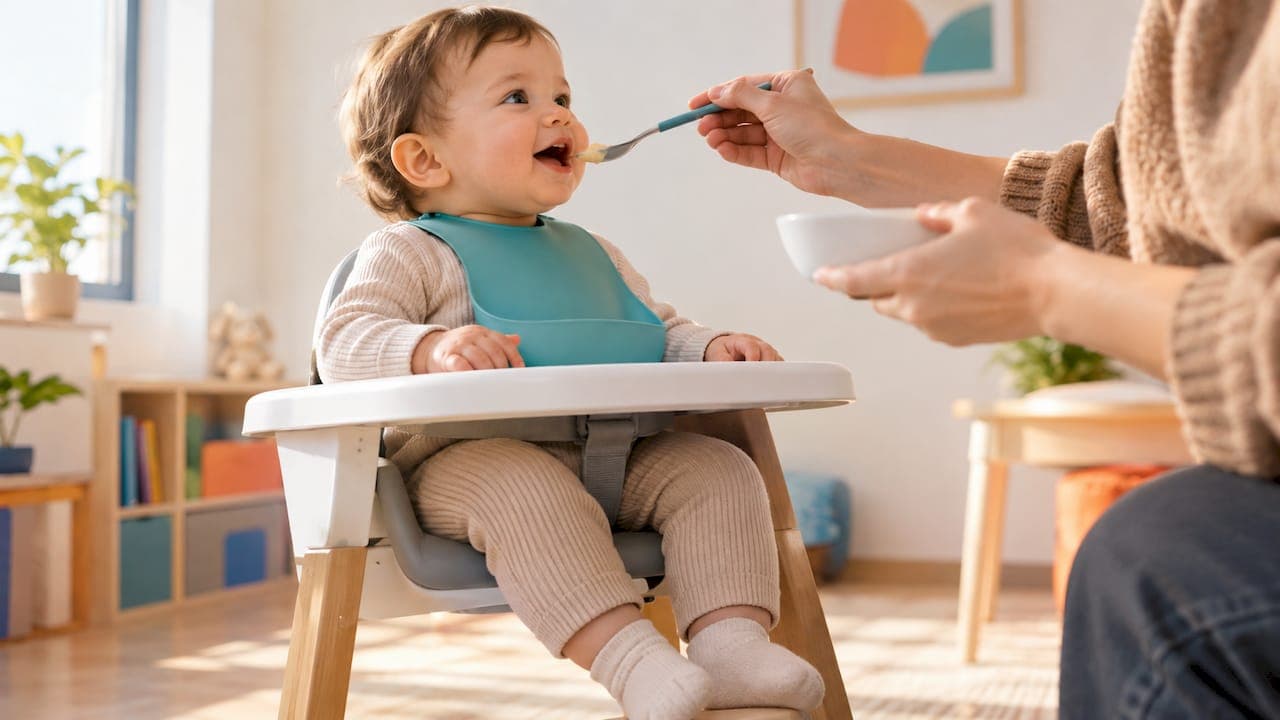
The posture target that matters most is 90-90-90: hips, knees, and ankles bent to roughly 90 degrees, with feet resting on a solid surface. Pair that with two non-negotiable safety habits, buckling the harness every time and never using the tray as a restraint, and you have a setup that keeps your baby stable, comfortable, and better able to focus on eating rather than fighting gravity.
TL;DR:
- Proper high chair setup emphasizes adjusting the seat and footrest to ensure hips, knees, and ankles are roughly at 90 degrees, with feet supported on a firm surface.
- A baby should show steady head control, minimal slumping, and the ability to sit with support before transitioning into a high chair, typically around 6 months.
- Always buckle the harness correctly, keep the tray at elbow height, and regularly reassess posture during the first few bites to avoid slumping or head bobbing.
- Falls from high chairs are common, so it is essential to follow safety standards, use harnesses every time, and keep the chair away from pushing surfaces or walls.
- Persistent posture or feeding issues may require professional support from feeding therapists or pediatricians, especially if safety measures are already in place.
Table of Contents
- What good high chair posture looks like
- When is a baby ready for a high chair?
- Step-by-step: adjust any high chair for optimal posture
- High chair safety essentials and CPSC guidance
- Common fit problems and quick fixes
- How feeding therapists think about posture during meals
- Potential developmental benefits of correct posture in a high chair
- Balancing safety with developmental opportunity
- How Thriving Joy can help with posture and mealtime success
- Sources
- FAQ
What good high chair posture looks like
The 90-90-90 target gives you something concrete to check, but it is a practical guideline, not a protractor measurement you need to nail exactly. Think of it as a range: hips, knees, and ankles each bending somewhere close to a right angle, with the body supported enough that your baby does not have to work to stay upright.
A few visual cues tell you whether a high chair is doing its job. Look for these each time you sit your baby down to eat:
- The bottom sits all the way back in the seat, not perched near the edge.
- Shoulders line up over the hips instead of leaning forward or slumping sideways.
- Shoulders stay relaxed and level, not hiked up toward the ears.
- The head sits in the middle, without tilting or tipping back.
- Feet rest flat on a footrest or are otherwise well-supported, not dangling.
Feet matter more than most parents expect. When feet have something solid to press against, a baby's core has a stable base to work from, which frees up the trunk and arms for reaching, grabbing, and the small stabilizing movements that eating requires. Without that base, a baby tends to slide, slump, or brace against the tray instead, and all of that effort competes with the effort needed to chew and swallow safely.
There is a physiological reason to take slouched posture seriously beyond comfort. A 2024 peer-reviewed study in Early Human Development found that some seated infant products increase head-neck and trunk flexion compared with lying on a flat surface, and that greater flexion in these areas can raise the risk of airway collapsibility and breathing difficulty. In plain terms, a slumped, chin-to-chest position can make it harder for a baby to breathe comfortably while eating, which is exactly the opposite of what you want during a meal.
One more habit worth dropping: feeding a baby while reclined, whether in a car seat, bouncer, or a high chair tipped back. Upright is the goal for a reason. It keeps the airway open and gives gravity a chance to help food and liquid move in the right direction instead of pooling near the throat.
When is a baby ready for a high chair?
Readiness is about function, not a date on the calendar. Before moving a baby into a high chair for meals, look for a cluster of physical signs rather than relying on age alone.
- Steady head control that holds without bobbing or falling to one side.
- Minimal slumping when seated, even with light support.
- The ability to sit with only light support, somewhere between a tripod lean and independent sitting.
For most infants, these skills line up with the timing for starting solid foods, commonly around 6 months, though the exact window varies by baby, and family-facing guidance ties this readiness window to steady head control rather than a fixed birthday. A baby who is still working on head control at 5 or 6 months simply needs more time, and pushing the timeline does not speed up development, it just increases the chance of poor positioning.
It helps to understand that supported sitting in a high chair is not the same experience as independent sitting on the floor. Research on infant sitting support suggests that propped or supported sitting changes how babies interact with people and objects around them, sometimes reducing the face-to-face engagement that comes more naturally when a baby is sitting independently and turning to look around. A high chair is a tool for safe, focused eating, not a substitute for the floor time that builds those independent sitting muscles in the first place.
If your baby is not quite ready for a full high chair, there are reasonable interim options. Lap feeding with firm support under the hips and back works well for very young infants starting purees, and short, closely supervised stints in a reclined infant seat can bridge the gap, as long as you avoid feeding while reclined.
Step-by-step: adjust any high chair for optimal posture
Most high chairs, even budget models, have more adjustability than parents use. Working through these steps in order gets you closest to a stable 90-90-90 setup, and the sequence matters because each adjustment depends on the one before it.
- Set the seat and backrest first. Recline the back to fully upright (never angled back for eating) and make sure the seat pad pushes your baby's hips all the way to the back of the seat, so the pelvis is stable before anything else is adjusted.
- Check seat depth against the knees. With hips back, look at the knee bend. If the seat pan is too deep, the knees will point straight out or the backs of the knees will dig into the front edge, both signs the depth needs adjusting or a rolled towel needs to go behind the back for support.
- Adjust the footrest, and treat this as the priority step. Raise or lower it until the knees form roughly a 90 degree angle and the feet sit flat against the surface. If feet dangle, this is usually the single biggest fix available.
- Set tray height and depth. The tray should sit close to elbow height, close enough that your baby can rest forearms comfortably without shrugging the shoulders up to reach it.
- Route and snug the harness. Shoulder straps should sit at or just above shoulder height, the lap belt low across the hips rather than the soft belly, and the whole harness should be snug enough that you cannot pinch more than an inch of slack.
- Do a short trial bite and reassess. Offer one or two bites and watch the whole picture: does the head stay steady, do the shoulders stay level, does the body stay put in the seat. Adjust anything that shifted and check again.
When a chair has no adjustable footrest, a stable, wide-based riser, sized to fully support both feet without wobbling, can substitute in a pinch. Skip stacks of books, folded towels that can slide, or anything not firmly anchored, since an unstable footrest defeats the purpose and adds a tipping risk instead of removing one.
Pro Tip: Watch the first minute of eating, not just the moment you buckle in. Slumping, head bobbing, or shoulders creeping up during that first bite are the clearest signs an adjustment did not hold, and they are easiest to catch early.
High chair safety essentials and CPSC guidance
Posture and safety are tied together more closely than most parents realize, since a baby who is sliding or slumping is also a baby working harder to stay in the chair at all. Federal guidance exists specifically because falls from high chairs are common enough to warrant a mandatory standard.
In 2018, the CPSC approved a federal safety standard for high chairs that took effect for chairs manufactured or imported on or after June 19, 2019. The standard requires improved stability, stronger restraint system performance, and clear printed warnings about fall hazards. If a chair in your home predates that date, whether it is a hand-me-down or a garage-sale find, check it carefully: confirm the frame is still structurally stable, the restraint hardware is intact and functions properly, there are no exposed pinch points, and the manufacturer's label is legible. If you cannot confirm all of those, retire the chair rather than risk it.
High chair falls remain common enough to track nationally. The CPSC's nursery products report estimates that high chairs were associated with an estimated number of emergency-department-treated injuries in 2024, with falls as the leading cause. That figure lines up with what pediatric safety advocates see repeatedly: babies climbing out, pushing off nearby surfaces with their feet, or tipping the whole chair over.
A handful of habits address most of that risk directly:
- Buckle the harness every single time, even for a quick snack, since the American Academy of Pediatrics is explicit that the tray alone is not a restraint.
- Keep the high chair away from counters, tables, or walls a baby could push off of to tip the chair.
- Lock any folding mechanism fully before every use and double-check it audibly clicks.
- Check the manufacturing label for the date and model, and look up recalls if the chair is secondhand or older.
- Never leave a baby unattended in a high chair, even for a moment, regardless of how snug the harness feels.
Common fit problems and quick fixes
Most posture problems in a high chair fall into a short, recognizable list, and most have a fast fix once you know what to look for.
- Sliding down the seat: the hips are not anchored at the back. Reset the baby's bottom fully into the seat crease and check whether the seat pad itself has flattened or lost grip.
- Shoulders creeping up toward the ears: usually a tray set too high or a harness pulled too tight across the chest. Lower the tray slightly and recheck strap tension.
- Feet searching for something to press against: the clearest sign the footrest needs raising, or that one needs to be added if the chair does not have one.
- Frequent slipping out from under the straps: often excess cushioning bunching up, or a harness routed incorrectly. Remove extra inserts that are not original to the chair and re-thread the straps at shoulder height.
Most of these fixes take under a minute once you spot the pattern, and rechecking after the first bite or two catches anything the initial setup missed.
Some signs point beyond a simple adjustment. Contact a pediatrician or feeding therapist if you notice persistent head bobbing that does not resolve with support, any sign of breathing difficulty during meals, frequent gagging or choking beyond the occasional new-food reflex, or a pattern that suggests low muscle tone rather than a chair that is simply misfit.
Pro Tip: Check posture again after a minute or two of feeding, not only when you first buckle in. Fatigue and small slips show up during the meal, not before it.
How feeding therapists think about posture during meals
Feeding therapists look at posture as one piece of a bigger picture, not an isolated checklist. A therapist assessing a mealtime watches postural control alongside oral-motor skill, how a baby manages a bite, coordinates the tongue and jaw, and paces swallowing, and behavior during the meal itself, including whether a baby seems distracted, resistant, or fatigued partway through.
Feeding therapy or lactation counseling tends to come up in a few recurring situations:
- Feeding difficulty that persists despite reasonable posture adjustments at home.
- Any concern about airway alignment or breathing during meals.
- Slow weight gain that a pediatrician has flagged as worth investigating further.
- Broader developmental concerns that show up during mealtime, such as low muscle tone or delayed motor skills.
A first evaluation typically covers a posture assessment in the actual high chair a family uses at home, an oral-motor and feeding skills review, and practical, tailored strategies rather than generic advice. Therapists often build in a short trial bite as part of that assessment, feeding a small amount while watching closely for slumping, head bobbing, or shoulder elevation, then adjusting and repeating until the posture holds steady for a minute or two. That same trial-and-check approach is worth borrowing for home use, since it catches problems a one-time glance at the setup would miss. For families noticing recurring feeding struggles beyond posture alone, a closer look at common feeding challenges can help clarify whether a home adjustment is enough or whether professional support would help.
Potential developmental benefits of correct posture in a high chair
Good positioning during meals does more than prevent slumping. When a baby's trunk and pelvis are stable, the muscles that would otherwise be working to keep the body upright are free to support other skills instead, hand-to-mouth coordination, reaching for a spoon or piece of food, and the small jaw and tongue movements that chewing requires.

A stable base also tends to support longer, calmer meals. A baby who is not fighting to stay upright has more attention available for the actual task of eating, trying new textures, managing a bite, and pacing swallows, rather than splitting focus between balance and food. Over time, that steadier practice supports the fine motor and oral-motor skills that make mealtimes progressively easier. None of this replaces the broader gross motor development that happens on the floor, but within the narrow window of a meal, correct posture gives a baby's body the best chance to focus where it counts.
Balancing safety with developmental opportunity
Posture advice can start to sound like a checklist, but the point behind it is simple: a well-set-up high chair lets your baby focus on the actual task of eating instead of fighting the chair. That matters for safety, and it matters for how mealtimes feel for everyone at the table.
The flip side is worth saying plainly. A high chair is a tool for meals, not a place to park a baby for long stretches of the day. Limit sitting time to what a meal actually requires, alternate positions throughout the day, and prioritize supervised floor time, since that is where the gross motor milestones, rolling, pivoting, pulling to sit, actually get built. If something about your baby's posture or feeding still feels off after working through the basics, reaching out for individualized guidance is a reasonable next step, not an overreaction.
**
How Thriving Joy can help with posture and mealtime success
Getting the chair adjusted correctly solves a lot of problems, but not every feeding struggle is a setup issue. When a baby continues to slump, gag, or resist meals despite a well-fitted high chair, that pattern is worth a closer look from someone trained to assess it.
There are a few paths offered depending on what a family needs:
- Feeding therapy for infants and children working through persistent feeding difficulty, oral-motor delays, or mealtime resistance.
- One-on-one parent coaching and group options like starting solids classes for parents who want hands-on guidance setting up posture and routines at home.
- Lactation counseling for families navigating posture and positioning questions tied to breastfeeding or bottle feeding.
A first evaluation looks at posture in the context of an actual meal, not in isolation, and builds a plan around what that specific baby needs rather than a one-size-fits-all script. Families can review feeding therapy details or browse coaching and workshop options to find the right starting point.
Sources
- CPSC: Nursery Products Annual Report 2025
- Commercial infant products influence body position and muscle use (Early Human Development, 2024)
- Healthychildren
- MomLovesBest — When Can Baby Sit in a High Chair?
FAQ
What is the 90-90-90 rule for high chairs?
The 90-90-90 rule is a practical target for high chair setup: hips, knees, and ankles each bent to roughly 90 degrees, with feet resting on a solid surface. Caregiver and family-focused guidance uses this target to check whether a high chair fits properly rather than treating it as an exact geometric requirement.
Is it appropriate for a 6-month-old baby to sit in a high chair?
Many babies are ready around the time they start solid foods, commonly near 6 months, but readiness depends on steady head control and the ability to sit with minimal support rather than age alone. A baby who still bobs or slumps needs more time before moving into a high chair for meals.
What is the correct position for a baby to sit in a high chair?
The correct position has hips pushed back in the seat, shoulders relaxed and stacked over the hips, head centered, and feet flat on a footrest with knees near a 90 degree bend. The harness should be buckled every time, since the American Academy of Pediatrics is clear that a tray is never a substitute for a restraint.
Should a 4-year-old sit in a high chair?
Most 4-year-olds have outgrown the need for a high chair and are better served by a booster seat or regular chair sized to keep feet supported and knees at a comfortable bend. If posture concerns continue at that age, such as ongoing slumping or difficulty staying seated through a meal, it is worth discussing with a pediatrician or feeding therapist rather than relying on a high chair indefinitely.