
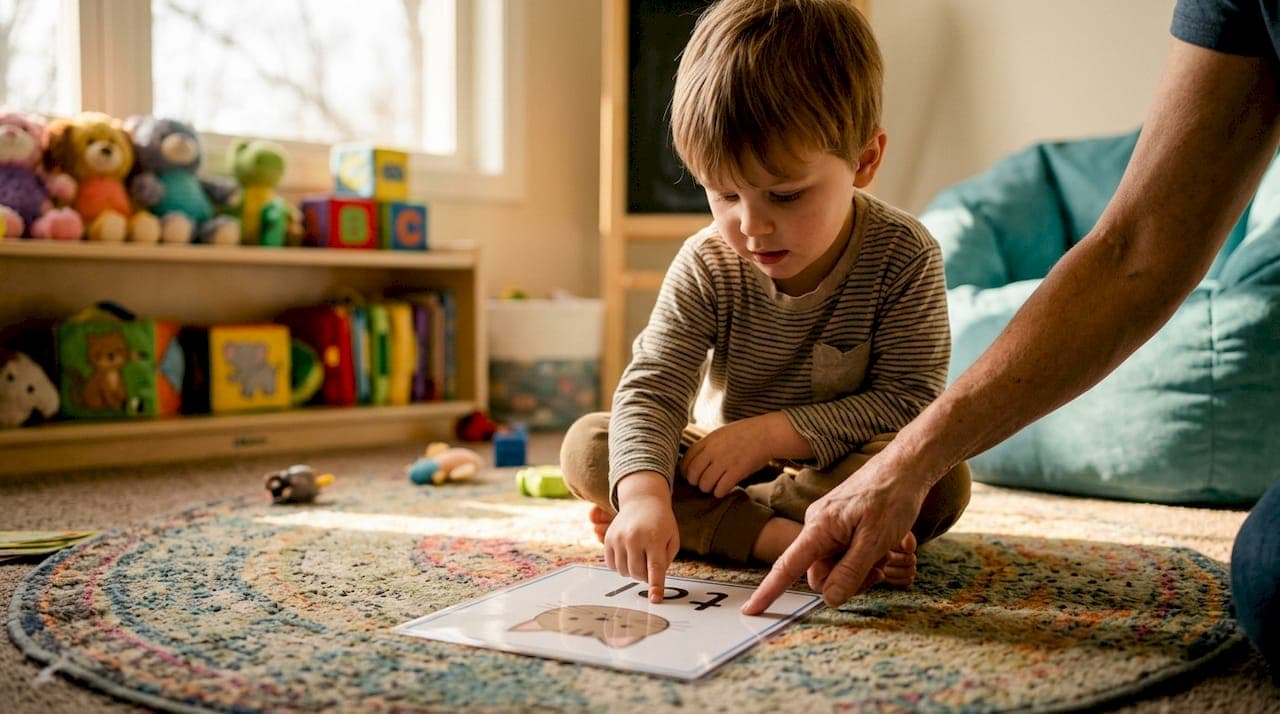
Final consonant deletion (FCD) happens when a child drops the last sound in a word, so "cat" becomes "ca" and "dog" becomes "do." Most children outgrow this pattern by around 3 to 3.5 years old, according to developmental sound charts, so a toddler dropping final sounds is usually right on track. Your next move depends on your child's age and how much of their speech is understandable to strangers.
If your child is under 3 and mostly unintelligible only to strangers, you have room to simply watch and support their sounds at home. If they're past 3.5 and still dropping most final consonants, or if familiar listeners struggle to understand them, it's time to loop in a speech-language pathologist.
Here's what to do right now:
- Monitor using a short home checklist of final sounds (we cover the exact probe words below).
- Try one high-trial activity today — something as simple as naming picture cards and exaggerating the ending sound (cuP, not cuh) builds awareness fast.
- Refer to an SLP if your child is over 3.5, unclear to unfamiliar listeners, or shows uneven progress across sounds.
We'll walk through age norms, a five-minute screening probe, therapy goals you can copy into an IEP, a session-ready progression, and word lists organized by final consonant.
Key Takeaways
Final consonant deletion typically resolves by age 3 to 3.5, and the fastest path to progress combines a clear baseline, a staged therapy progression, and short daily practice at home.
| Point | Details |
|---|---|
| Know the age window | Most children suppress FCD by 3 to 3.5 years; persistence past that calls for an evaluation. |
| Run a quick probe | Test target words and refer out if 5 or more show final consonant omission past age 3. |
| Follow the progression | Move from auditory discrimination to minimal pairs to single words, phrases, then conversation. |
| Set measurable goals | Use percent accuracy, trial counts, and cue levels so progress is trackable, not guessed at. |
| Practice in short bursts | Three to five minutes during bath time, meals, or books beats one long weekly drill. |
| Get a professional evaluation | Thrivingjoy's speech therapy for toddlers builds an individualized plan around your child's own words and daily routines. |
Table of Contents
- Is Final Consonant Deletion Normal or a Red Flag?
- What Causes Final Consonant Deletion?
- How Do You Assess and Track Progress with FCD?
- What Do Measurable FCD Therapy Goals Look Like?
- What Does a Therapy Progression for FCD Look Like?
- Which Play-Based Activities Build High Trial Counts?
- What Word Lists Work Best for Final Consonant Practice?
- How Can Parents Practice at Home Without Pressure?
- When Does FCD Signal a Bigger Concern?
- How Thriving Joy Approaches Final Consonant Deletion
- Why Small, Consistent Steps Beat Perfect Ones
- Ready to Get Your Child's Speech Assessed?
- Where Can You Find More FCD Resources?
- Frequently Asked Questions
- Sources
Is Final Consonant Deletion Normal or a Red Flag?
Final consonant deletion is one of the most common phonological patterns in early speech, and for most toddlers, it's a normal part of learning to talk rather than a disorder. The pattern typically fades between 2.5 and 3.5 years, and most children have suppressed it entirely by age 3, according to ASHA's developmental milestones. Some individual sounds, especially later-developing consonants like /r/, /s/ blends, and /l/, may not stabilize in final position until early school age, per Gillette Children's speech sound charts, so context always matters more than a single missed sound.
A quick five-minute screening probe can tell you a lot. Show your child pictures of these eight words and ask them to name each one, listening specifically for whether the final consonant survives:
- Cup
- Bed
- Dog
- Book
- Bike
- Soap
- Cake
- Boat
Score it simply: if your child drops the final consonant on five or more of the eight words and they're past age 3, that's worth a conversation with an SLP. Dropping one or two occasionally, especially on trickier sounds, is often still typical.
Watch for these red flags regardless of age:
- Your child is difficult to understand even for people outside the immediate family.
- The pattern persists past 3.5 years with little to no improvement.
- Some sounds are produced correctly in one word but never in others, with no clear pattern.
- There's a history of chronic ear infections, fluid in the ears, or a failed hearing screening.
- Your child also struggles with word-finding, sentence structure, or seems to "grope" for mouth positions when trying to talk.
Any one of these alone isn't necessarily a crisis, but two or more together are a good reason to schedule an evaluation rather than wait it out.
What Causes Final Consonant Deletion?
Final consonant deletion is the phonological process where a child consistently omits the last consonant sound in a word, even though they may produce that same sound correctly at the beginning of other words. A child who says "cat" as "ca" might say "car" perfectly fine, because the ending position, not the sound itself, is what's difficult. A few more examples: "dog" becomes "do," "book" becomes "boo," and "hat" becomes "ha."
Clinicians generally point to three overlapping explanations for why this happens.
Production and motor-planning demands. Ending a word requires more precise oral motor control than starting one, and young children's speech systems are still building that coordination. Research on speech-motor planning suggests that dropping the ending often reflects where a child's motor system currently sits, not a lack of effort or attention.

Grammatical and phonological patterns. Some linguists argue FCD isn't purely a motor issue. An analysis from the University of Arizona makes the case that the pattern reflects a mix of production limits and underlying phonological rule-setting, meaning a child's whole sound system, not just their mouth muscles, is still calibrating.
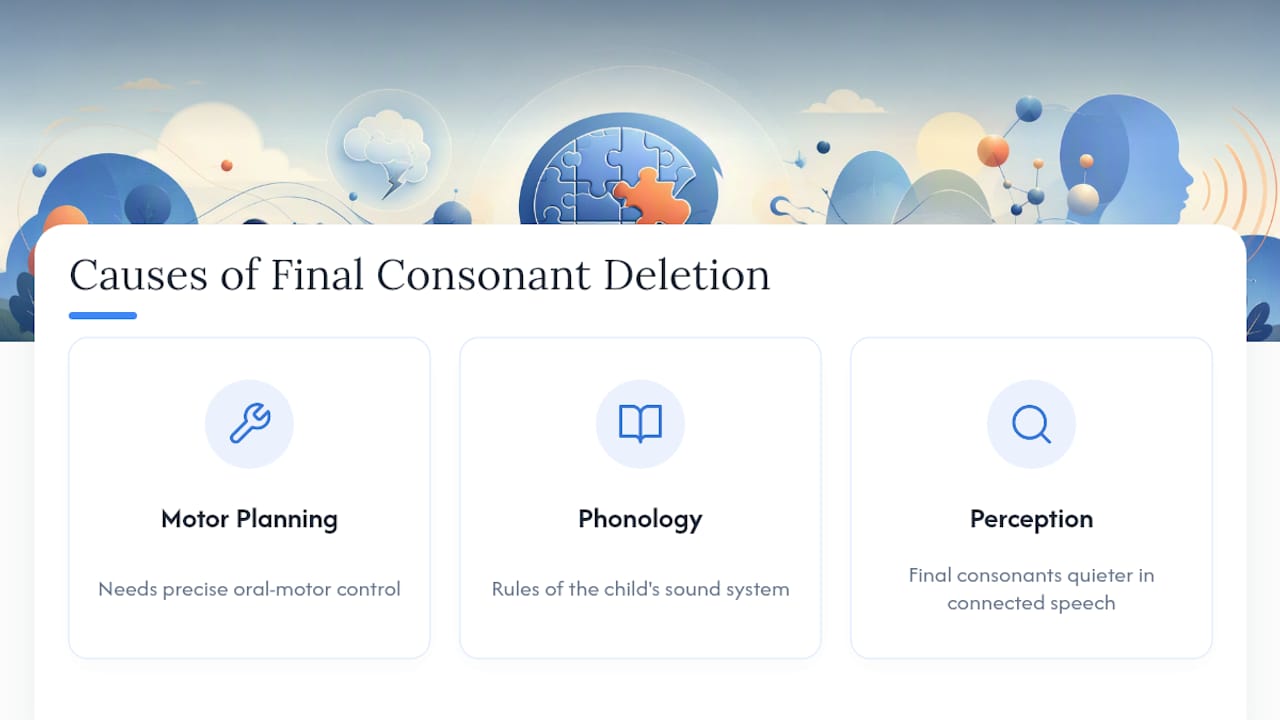
Perceptual and input factors. Final consonants in connected speech are often quieter and shorter than initial ones, so a child may simply be hearing them less clearly during everyday conversation.
Why does this matter for therapy? If a clinician suspects motor demands are the primary driver, sessions often start with easier, high-visibility sounds and heavy modeling. If the sound system itself seems disorganized, auditory discrimination work usually comes first to sharpen what the child hears before asking them to produce anything.
How Do You Assess and Track Progress with FCD?
A solid baseline probe gives you a real number to compare against later, instead of guessing whether therapy is working.
- Choose 20 to 30 CVC words that sample a range of final consonants: /p, t, k, b, d, g, m, n, s/.
- Show a picture or object for each word and ask your child to name it once, without modeling the target first.
- Mark each response as correct, omitted, or substituted.
- Calculate percent accuracy: correct productions divided by total words, times 100.
- Note which specific final consonants are missed most often. This tells you where to start.
Every session, a clinician (or a parent tracking at home) should log a few consistent data points:
- Date and session number
- Prompt level used (independent, modeled, or hand-over-hand cueing)
- Number of trials attempted
- Percent accuracy for that session
- Type of cues given (verbal reminder, visual cue, tactile cue)
What Do Measurable FCD Therapy Goals Look Like?
Goals should escalate in complexity as accuracy improves, moving from single words all the way to unstructured conversation. Here's a tiered set you can adapt for a treatment plan or IEP:
- Short-term goal 1: The child will produce final consonants /p, t, k/ in single words with 80% accuracy across 20 trials, given minimal verbal cues.
- Short-term goal 2: The child will produce target final consonants in two-word phrases with 75% accuracy across 15 trials, given visual cueing as needed.
- Short-term goal 3: The child will produce target final consonants in structured sentences with 70% accuracy across 10 trials, given moderate cueing.
- Long-term goal: The child will produce final consonants across all trained sound classes in spontaneous conversation with 80% accuracy, as measured by conversational sample, with no more than occasional cueing.
The template underneath all of these is simple: pick a percent accuracy, a trial count, and a cue level, then adjust as the child progresses. "Produce final [consonant class] in [single words/phrases/sentences] with [X]% accuracy over [Y] trials with [cue level]" covers almost every version you'll need to write.
When prioritizing which sounds to target first, intelligibility should usually win over theoretical sequencing. A speech and language resource on FCD activities and goals recommends targeting the sounds that show up most in a child's everyday vocabulary first, since fixing "cup," "milk," and the child's own name does more for daily communication than fixing an obscure word they rarely say.
What Does a Therapy Progression for FCD Look Like?
Therapy for final consonant deletion moves through five stages, and skipping ahead too fast is the most common reason progress stalls.
- Auditory bombardment and discrimination. The child listens to lists of words ending in the target sound, sometimes through slightly emphasized or slowed speech, without being asked to produce anything yet. This builds the auditory map before demanding motor output. Clinical guidance consistently recommends this as the starting point rather than jumping straight to drilling.
- Minimal pairs. Word pairs like "bee" versus "beat" highlight that leaving off the ending changes meaning, which gives the child a concrete reason to include it.
- Single-word drills with scaffolding. High-repetition naming tasks, using picture cards or objects, with cues fading as accuracy climbs.
- Phrases and sentences. The same target sounds embedded in short, functional phrases the child actually uses at home.
- Conversation and generalization. Practice folds into unstructured talk, play, and storytelling, where the real test of carryover happens.
A typical 30-minute session might break down as five minutes of warm-up and auditory bombardment, fifteen minutes of high-trial single-word or phrase drilling (aim for 60 to 100 trials in that window), and ten minutes of play-based generalization where the target sound comes up naturally in a game.
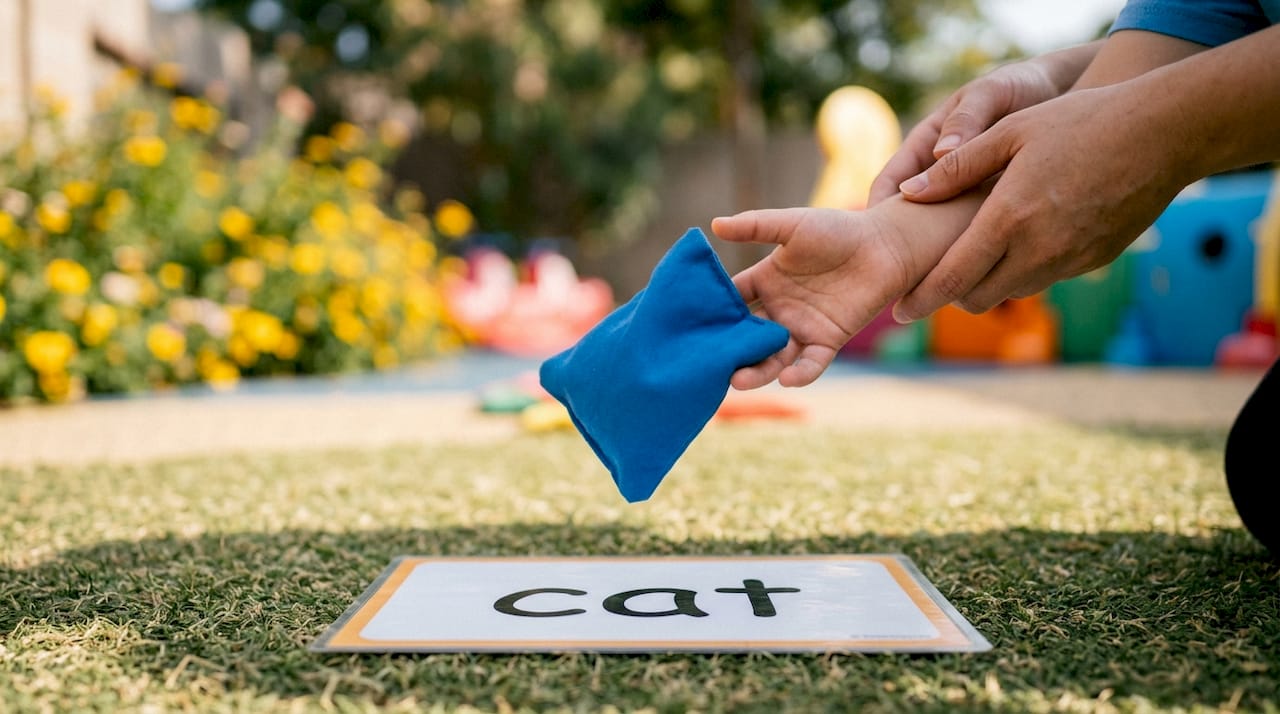
Pro Tip: Keep trial counts high by turning drills into a game with a physical component, like tossing a beanbag onto a target word card each time your child says it correctly. Kids rarely notice they've said the same word 40 times when they're also trying to land a beanbag.
Which Play-Based Activities Build High Trial Counts?
Repetition is what changes speech patterns, so the best activities disguise dozens of trials inside something that feels like play.
- Minimal-pair treasure hunt. Hide picture cards around the room (some with, some without the final consonant) and have your child find and name each one, sorting them into two piles.
- Block-stacking with target words. Say a target word before each block placement. Adapt for teletherapy by having the child stack cups instead and naming a word before each one on screen.
- Bingo with final-consonant words. Call out target words instead of numbers, and your child covers the matching picture. Works easily online with a shared screen.
- Articulation relay race. Line up target word cards across the room; the child says each word correctly before moving to the next one. For toddlers, shrink this to a hallway or even a couch cushion trail.
- Picture-card penny game. Every correct production earns a penny toward a small prize at the end. Easy to run virtually by tallying points on screen.
- Puppet show retell. The child uses puppets to retell a simple story using target words, which naturally builds toward the conversation stage.
- Sticker book naming. Flip through a sticker book and name each image, exaggerating the ending sound together before turning the page.
Pro Tip: If a child is getting frustrated by direct correction, try recasting instead: if they say "ca" for cat, respond naturally with "Oh, a cat! What color is the cat?" You're modeling the target without turning it into a test, and that keeps trial counts high without adding pressure.
What Word Lists Work Best for Final Consonant Practice?
Starting with CVC (consonant-vowel-consonant) words keeps the target sound simple and isolated. Here are sample sets organized by final consonant:
| Final Sound | Sample CVC Words |
|---|---|
| /t/ | cat, hat, boat, coat, bat |
| /d/ | bed, bead, road, bird, seed |
| /k/ | book, cake, bike, duck, lock |
| /g/ | dog, bag, pig, leg, bug |
| /s/ | bus, house, kiss, dress, juice |
| /z/ | nose, cheese, keys, toes, shoes |
| /m/ | gum, comb, drum, home, room |
| /n/ | pen, sun, fan, moon, bone |
| /p/ | cup, soap, cap, rope, tape |
| /b/ | tub, web, cab, crib, tube |
For longer probe lists, minimal pairs, and printable flashcards, resources like Chatter Labs' FCD activity library offer expanded sets organized the same way, which is useful once you've worked through the basics above and need fresh stimuli to avoid rote memorization. Thrivingjoy also has fun speech therapy activities for toddlers that pair well with these word lists for home practice.
How Can Parents Practice at Home Without Pressure?
You don't need a formal session to build practice into your day. Three to five minutes during a routine you're already doing works better than a scheduled 20-minute drill that both of you dread.
- Bath time: Name body parts and bath toys, exaggerating final sounds ("soap," "cup," "tub").
- Mealtime: Talk through the meal ("Do you want more juice? More milk?"), modeling target endings naturally.
- Book reading: Pause on pictures and ask your child to name them, then repeat the word back with a slight emphasis on the ending if they dropped it.
When your child drops a final sound, the most useful response is a simple recast: repeat the word back correctly, without asking them to fix it themselves. If they say "I see a ca," you can say, "Yes, a cat! A big orange cat." Praise the attempt, not just the accuracy, especially in the early stages.
A few dos and don'ts worth keeping in mind: keep sessions short and end on a win, avoid correcting every single error in a row (pick your battles), and reward effort and attempts rather than only perfect productions. Constant correction tends to make kids talk less, which works against everything you're trying to build. Thrivingjoy's guide on helping your child say sounds correctly walks through more of these home strategies in detail.
Pro Tip: Pick one routine, like bath time, and commit to it as your practice window for two weeks. Consistency in one small pocket of the day beats scattered attempts throughout.
When Does FCD Signal a Bigger Concern?
Final consonant deletion is usually just one phonological process among several typical patterns, but sometimes it points to something broader.
- Inconsistent errors with groping or struggle (the child seems to search for mouth positions) can suggest childhood apraxia of speech and warrants a referral for a full motor speech evaluation.
- A history of ear infections, fluid buildup, or a failed hearing screening should prompt a referral to audiology before or alongside speech therapy.
- Multiple phonological processes stacking up (final consonant deletion plus cluster reduction plus fronting, for example) may indicate a broader phonological disorder rather than an isolated delay.
- Structural concerns, like a history of cleft palate or noticeable differences in oral structure, need a specialist who can rule out physical causes.
Before your SLP appointment, gather a short list of 5 to 10 words your child regularly says and gets wrong, note any hearing history, and jot down any other developmental concerns you have. That short prep list speeds up baseline testing considerably. Thrivingjoy's explainer on what happens during a speech-language evaluation walks through what to expect at that first appointment.
How Thriving Joy Approaches Final Consonant Deletion
Every evaluation starts with the same question: how well can this child be understood by the people in their daily life? That focus on functional intelligibility, rather than chasing perfect production of every single sound at once, shapes everything that follows.
Our early sessions prioritize what a child can already do, then build outward from there. We collect a handful of frequently used words a family already knows their child struggles with, baseline accuracy on those, and build the first plan around functional vocabulary rather than an arbitrary sound chart. Parents leave the first visit with one home practice routine, not five.
A typical early plan includes a short-term single-word goal, one home practice routine tied to an existing daily habit, and simple data collection so families can see progress in real numbers, not just a general sense of "things seem better."
Why Small, Consistent Steps Beat Perfect Ones
Parents often expect speech therapy to feel dramatic, big breakthroughs, sudden clarity.
What actually moves the needle isn't intensity. It's showing up for short, low-pressure practice consistently, and trusting a probe score over a gut feeling about whether things are "getting better." If your child is under 3.5 and only occasionally unclear, you likely have time to build good home habits before formal therapy is even necessary. If they're older or harder to understand, get the evaluation now rather than waiting for a growth spurt that may or may not come.
Ready to Get Your Child's Speech Assessed?
If you've worked through the screening probe above and you're still unsure whether your child's final consonant deletion needs professional attention, that uncertainty itself is worth acting on. Thrivingjoy's speech therapy for toddlers in Lutz starts with a full evaluation that goes beyond a five-minute home check, mapping out exactly which sounds and word positions need targeted work and building a plan around your child's actual vocabulary rather than a generic sound chart.
Families working with Thrivingjoy get an individualized home practice plan after that first visit, along with caregiver coaching so the strategies from the therapy room actually carry into mealtime, bath time, and bedtime routines. Services include early intervention speech therapy, one-on-one caregiver coaching, and home plans built around the words your child uses most. If feeding concerns are part of the picture too, Thrivingjoy's feeding therapy services address that alongside speech, since the two often overlap in young children. Book an initial evaluation through the speech therapy page to get a clear answer on where your child stands and what comes next.
Where Can You Find More FCD Resources?
- ASHA's communication milestones for general age-based norms
- Speech and Language Kids' FCD guide for goal and activity templates
- Chatter Labs' word list and activity pack for extended stimuli
Remember that developmental milestones describe typical ranges, not diagnostic cutoffs. A child slightly outside the average window isn't automatically a concern, but it's always reasonable to ask a professional for a second opinion.
Frequently Asked Questions
What is final consonant deletion in speech therapy? Final consonant deletion is a phonological process where a child leaves off the last sound in a word, saying "boo" for "book" or "ha" for "hat." It's one of the most common patterns in early speech development and usually resolves on its own by around age 3 to 3.5.
At what age is final consonant deletion no longer typical? Most children stop dropping final consonants by 3.5 years old. If the pattern persists strongly past that age, or if your child is difficult for strangers to understand, an evaluation is worth scheduling.
How is final consonant deletion different from other phonological processes? Other common patterns include cluster reduction (dropping part of a consonant blend, like "top" for "stop") and fronting (replacing back sounds like /k/ with front sounds like /t/). FCD specifically targets the ending position of a word, regardless of which consonant is involved.
When does the /r/ sound typically develop, and does that relate to FCD? The /r/ sound is one of the latest-developing sounds in English, often not fully mastered until age 5 to 7. A child dropping final /r/ in words like "car" may simply be within a normal, extended developmental window rather than showing a true error pattern.
What age do s blends typically develop? S blends (like "sp," "st," "sn") tend to develop later than single consonants, often stabilizing between ages 4 and 6. Teaching s blends usually starts only after single final consonants are solid, since blends add another layer of motor complexity.
Can parents treat final consonant deletion without a speech therapist? Mild, age-appropriate FCD often improves with the home strategies covered above, like modeling and recasting during daily routines. If your child is past 3.5, hard to understand, or showing multiple phonological patterns at once, working with a speech-language pathologist gets you a faster, more targeted plan.
This article is general information, not a substitute for advice from a qualified doctor. Consult a qualified healthcare professional about your own circumstances before acting on anything here.
Sources
- Communication milestones | American Speech-Language-Hearing Association (ASHA)
- PMC article on speech-motor planning and child speech development
- A unified theory of final consonant deletion in early child speech (University of Arizona repository)
- Final Consonant Deletion | Activities, Words, and Goals | Speech and Language Kids
- Final Consonant Deletion: Word Lists, Minimal Pairs & Activities | Chatter Labs