

Follow the Satter Division of Responsibility: you decide what, when, and where your child eats; your child decides whether and how much. This split, backed by peer-reviewed research and endorsed by feeding specialists, lowers mealtime stress and builds lasting eating competence. Tonight, pick the menu and set snack times. Then step back and let your child do the rest.
TL;DR:
- Full adherence to the Satter Division of Responsibility is essential, as partial application does not produce the same positive outcomes in children's self-regulation and weight management.
- Serving familiar foods alongside new options and maintaining a consistent meal schedule support children’s hunger cues and reduce mealtime stress.
- Avoid using rewards, restricting portions, or making separate meals, as these behaviors undermine the model's effectiveness and encourage control.
- Structure early feeding by controlling what, when, and where food is offered, while children decide whether and how much to eat, at every stage of development.
- If persistent food refusal, gagging, or very limited eating occur despite full implementation, seeking professional feeding therapy is advised.
Table of Contents
- What Is the Division of Responsibility in Feeding?
- Does Research Actually Support This Feeding Method?
- How Do You Put the Division of Responsibility into Practice?
- How Should You Apply This at Different Ages?
- What Mistakes Undermine This Approach, and How Do You Fix Them?
- What Does a Feeding Therapist's Perspective Add to This Model?
- Where Can You Learn More About This Approach?
- Sources
What Is the Division of Responsibility in Feeding?
The Satter Division of Responsibility (sDOR) comes from dietitian and family therapist Ellyn Satter, who mapped mealtime roles into two clear jobs. You handle the structure. Your child handles the eating. That split sounds simple, but it reshapes almost every mealtime interaction once you apply it consistently.
You decide what food appears on the table, when meals and snacks happen, and where eating takes place, according to the Ellyn Satter Institute. Your child decides whether to eat anything at all, and how much of it. That is the entire model.
This mirrors authoritative parenting: warm, structured, but not controlling. You're not a short-order cook, and you're not a food police officer either. Consider two quick examples:
- At dinner, you serve chicken, rice, and green beans. Your child eats only rice. You say nothing and trust the next meal to balance things out.
- At snack time, you offer apple slices and crackers at 3:00 PM. Your child eats two crackers and leaves the apple. That's their call, not a problem to fix.
Does Research Actually Support This Feeding Method?
The evidence backing sDOR is stronger than most parenting frameworks you'll encounter, and it comes with an important caveat: the model only works when applied in full.
Children whose parents avoided restricting how much they ate showed lower BMI and less tendency to eat in the absence of hunger, according to research published in PMC testing sDOR against restrictive snack-management practices.
That finding cuts against a common instinct. Many parents assume some restriction protects kids from overeating. The data suggests the opposite: restriction interferes with a child's ability to self-regulate, while the structured freedom of sDOR supports it.
Validated tools like the sDOR.2-6y and ecSI 2.0 questionnaires let researchers measure how closely parents follow the model, and higher adherence tracks with better psychosocial and feeding outcomes, per the Ellyn Satter Institute. But here's the part that trips people up:
- Setting a meal schedule while still restricting portions doesn't count as sDOR. It's a hybrid that removes the model's benefits.
- Hiding vegetables in other foods, negotiating bites, or offering dessert as a reward all reintroduce the control sDOR is designed to remove.
- Partial application, according to the PMC study, does not replicate the same outcomes as full commitment to the model.
Full consistency isn't optional here. Half-measures explain why some parents try this approach for two weeks, see no change, and give up.
How Do You Put the Division of Responsibility into Practice?
Implementation comes down to four habits: planning, scheduling, serving, and staying neutral when things get messy at the table.
- Plan meals with one familiar item. Include at least one food you know your child already eats without protest, alongside newer or less-preferred foods. This keeps you from cooking separate meals while still giving your child something safe to land on.
- Set a consistent meal and snack schedule. Regular meals and snacks, spaced at consistent intervals, support real hunger and appetite regulation. Between those times, offer only water, a practice recommended by the Penn State Thrive/5210 program.
- Serve family-style when possible. Put food in the center of the table and let your child serve themselves, or plate age-appropriate portions and let seconds be their choice, not yours.
- Keep the table neutral. No cheering when a vegetable disappears, no bribing with dessert, no "just one more bite." The Ellyn Satter Institute points to neutral affect as one of the most overlooked pieces of the model.
- Script the tough moments in advance. If your child refuses dinner, try: "That's okay, this is what we're having. There's an apple and crackers at snack time." If they ask for more of one food, let them, without commentary on quantity.
Pro Tip: When a meal goes sideways, resist the urge to explain your reasoning at the table. A calm, short response ("This is dinner, more food comes at snack time") does more than a five-minute negotiation ever will.
How Should You Apply This at Different Ages?
The roles inside sDOR don't change, but how much structure you provide shifts as your child grows.
- Infants: You control what's offered (breast milk, formula, or first foods), while your baby leads the timing and pace of feeding. This is the earliest form of "whether and how much."
- Toddlers and preschoolers: You now add when and where meals happen, alongside what's served. Your child still fully controls whether they eat and how much, even as they test limits constantly at this stage.
- School-age children: Structure stays in your hands, but children take on more independence, packing part of a lunch, choosing between two prepared sides, or serving themselves at the table.
Each transition should happen gradually. Moving from toddler grazing to a school-age snack schedule works best as a two- or three-week shift, not an overnight rule change.
What Mistakes Undermine This Approach, and How Do You Fix Them?
Most struggles with sDOR trace back to a handful of repeatable mistakes.
- Bribing or rewarding bites. ("Two more bites and you get ice cream.") Fix: separate dessert from performance entirely, and offer it as a routine part of the meal.
- Making separate meals on request. Fix: keep one familiar food on the table instead of cooking a second dinner.
- Restricting portions or "healthy" foods. Fix: serve appropriate portions for the table and let your child ask for more, even of foods you'd rather they eat less of.
- Hiding disappointment or pressuring with "the look." Fix: practice a neutral face and a short, calm script before the meal starts.
- Allowing constant grazing between meals. Fix: return to a fixed snack schedule with water as the only between-meal option, per Thrive/5210 guidance.
Pro Tip: If your child gags frequently, loses weight, eats fewer than 10 foods total, or shows extreme distress at meals despite weeks of consistent sDOR, those are signs to seek a feeding therapy evaluation rather than continuing to troubleshoot alone.
What Does a Feeding Therapist's Perspective Add to This Model?
Coaching families through sDOR rarely starts with the child. It starts with observing what parents say and do at the table, then identifying one or two specific behaviors to change first.
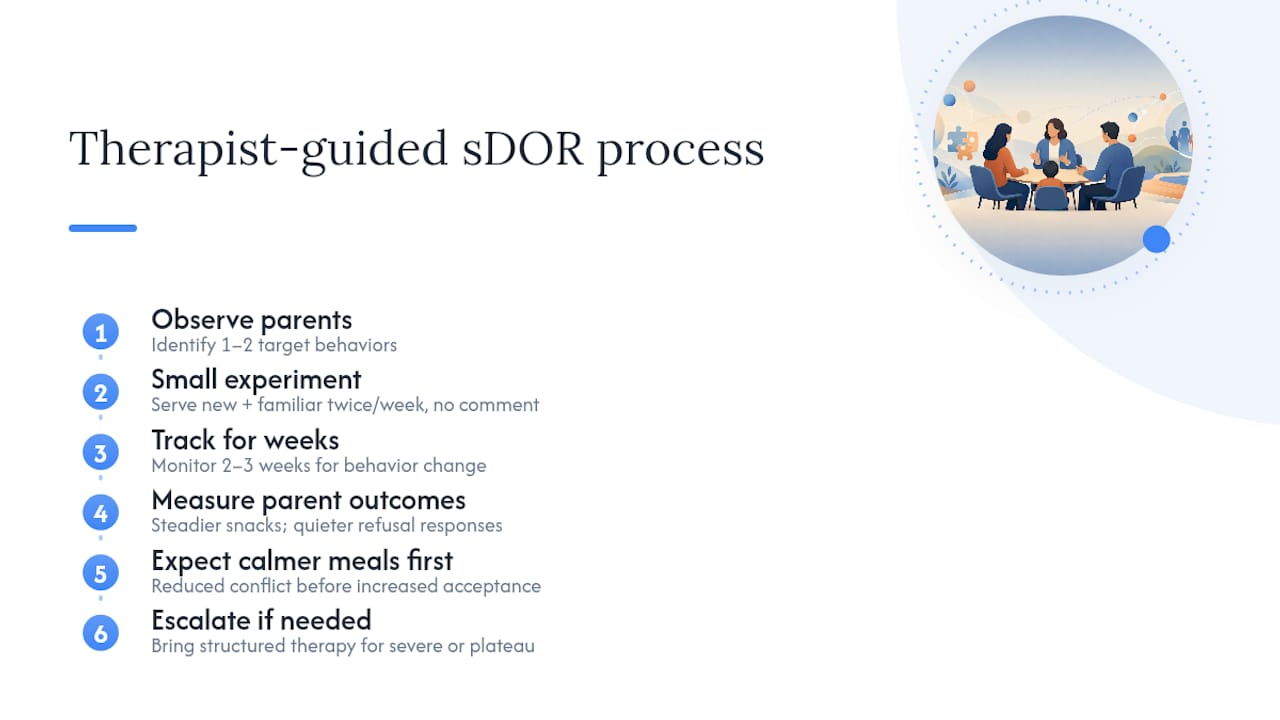
A therapist might run a small, time-limited experiment: serve one new food alongside a familiar one twice a week, with no comment on whether it gets eaten. That single change, tracked over two or three weeks, often reveals more than a week of general "try to relax" advice. Progress gets measured in parent behavior first, a steadier snack schedule, a quieter response to refusals, rather than in how much the child eats on any given night.
Families who stick with this process commonly report calmer dinners within a few weeks, even before food acceptance visibly improves. That order matters: reduced conflict tends to arrive before expanded variety, not after. When a family plateaus, or when a child shows signs like extreme food refusal, gagging, or very limited intake, that's the point to bring in structured feeding therapy or parent coaching support rather than continuing to adjust scripts at home.
— Jamie
If mealtimes at home feel stuck despite consistent effort, Thriving Joy's feeding therapy services in Lutz work directly with families to identify what's driving the struggle, whether it's sensory sensitivity, past pressure, or a stalled transition between developmental stages, and build a plan around it. Sessions are available through private pay, most major insurance plans, and scholarship support, so cost doesn't have to be the reason a hard mealtime pattern continues.
Where Can You Learn More About This Approach?
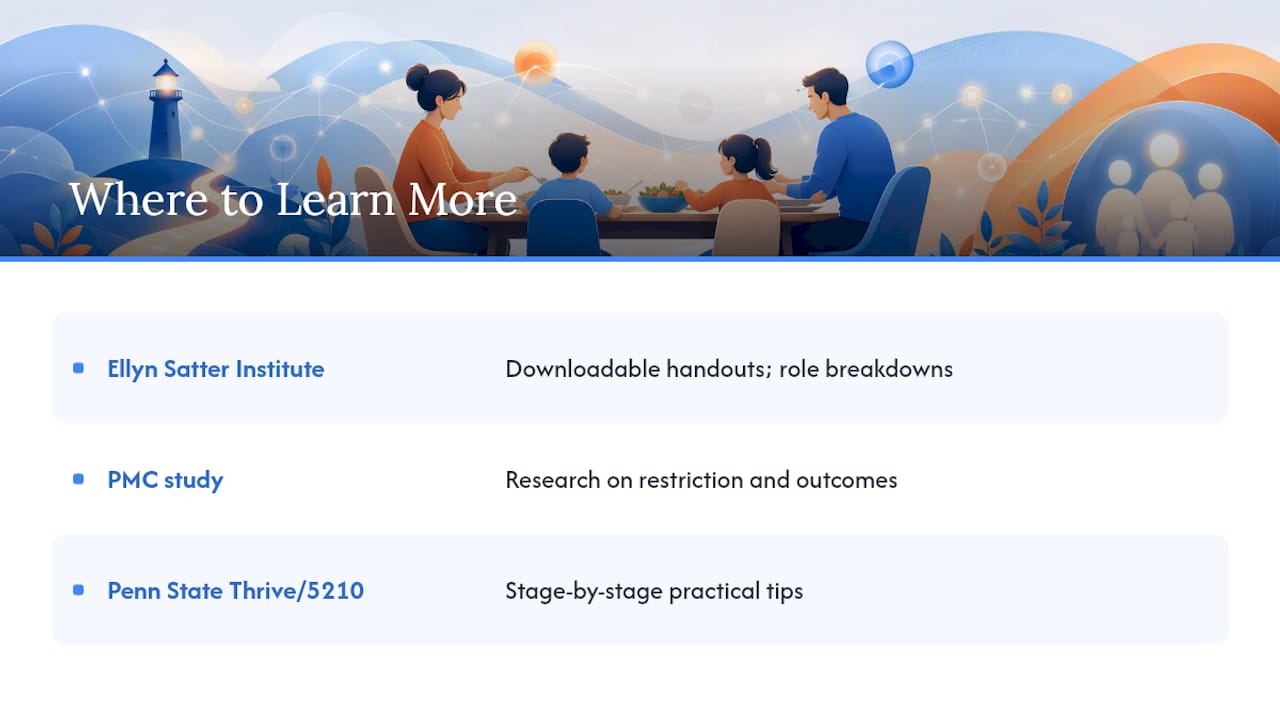
Start with the Ellyn Satter Institute for downloadable handouts and detailed role breakdowns. For the research behind restriction and outcomes, read the PMC study directly. Penn State's Thrive/5210 program offers stage-by-stage practical tips worth bookmarking.
Sources
- Testing Satter’s Division of Responsibility in Feeding in the context of restrictive snack-management practices — PMC
- The Satter Division Of Responsibility In Feeding — Ellyn Satter Institute
- The Division of Responsibility in Feeding — Thrive/5210 (Penn State)