
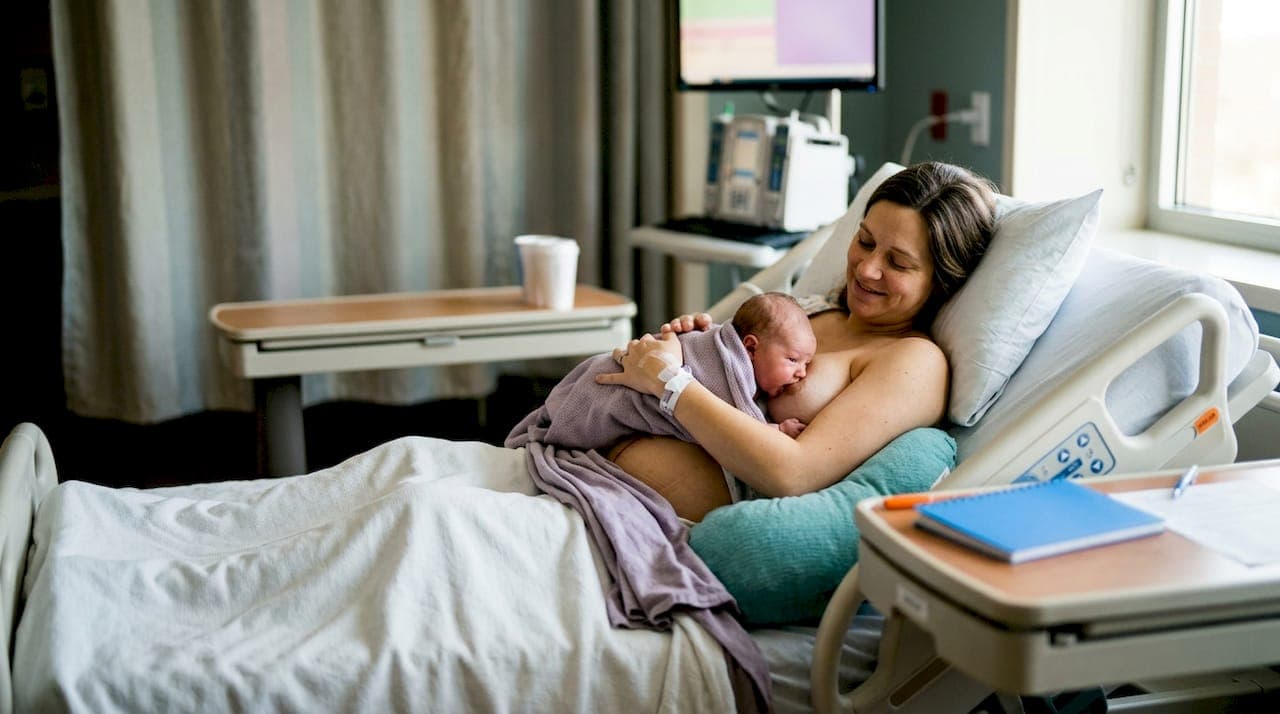
Yes, you can breastfeed after a C-section. What helps most is getting skin-to-skin contact as soon as you're alert, stimulating your breasts through latching or hand expression within the first couple of hours, staying ahead of your pain with the right medication, and asking for lactation support before you leave the hospital. If milk takes longer to come in, early and frequent expression protects your supply while you wait.
TL;DR:
- Women who deliver by cesarean are about 33% more likely to experience delayed lactation onset beyond 72 hours postpartum.
- Early skin-to-skin contact and hand expression within the first two hours after birth are crucial for promoting milk production in C-section mothers.
- Positions that avoid pressure on the incision, like the football hold or laid-back nursing, help protect the surgical site while maintaining effective latch.
- Pain management with acetaminophen and ibuprofen, scheduled rather than reactive, supports breastfeeding success and maternal comfort.
Table of Contents
- Why Breastfeeding May Be Harder After a C-Section
- Immediate Hospital Actions: Your First-Hours Checklist
- Is Skin-to-Skin Safe Right After Surgery?
- What Positions Protect Your Incision While Nursing?
- Which Pain Medications Are Safe While Breastfeeding?
- How Do You Hand-Express or Pump Milk Early?
- What If Your Baby Is in the NICU or Too Sleepy to Latch?
- When Does Milk Come In, and What Is Delayed Onset of Lactation?
- How Often Should You Feed, and How Do You Know Baby Is Getting Enough?
- When Should You Call for Help?
- How Thriving Joy Supports Breastfeeding After a C-Section
- A Realistic Perspective on the First Weeks
- Ready for Hands-On Lactation Support?
- Sources
- FAQ
Why Breastfeeding May Be Harder After a C-Section
A cesarean birth changes the biology of those first hours in ways a vaginal birth doesn't. Research shows women who deliver by C-section are about 33% more likely to experience delayed onset of lactation, meaning milk doesn't fully "come in" until after 72 hours postpartum. Part of the reason is mechanical: surgery, anesthesia, and recovery time can separate you from your baby during the window when frequent stimulation matters most. Pain and limited mobility make positioning harder, too.
There's a hormonal piece as well. Labor triggers a natural surge of oxytocin and prolactin that helps kickstart milk production, and a scheduled or unlabored cesarean means you may miss part of that surge. Add in the stress of surgery, and lactogenesis (the medical term for your milk supply ramping up) can simply take longer to get going. None of this means breastfeeding won't work. It means the early moves you make matter more, not less.
Immediate Hospital Actions: Your First-Hours Checklist
The first few hours after delivery are when small requests make an outsized difference. Speak up early, because maternity staff can't read your preferences, they can only respond to them.
- Ask for skin-to-skin contact as soon as you're alert and your care team confirms its safety, even in the recovery room.
- Request hands-on help positioning your baby for that first breast contact, since post-surgical numbness and IV lines make this trickier than it sounds.
- If your baby can't latch right away, start hand expression or pump stimulation within the first one to two hours rather than waiting.
- Ask for rooming-in so your baby stays with you between feeds instead of in a separate nursery.
- Request at least one observed, effective feed with a nurse or lactation consultant present before you're discharged.
- Schedule a follow-up appointment for 48 to 72 hours after you go home.
Pro Tip: Write your requests on a sticky note or your hospital whiteboard. Shift changes mean new nurses, and repeating "skin-to-skin ASAP" out loud every few hours is easy to forget when you're recovering from surgery.
Is Skin-to-Skin Safe Right After Surgery?
Skin-to-skin contact is both safe and genuinely helpful after a cesarean, as long as you're monitored appropriately. It's feasible in the operating room or recovery area once you're responsive, and it does real physiological work: it helps stabilize your baby's temperature and blood sugar while cueing early feeding behaviors.
What should staff provide while you're doing it post-surgery?
- A support person or nurse nearby to help position your baby safely, since your arms and torso may still feel weak or numb.
- Monitoring of your vital signs and your baby's, particularly if you received general anesthesia.
- Pillows or a wedge to keep the baby's weight off your incision.
Rooming-in extends these benefits by multiplying your feeding opportunities across the day and night instead of confining them to scheduled nursery visits. Hospitals that build skin-to-skin and rooming-in into standard practice see higher breastfeeding initiation and less formula supplementation as a result. Ask about your facility's approach before your due date if you can.
What Positions Protect Your Incision While Nursing?
Your incision dictates a lot about how you'll hold your baby for the first several weeks, and that's normal to plan around. A few positions keep pressure off the surgical site while still giving you a stable, comfortable latch.
- Football (clutch) hold: tuck your baby under your arm, facing you, with their feet pointing toward your back, so their weight rests on a pillow instead of your abdomen.
- Cross-cradle hold with incision support: use a firm pillow or rolled towel across your lap as a barrier before bringing baby to the breast.
- Laid-back nursing: recline at an angle with your baby resting on your chest, letting gravity do the positioning work.
- Modified side-lying: helpful once you can roll comfortably, with a pillow between your knees and another supporting your back.
Have your partner or a support person help you get in and out of bed for the first few days. Rolling to your side before sitting up, rather than pulling straight up with your abdominal muscles, spares your incision real strain.
Pro Tip: Keep a nursing pillow within arm's reach at all times during the first two weeks. Reaching for one across the room while holding a newborn is exactly the kind of twisting motion your incision doesn't need.
Which Pain Medications Are Safe While Breastfeeding?
Getting your pain under control isn't a side issue. It's central to whether breastfeeding gets off to a good start. Acetaminophen and ibuprofen are considered first-line options and are compatible with breastfeeding, and using them on a schedule rather than waiting for pain to spike tends to work better.
A stepwise, multimodal approach that layers acetaminophen and ibuprofen together, rather than relying on one drug alone, reduces the odds that unmanaged pain pushes you toward early weaning.
- Take acetaminophen and ibuprofen on the schedule your care team recommends, not just when pain becomes severe.
- If opioids are prescribed, use the lowest effective dose for the shortest time, and avoid codeine specifically, since it carries documented infant risk.
- For any medication question specific to breastfeeding, check the LactMed database or ask your obstetrician or an IBCLC directly.
Worth knowing: Afterpains, the cramping you feel while nursing in the first days, are a normal sign of your uterus contracting back down, not a sign that something is wrong with your incision.
How Do You Hand-Express or Pump Milk Early?
If your baby can't latch right away, whether from prematurity, sleepiness, or NICU care, hand expression or pumping becomes your bridge until direct feeding is possible.
- Start within the first two to four hours after birth, if your care team clears you, rather than waiting until the next scheduled nursery visit.
- Express for 10 to 15 minutes on each side, roughly every two to three hours during the early days.
- Increase frequency as your baby would naturally feed on demand, rather than sticking to a rigid clock once things are underway.
- Combine hand expression with pumping when possible, since manual technique often draws out more colostrum in the first day or two than a pump alone.
The evidence backs starting early and specifically. One systematic review found that early pump stimulation shortened time to lactation onset by about 19.6 hours compared with delayed pumping, and some trials linked it to higher exclusive breastfeeding rates by discharge.
Pro Tip: Ask for a hospital-grade pump rather than relying solely on a personal pump those first days. The suction pattern is built to mimic a newborn's early feeding rhythm more closely than most consumer models.

What If Your Baby Is in the NICU or Too Sleepy to Latch?
Separation or a sleepy newborn doesn't have to derail your supply if you act on it quickly. The priority is keeping your breasts stimulated on a schedule, even when direct feeding isn't yet possible.
- Start collecting and storing expressed colostrum as early as you can. Every drop matters in the first 48 hours.
- Set a expression schedule of roughly every two to three hours, even overnight, to mimic what a feeding baby would do.
- Ask about supplemental nursing systems or cup and finger feeding as alternatives to routine formula, when medically appropriate for your baby's situation.
- Loop in a lactation consultant early, and get weight and feeding checks scheduled for 48 to 72 hours after discharge.
A certified lactation consultant can help you build a realistic expression schedule around NICU visiting hours or a baby who just needs more time to wake up for feeds.
When Does Milk Come In, and What Is Delayed Onset of Lactation?
For most new mothers, milk transitions from colostrum to a fuller supply, what's often called "milk coming in," within 48 to 72 hours after birth. When it takes longer than 72 hours, that's classified as delayed onset of lactation, or DOL.
Cesarean delivery raises the risk of DOL by roughly 33%, with an overall incidence around 30% across all birth types.
The good news: several concrete actions lower that risk regardless of how you delivered.
- Stimulate your breasts frequently, aiming for 8 to 12 times a day in the first several days.
- Prioritize skin-to-skin contact whenever you and your baby are both able.
- Start pumping or hand expression early rather than waiting to see if latching improves on its own.
- Keep your pain controlled, since unmanaged pain interferes with the hormonal signals that drive milk production.
- Get lactation support involved promptly if day three arrives and you don't notice changes in fullness.
If DOL does happen, don't panic and don't stop. Escalating support and maintaining frequent expression is what protects your supply while your body catches up.
How Often Should You Feed, and How Do You Know Baby Is Getting Enough?
Feed or express roughly every two to three hours in the early weeks, but let your baby's hunger cues, not a strict timer, guide you. Rooting, hand-to-mouth movements, and fussiness are earlier signals than crying.
A few signs tell you things are on track: an effective latch that doesn't pinch, audible swallowing during feeds, and a wet and dirty diaper count that climbs toward six or more wet diapers by day four. Steady weight trends at follow-up visits matter more than any single day's numbers.
Before you leave the hospital, run through this short list:
| Discharge checklist item | Why it matters |
|---|---|
| One observed, effective feed with staff present | Confirms latch and swallowing look right before you're on your own |
| Follow-up scheduled for 48 to 72 hours | Catches early weight loss or feeding issues while they're easy to fix |
| Contact information for lactation support | Gives you a fast path to help instead of guessing at 2 a.m. |
When Should You Call for Help?
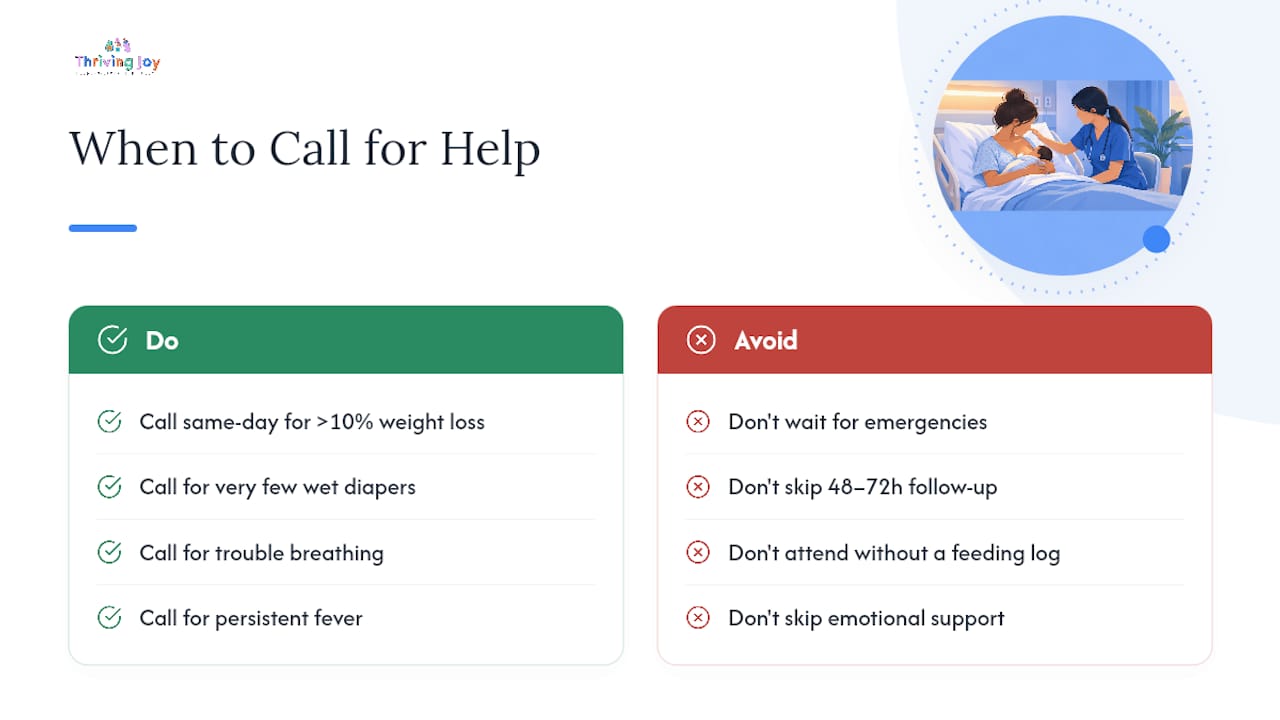
Some signs warrant a same-day call rather than waiting for your scheduled follow-up. Weight loss over 10% of birth weight, very few wet diapers, trouble breathing, a persistent fever, severe or worsening incision pain, or unusual sedation or floppiness in your baby all deserve prompt attention.
For everyday feeding struggles that aren't emergencies, hospital lactation staff, an IBCLC, or your pediatrician are your first calls. Local breastfeeding support groups can fill in the gaps between appointments, and that 48 to 72 hour follow-up window matters enough to protect on your calendar even when life feels chaotic.
Before an appointment, gather a feeding log, any photos that show latch or diaper output, minutes per breast if you've been tracking pump sessions, and a list of your current medications. It also helps to loop in emotional support during this stretch. A mom-focused therapist can help you process the parts of C-section recovery that are more emotional than physical.
How Thriving Joy Supports Breastfeeding After a C-Section
Thriving Joy's lactation counseling is built around the exact situation many C-section parents face: a baby who needs coaxing to latch, an incision that limits positioning, and a mother who needs a real plan, not generic advice. A typical visit covers incision-aware positioning, hands-on expression training, a personalized pump schedule, and a follow-up plan that tracks feeding and weight after discharge. It's practical support built around your recovery, not a one-size-fits-all script.
A Realistic Perspective on the First Weeks
Recovering from surgery while learning to breastfeed is genuinely hard, and it's fair to feel exhausted by both at once. What tends to get lost in breastfeeding advice is how much mobility and pain shape those first days, not just latch technique. Set small, stepwise goals instead of measuring yourself against an idealized timeline. Most parents who ask for help early, rather than waiting to see if things improve on their own, find their way to a rhythm that works. Reach out sooner than you think you need to.
— Thriving Joy
Ready for Hands-On Lactation Support?
Thriving Joy's lactation counseling is designed specifically around the C-section recovery timeline, not a generic breastfeeding checklist. Sessions cover incision-aware positioning, hand expression coaching, pump plan adjustments, and follow-up feeding checks, all delivered with the flexibility to meet you at your office visit, your home, or wherever recovery has you parked with pillows and a nursing cover. If you're navigating a slow latch, a sore incision, or a supply that feels like it's taking its time, book a lactation counseling session and get a plan built around your actual recovery, not a generic timeline.
This article is general information, not a substitute for advice from a qualified doctor. Consult a qualified healthcare professional about your own circumstances before acting on anything here.
Sources
- Incidence and factors influencing delayed onset of lactation: a systematic review and meta-analysis | International Breastfeeding Journal
- Effectiveness of breast pumps in early postpartum breastfeeding for women after cesarean section: A systematic review
- Optimizing Support for Breastfeeding as Part of Obstetric Practice | ACOG
- Supporting Evidence for Maternity Practices in Infant Nutrition and Care (mPINC) | CDC
FAQ
Why Is Breastfeeding Harder After a C-Section?
Surgery, anesthesia, pain, and sometimes separation from your baby can delay the early, frequent breast stimulation that normally kickstarts milk production. Cesarean delivery is linked to a roughly 33% higher risk of delayed onset of lactation compared with vaginal birth, though most mothers still go on to breastfeed successfully with early support.
How Long After a C-Section Can I Breastfeed?
You can typically begin breastfeeding or skin-to-skin contact within the first hour or two after surgery, once you're alert and your care team confirms it's safe. Many hospitals now support this even in the recovery room, following practices outlined by the CDC's mPINC guidance.
How Do I Help My Milk Come In Faster After a C-Section?
Frequent breast stimulation, through direct feeding, hand expression, or pumping, started within the first few hours makes the biggest difference. Early pump use specifically has been shown to shorten time to lactation onset by about 19.6 hours in clinical research, and combining that with skin-to-skin contact and good pain control gives your body the strongest signal to ramp up production.
Does Breastfeeding Help Heal a C-Section Faster?
Breastfeeding triggers oxytocin release, which helps your uterus contract back down, something you may notice as afterpains during nursing sessions in the first days. It doesn't directly speed incision healing, but the hormonal response supports your overall postpartum recovery.
What Does Thriving Joy Offer for C-Section Breastfeeding Support?
Thriving Joy provides lactation counseling tailored to C-section recovery, including incision-aware positioning, pump plan coaching, and follow-up feeding checks. More information on pricing is available directly on the website.